


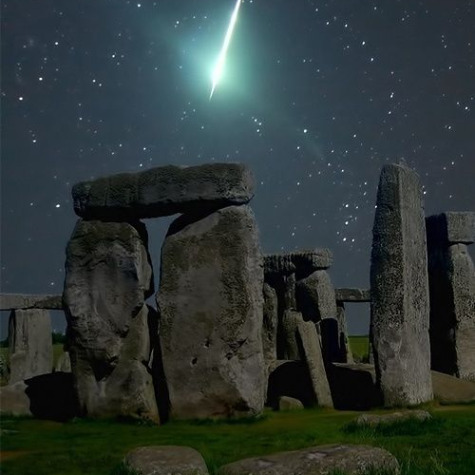
The Lyrids 2026 campaign has ended.
We now move on to the Arietids and zeta Perseids, the strongest daylight meteor showers of the year. First discovered at Jodrell Bank Observatory in England in 1947, these showers occur when Earth passes through dense streams of meteoroids in space. Their peaks often overlap, and the parent bodies of both showers are still unknown.
Thank you for your support!
Research
Context
BRAMS (Belgian RAdio Meteor Stations) is a Belgian network of radio receiving stations using forward scattering to detect and characterize meteoroids falling into the Earth’s atmosphere.
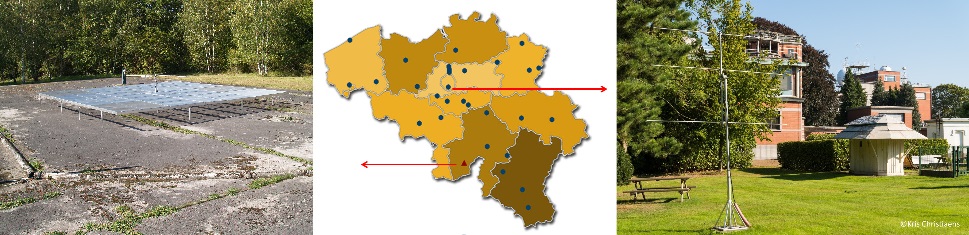
A dedicated transmitter/beacon (red triangle on the map above) is located in the south of Belgium and emits toward the zenith a pure sine wave at a frequency of 49.97 MHz and with a total power of 150 Watts. The incident radio wave is reflected on the ionized trail left behind the meteoroid when it falls into the atmosphere. About 30 receiving stations (blue dots in the image above) are spread all over Belgium and record radio signals reflected off meteor trails (hereafter called meteor echoes). Pictures of the transmitter and of one receiving antenna (located in Uccle) are visible respectively in the left/right parts of the image above.
Radio observations have two main advantages over optical ones : 1) data can be recorded 24h a day and do not depend on weather conditions, 2) they are sensitive to meteoroids with lower masses that do not produce any visible light but are much more numerous.
Every day a huge amount of data is produced by the BRAMS network with thousands of meteor echoes registered, which requires the use of automatic detection algorithms. BRAMS radio data are usually presented as images (called spectrograms, see definition below) and automatic detection algorithms try to detect specific shapes associated with meteor echoes. However, none of them can perfectly mimic the human eye which stays the best detector.
With this Radio Meteor Zoo project we focus on meteor showers, which are mainly due to dust particles released on its orbit by a comet when it approaches the Sun. The Perseids around August 12 are a well-known example of a meteor shower. During a meteor shower, many radio meteor echoes display complex shapes in BRAMS data and automatic detection algorithms struggle to detect them correctly. This is where the Radio Meteor Zoo volunteers come in. You can help us a lot by identifying meteor echoes during meteor showers.
Your meteor detections will be used to provide activity curves (number of meteors per time period, moment of peak activity , ...), to estimate the mass index of the meteor shower (which is a measure of how particle masses are distributed: a high mass index indicaties more mass in smaller particles while a low mass index refers to more mass in larger particles), to calculate meteor fluxes, to compute trajectories of meteoroids using data from multiple BRAMS receiving stations, ...
Below more details are provided about meteoroids, meteor showers, forward scattering of radio waves and BRAMS data.
What is a meteoroid?
A meteoroid is a solid object moving in interplanetary space, of a size considerably smaller than an asteroid and considerably larger than an atom (IAU definition). Meteoroids travel around the Sun in a variety of orbits and with velocities ranging from ∼ 11 to ∼ 72 km/s. Sometimes they are in a collision orbit with Earth and enter our atmosphere. Most meteoroids are tiny pieces of dust.
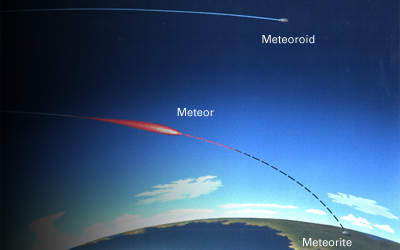
What is a meteor?
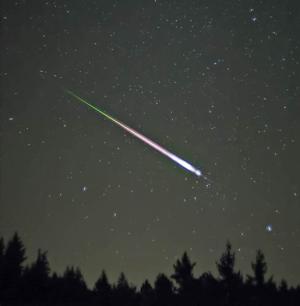
A meteor (or "shooting star“) is the visible phenomenon resulting from the passage of a meteoroid into the Earth's atmosphere. It typically occurs between altitudes of ~ 120 and ~ 80 km.
What is a meteorite?
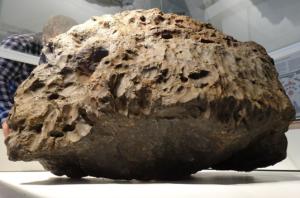
A meteorite is a solid piece of debris which has survived the passing of a meteoroid through the Earth’s atmosphere and falls on the ground. It is considerably smaller than the size of the initial meteoroid. Only large meteoroids can give rise to meteorites which are therefore quite rare.
Meteor shower
Most meteors can occur at any time and in any direction. They belong to what is called the sporadic meteors. Their origin is mostly related to asteroids. They constitute the bulk of meteors falling into the Earth's atmosphere. However, there is a second population of meteors associated with dust released along the orbit of a comet.
When a comet approaches the Sun, it warms up and releases dust grains along its orbit. If Earth is crossing the orbit of this comet, it passes every year at the same time into a cloud of dust particles which produces a meteor shower.
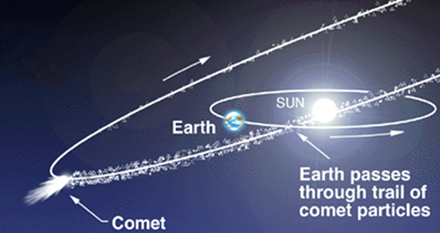
Due to a geometrical effect, all meteors belonging to a meteor shower seem to come from one point in the sky called the radiant. Each meteor shower is named after the constellation this point belongs to. For example, the radiant of the Perseids is located in the Perseus constellation.
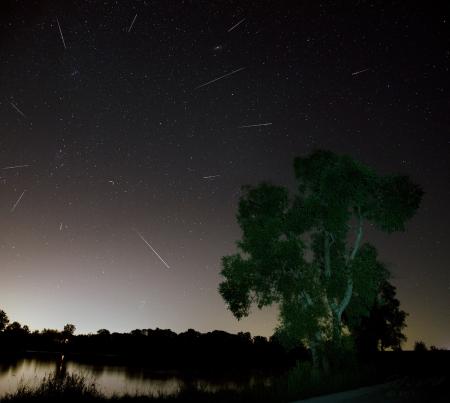
Image Credit & Copyright: Darryl Van Gaal
Ionization trail
When a meteoroid enters the Earth’s atmosphere, it also creates a trail of ionization (made of ions and electrons) along the trajectory behind it. In first and good approximation, this trail is more or less a straight line.
Forward scattering of radio waves
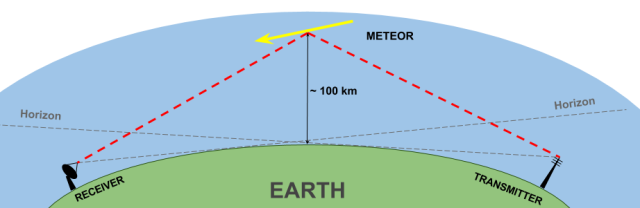
- This ionization trail (yellow line in the image above) can temporarily reflect a radio wave (red line) sent by a transmitter on the ground.
- If a receiver is tuned to the frequency of the transmitter, it can receive a signal with a duration lasting from a fraction of a second up to a few seconds : this is called a meteor echo.
- Forward scatter means that the receiver is not located at the same place as the transmitter.
- The duration of the meteor echo is roughly dependent on the size of the meteoroid : the bigger the meteoroid, the longer the reflected signal lasts.
- Most meteor echoes last only a fraction of a second.
- The analysis of the signal can provide a great deal of information on the meteoroid such as mass, speed and trajectory.
The BRAMS data
BRAMS data are usually presented under the form of a spectrogram which provides the frequency content of the received signal as a function of time. A typical spectrogram is shown below : frequency is along the vertical axis and spans 200 Hz while time is along the horizontal axis and spans 5 minutes. Power of the signal is color coded. Red means very large power. Blue is very low power (noise). Power increases from blue to green to yellow to red.
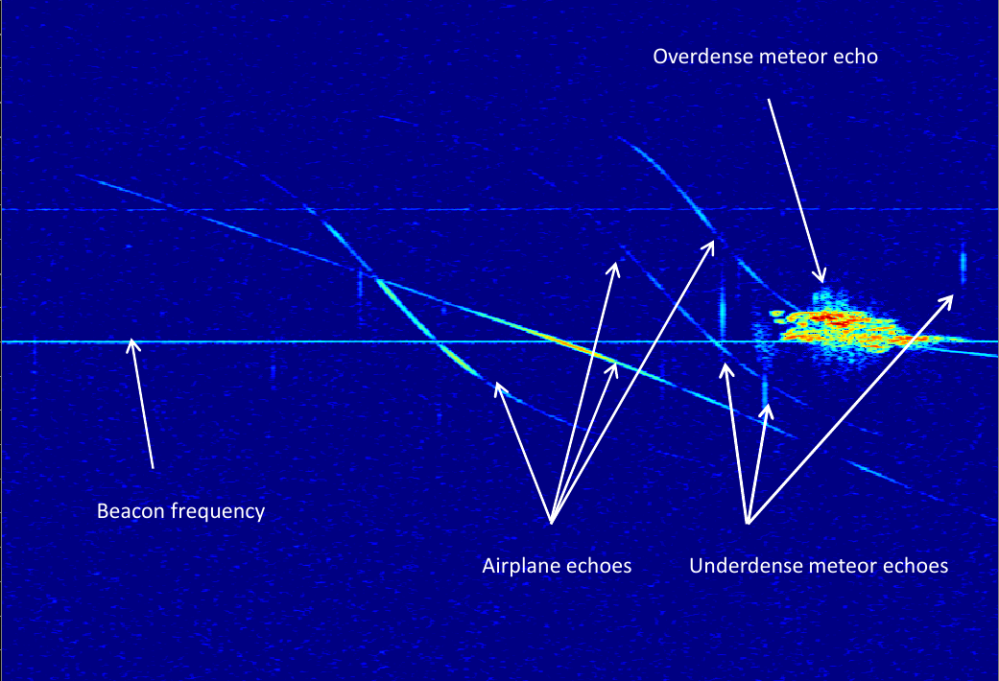
- The horizontal signal (called the beacon frequency in the image above) is the direct signal coming from the transmitter. The spectrogram is built in a way that the 200 Hz range is centered on this signal.
- The long-lasting signals are reflections of the radio wave on airplanes.
- The short-lived signals are underdense meteor echoes. They appear mostly vertical. They are due to tiny dust particles and make the bulk of meteor echoes detected by BRAMS. Some meteor echoes are bright, others are faint. Note that the signal can be discontinuous but if it is along the same vertical line, we consider it as a single meteor echo.
- Overdense meteor echoes with long duration : they are produced by larger meteoroids. Difficulty is that their shape in spectrograms can be very complex and take multiple forms. Two additional examples are shown below to illustrate the variety and complexity of shapes. Overdense meteor echoes occur a lot during meteor showers.
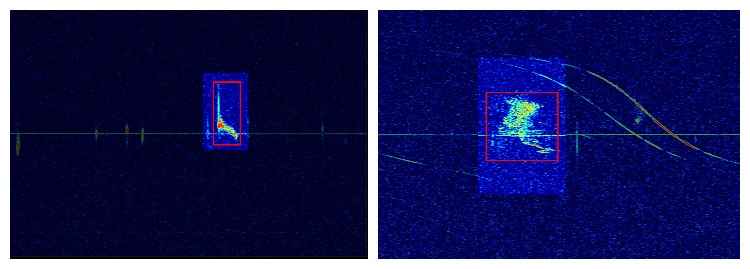
There are some additional types of signals that can occur in spectrograms :
- Broad-band interference which appears vertical and spans the whole 200 Hz range. These are not meteor echoes. They are produced by local interference nearby the receiving station (e.g. signals produced by a computer, an electrical switch, ...or lightnings). An example is given below.
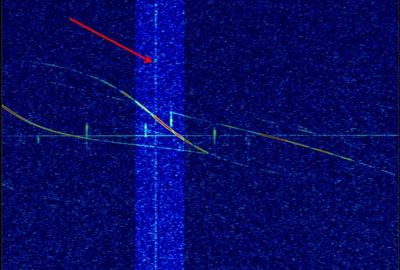
Broad-band interferences are usually short-lived but can also sometimes last longer as in the example below. - Airplanes usually appear as thin lines that usually have an inverse S-shape. The following example has 7 airplanes.
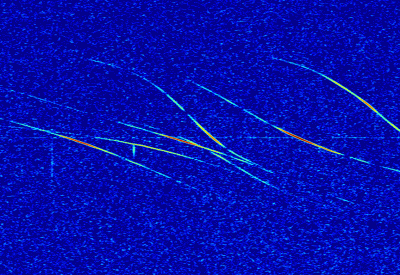
But sometimes, e.g. when a plane makes a sudden turn, more complicated shapes can occur.
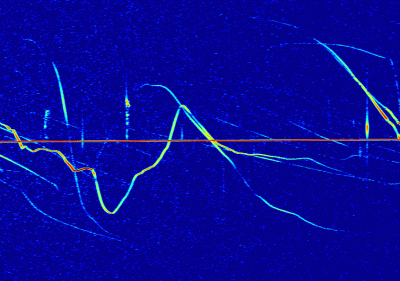
A second example:
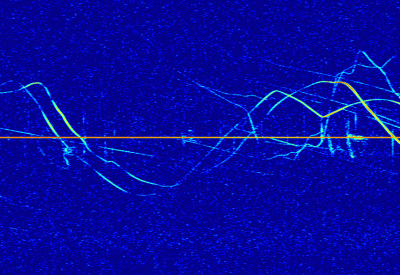
Importance of citizen science participants
BRAMS data are saved every 5 minutes. With approximately 30 stations in the BRAMS network, more than 8000 spectrograms are created every day. This requires automatic detection algorithms for meteor echoes. Some have been developed but they are struggling either to detect underdense meteor echoes when many airplane echoes superimpose, or to detect the complex overdense meteor echoes. The (trained) human eye is still the best detector in these cases. As mentioned above, during meteor showers, many overdense meteor echoes occur and so we request the help of many eyes from citizen science participants. Your help is invaluable!