


Finished! Looks like this project is out of data at the moment!
Thank you to all of the volunteers that have contributed to the completion of not just one but three workflows!
Research
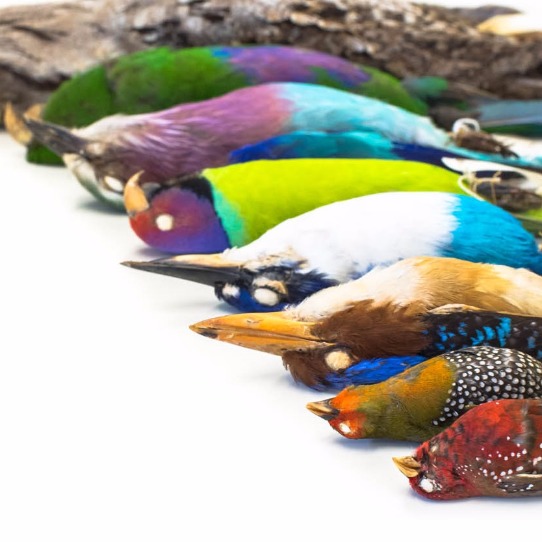
Help us measure the spectacular diversity of bird colouration
With approximately 10,000 living species, birds are one of the most diverse groups of animals on earth. One characteristic that makes birds so fascinating is their spectacular colouration. From the striking iridescence of hummingbirds to the vibrant colours of macaws, birds have evolved an astounding diversity of colours and patterns.
In addition to the colours that we can see, many bird species can also perceive light in the ultraviolet (UV) range of the spectrum. The discovery that many birds see and respond to UV colouration has had a significant impact on how researchers now measure bird plumage colouration, as well as on our understanding of how birds see each other.
Our team is hoping to measure the dazzling array of plumage colouration in birds to gain a better understanding of how and why spectacular animal colouration evolves. Some of the key questions we hope to answer are:
- Just how colourful are birds?
- How quickly does plumage colour evolve?
- Are evolutionary changes in plumage colour associated with the origin of new species?
Project overview

1. Selecting specimens
Specimens are selected from the bird collections at the Natural History Museum, London. Where possible, three males and three females are chosen for each species. Our aim is to photograph as many bird species as possible.
2. Photographs: human-visible and UV light
We photograph each specimen with a specialist camera that can capture human-visible (400–700 nm) and ultraviolet (UV, 300–400 nm) wavelengths of light. We take photos in pairs, first with a filter that only transmits human-visible wavelength and second with a filter that only transmits UV wavelengths. We take six photographs of each specimen:
a. Back view — visible + UV
b. Side view — visible + UV
c. Belly view — visible + UV
3. Zooniverse!
To make sense of the colour information stored in the photographs, we need to identify different areas of the bird's plumage, such as the crown, breast and tail. Colour in these different "patches" can serve different functions in different species, often including signalling (e.g. attracting mates, warning predators). We need your help to mark each of 10 different patches on the photographs.
There are two main workflow types: points and outline.
– Points - place points to locate 10 key bird body regions.
– Outline - trace the outline by drawing a polygon around the edge of the bird
Each workflow can be performed on three different views of the bird (back, side, belly).
4. Data & Discoveries
The points you place provide us with {X,Y} coordinates telling us where to measure within each image. Based on this information, we then extract data on colouration and pattern for each specimen, which we use to tackle important unanswered questions on the causes of evolution of colouration and the role that colour differences play in the origin of species.
5. Outcomes
The database that you can help to build starts from museum collections. Our aim is to pass the data back to the NHM via the Data Portal. This means that you will be contributing not only to research on bird evolution but also helping to build a digital legacy of museum collections.
How can you help?
We need your help to identify key areas of bird plumages to generate the raw data we need to tackle big, unanswered questions about evolution. Along the way, you will:
1. See a dazzling array of plumages from many thousands of species – some of which are now vanishingly rare
2. Explore hidden dimensions of plumage colouration by studying both human-visible and UV images of birds
3. Directly contribute to the most ambitious study of animal colouration ever undertaken
4. Help advance our understanding of the way evolution works and how biodiversity is generated and maintained.
Come and join the team!


