


Finished! Looks like this project is out of data at the moment!
Thank you to all of the volunteers that have contributed to the completion of not just one but three workflows!
FAQ
FAQ
How do I get in contact with you?
If you’d like to discuss any aspect of our project, you can leave a comment in the ‘Talk’ section, contact us directly on twitter (@MacrobirdEvol) or send an email to macrobirdevolution@gmail.com.
What are you asking me to do?
We want to collaborate with the public to enhance our understanding of avian colour diversity in both the human visible and ultraviolet spectrums.
We need help in plotting key areas of plumage on photographs of as many of the world’s 10,000 living species of bird as possible. This information will allow us to begin measuring the huge array of colour and pattern across species.
You will be asked a series of questions about the species you are assigned, using a simple plotting tool to draw shapes around key areas of plumage. In doing so, you will be able to view a huge range of species up-close, revealing specimens from museum research collections that are rarely seen by the public, through both our human visible and ultraviolet filters.
Whether you help us by classifying one species or hundreds, every contribution counts and will help us progress towards answering fascinating questions about colour diversity in birds.
I think I made a mistake, can I go back and change a classification?
Once you have submitted a bird, you won’t be able to go back and work on it again.
Don’t worry though, as we’re analysing patches of colour across the overall specimen the placement of patches doesn’t need to be exact. We will review all the data we generate and can have the same birds classified by more than one person if this is necessary.
How have you photographed all these birds?
In order to accurately measure colour variation and UV reflectance across all species, each bird needs to be photographed using specially modified equipment in a standardised environment.
For many reasons, this would be an impossible task using birds in the wild. So, as with many wide-ranging projects of this nature, museum collections are an essential resource.
We have relied on the ornithology collections of the Natural History Museum- encompassing 95% of all extant species, they are an unparalleled archive of biodiversity. The majority of these specimens are historical, largely dating from the nineteenth to the early twentieth centuries, having been cared for by the museum for a hundred years or more. By applying modern techniques to these historical resources, we will be better able to understand how this amazing diversity has come to be.
If you would like to know more about how we collect this data and our use of the museum collections, see the relevant section of our Field Guide.
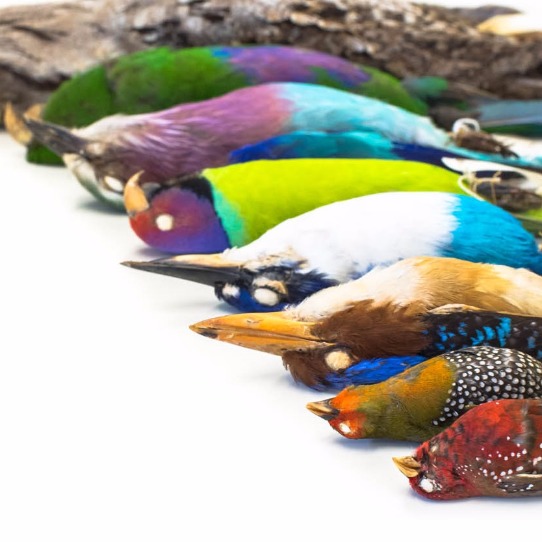
Why do the birds look like this?
The birds included in our study are all part of the Natural History Museum's collections- amassed over the past three centuries. The vast majority date back a hundred years or more. These specimens now form a research collection, preserved for use in studies of all kinds- by artists, historians, scientists etc.
The specimens are kept as 'study skins'- with the exterior plumage preserved and stuffed with a material to give the approximate form of the bird in question. This allows the specimens to lie flat, stored in trays within the collections where they are free from light, pest and environmental damage. As they are not on display, glass eyes (as we would expect to see in museum galleries and public displays) are not generally used.
Can I download these images?
The images we are asking citizen scientists to work on can’t be downloaded at this stage.
However, we are committed to making our data openly available in the long run. As with our previous project - MarkMyBird.org - we hope our plumage photographs and colour data will eventually be accessible in full via the NHM Data Portal. Updates will be provided along the way.
In the meantime, if you have a specific reason for wanting access to these images, please do get in touch.
Who owns the copyright?
All images on these pages © The Trustees of The Natural History Museum, London.