


FAQ
What do I do if I don't see the head or the tail of the fish?
We want to analyze every fish in the image, so mark every fish that you see, even if you cannot see the heads or tails on some of them. Mark across as much of the fish as you can see, and when the question asking “Could you see both the head and tail of the fish” appears, click “No” (This and other questions can be viewed in the "How to mark the fish" section of the field guide, specifically under the section "Marking FAQ").
How do I mark a fish when it’s face is only showing?
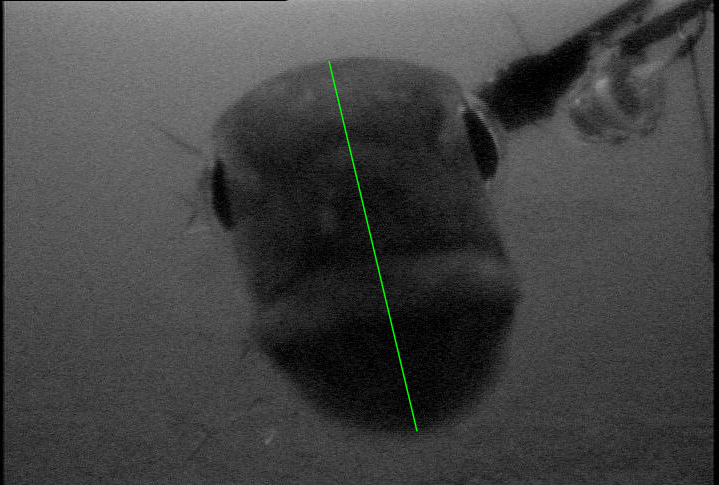
If you see an image with a fish facing towards the camera (so that no other body part is seen besides the head), mark the fish by clicking and dragging along the longest axis (seen in the image above). When the question asking “Could you see both the head and tail of the fish” appears, click “No” (This and other questions can be viewed in the "How to mark the fish" section of the field guide, specifically under the section "Marking FAQ").
How do I mark a fish if it is really far away?
One way to get a closer look at the fish is to use the zoom in button (+) to the right of the image. TIP: If you are using a mouse, once you have clicked the zoom in button, you can use the wheel of the mouse to zoom in and zoom out instead of clicking on the button repeatedly. If you cannot tell what species of fish you are looking at, simply mark the fish as “Other or Can't Tell”. (This and other questions can be viewed in the "How to mark the fish" section of the field guide, specifically under the section "Marking FAQ").
I see something in the image, but I am not sure if it is a fish or not. Should I mark this object?
Since we want to try and avoid subjectivity when we collect data, if you see something in an image and are not sure if it is a fish, DO NOT MARK THIS OBJECT. Only mark a fish in an image if YOU ARE SURE THAT IT IS A FISH (This and other questions can be viewed in the "How to mark the fish" section of the field guide, specifically under the section "Marking FAQ").
How do I mark a fish if it is bent?
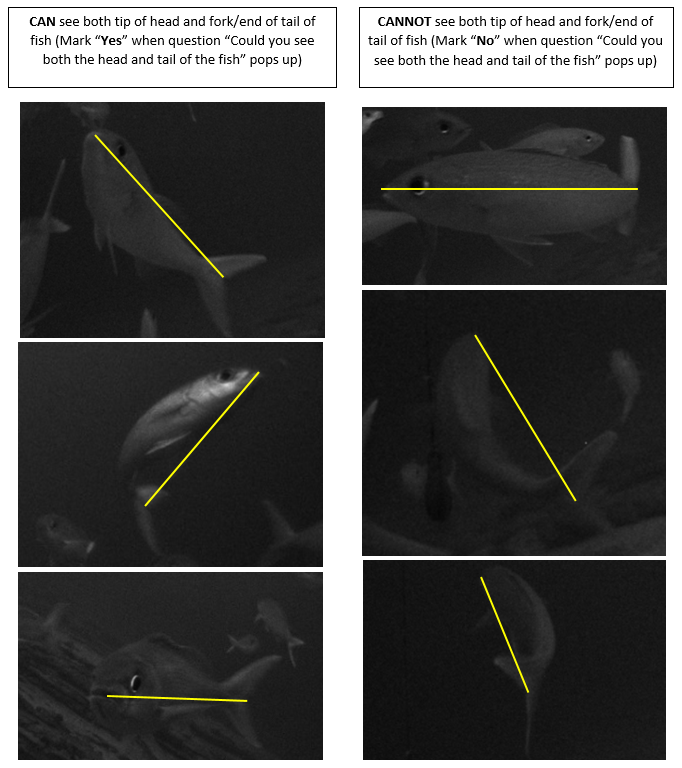
Left column shows images of bent fish that have both the tip of the head and the fork/end of the tail visible (Yellow lines indicate how they should be marked and when the question "Could you see both the head and the tail of the fish" appears, click "Yes"). Right column shows images of bent fish that have the tip of the head and the fork/end of the tail **NOT** visible (Yellow lines indicate how they should be marked and when the question "Could you see both the head and the tail of the fish" appears, click "No").
We need information on every fish in the image, so mark every fish even if some of them are bent. If a fish is bent, just mark it as you would with any other fish, starting at the head and ending at the tail. When the question "Could you see both the head and the tail of the fish?" pops up, click "Yes". If the fish is bent in a way so that the head and/or the tail is not visible, mark across as much of the fish as you can see (again, starting at the head and ending at the tail) and when the question "Could you see both the head and the tail of the fish?" pops up, click "No." The image above shows examples on how to mark fish that are bent at various angles and whether to answer "Yes" or "No" to "Could you see both the head and the tail of the fish?"(This and other questions can be viewed in the "How to mark the fish" section of the field guide, specifically under the section "Marking FAQ").
I am trying to identify a fish and I know that it's either Opakapaka or Kalekale, but I cannot narrow it down to just one species. How should I identify and mark the fish in this case?
Opakapaka and Kalekale look extremely similar to each other and even our expert annotators have trouble telling the two apart sometimes, so don't worry if you're having difficulties with distinguishing the two species. If you see a fish and can identify that it is either Opakapaka or Kalekale but cannot narrow it down to one species, choose "Other or Can't Tell" to mark and identify this fish.
I am analyzing an image and it has a TON of fish in it! Should I mark every fish in this case?
Since we want to gather information on every single fish in an image, please mark every single fish, even if there are a lot of them in the image.
Why do the fish look so different in monochrome than in color?
Monochrome footage changes colors such as yellow to black, which means that yellow undertones that may not be apparent in color on fish such as Ehu will appear black in monochrome.
Why do you need us to mark the position of the fish when we are analyzing images?
We are hoping to gather four types of data from these images:
- Are there fish in the image?
- How many are there?
- Where are they (in terms of relative position)?
- What species are they?
Your answer to the first question "Do you see a fish in this image?" will give us information on the first type of data we need to gather ("Are there fish in the image?"). The species-specific markings that you make on the second part of the workflow will give us information on the rest of the data that we need ("How many are there?", "Where are they (in terms of relative position)?", and "What species are they?"). Thus, it is very important that you mark every fish in the image in order to have an accurate count of the amount of fish in the image.
The markings that you make will help us gather training data to give to machine learning algorithms, which will be able to identify where a fish is in the image and what species it is.
What is the black object at the right of the image?
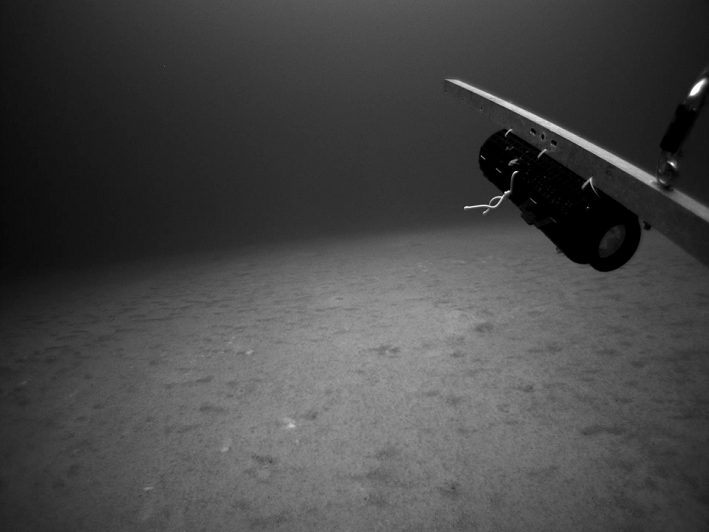
Since we want to capture images of fish during the surveys, the black object at the right of the screen contains bait to help attract fish into the camera's view.
Where can I go if I want to learn more about the science behind OceanEYEs?
There is a quick overview of the science behind OceanEYEs in the Research tab in the "About" section. If you have read this page and are still interested in learning more, then feel free to click on any of the links at the bottom of the Research page (These links are also on our home page under "External Project Links") to learn more about NOAA Pacific Islands Fisheries Science Center, the MOUSS stereo-video camera system, and much more! Finally, if there are any questions that you would like to ask about the science to the OceanEYEs team, feel free to comment on the discussion board in the "Talk" section, and we will reply to you as soon as possible!
Where can I go if I want to learn more about the culture and history behind bottomfishing?
There are stories taken from the "Hawaiʻi Bottomfish Heritage Project" blogs in the Education tab of the "About" section if you would like a quick glimpse into the culture and history behind bottomfishing. If there is a particular story that interests you, there are links in each section to the corresponding blog in which the story comes from if you would like a deeper look into that particular piece. Feel free to also check out the “Fishermen Quote” for each of the Deep 7 species in the field guide to get a glimpse into what fishermen’s thoughts are on each of the bottomfish!
Where can I go if I have questions that have not been answered?
Feel free to use the "Talk" section of our project to interact with fellow users and members from the OceanEYEs team and to ask any additional questions you might have! If there is a particular image that you have questions about while annotating, click the blue "Done and Talk" button to have your comments and questions associated to that specific image.