


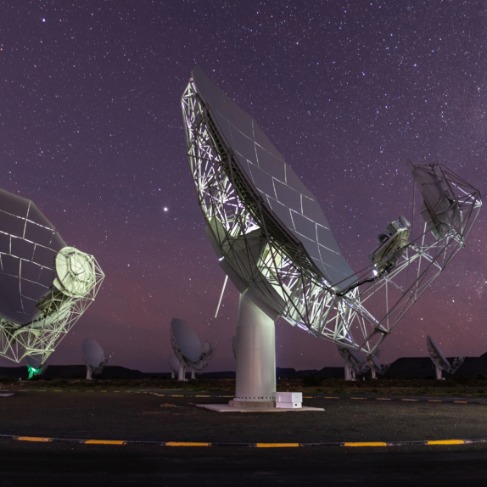
Finished! Looks like this project is out of data at the moment!
Thank you for your efforts! We've completed the classification stage for this project! To browse other active projects that still need your classifications, check out zooniverse.org/projects.
Results
More Science from Your Classifications
First Results
Thank you so much for all your hard work classifying our data. We've scoured through what you said and found 168 really interesting sources that we are investigating in detail now. This includes you all finding the X-ray binaries that we were pointing the telescope at, but more importantly you found 142 new transient and variable sources we had not seen before! This is a brilliant result and it's been so great to work with you all on this. You can read more about the amazing science you've all found here. I'll summarise some of it below.
One of the ways we usually look for interesting objects in our images is processing the data through a pipeline called the TraP and calculating two statistics, V and η - these quantify the amplitude of variability and how statistically significant it is respectively. Below we can see what every one of our sources looks like in terms of these parameters, where the sources >40% of you said were transient or variable are coloured in and everything else is in grey.
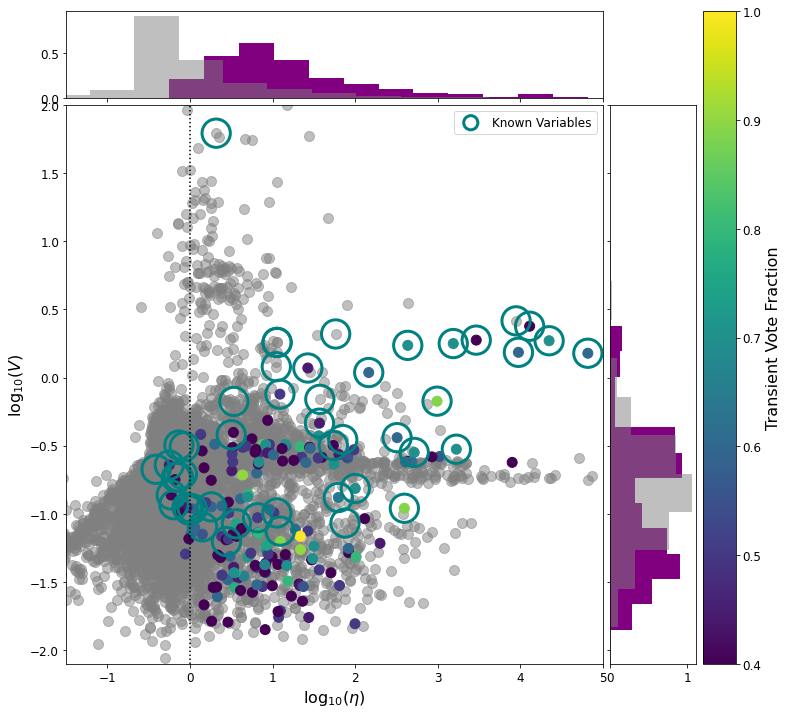
The exact details of the plot are not so important, but there are a couple of things to note:
- There are many transient/variable sources you found that we have checked that are not anomalous. That means we would not have found them without you combing through the data. This is a brilliant result!
- Most of the known interesting variables (circled in teal; usually X-ray binaries) are in the top-right side of this figure i.e. they are outliers in η and V. These are some of the sources you mentioned to us on the Talk forum! You recovered almost all of these, and the cases you didn't this was either to do with bad images we showed you or limited data points, of which only 1-2 showed variability.
- The Known Variables that are less anomalous are generally the distant galaxies that we see changing in brightness or scintillating. These took a then-PhD student a long time to find, looking at each and every light curve in their data! For more on these and the great work that Dr Laura Driessen's done, see the precursor results below / her most recent paper.
Counterparts with other telescopes
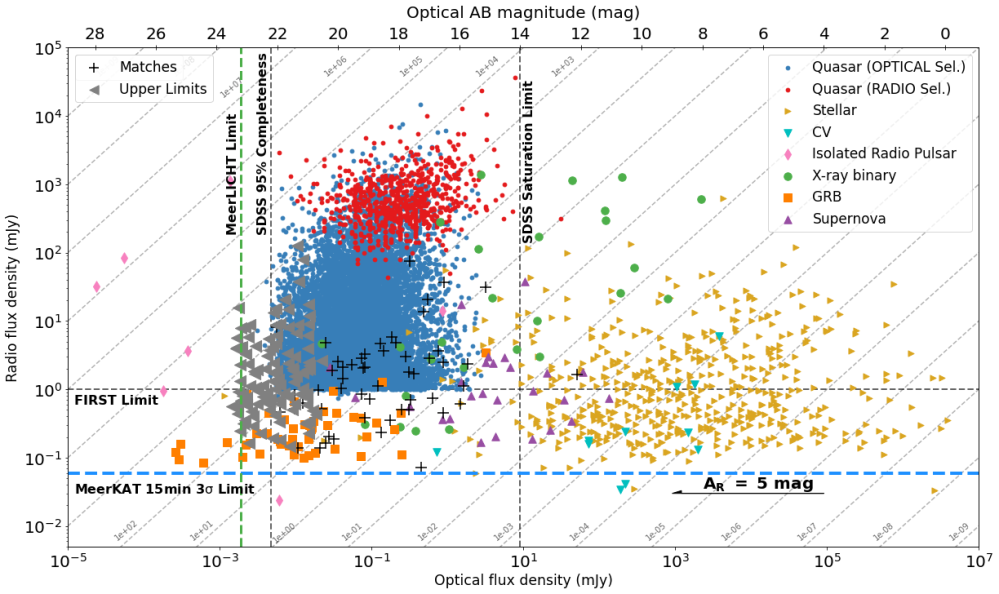
We wanted to see what kinds of objects you had found, so used our 'sister' telescope MeerLICHT to investigate what optical counterparts existed for our radio variables. Here's the main result of that, where you can see most of the radio sources you found have optical counterparts consistent with being quasars or other AGN (i.e. they are distant cores of galaxies)
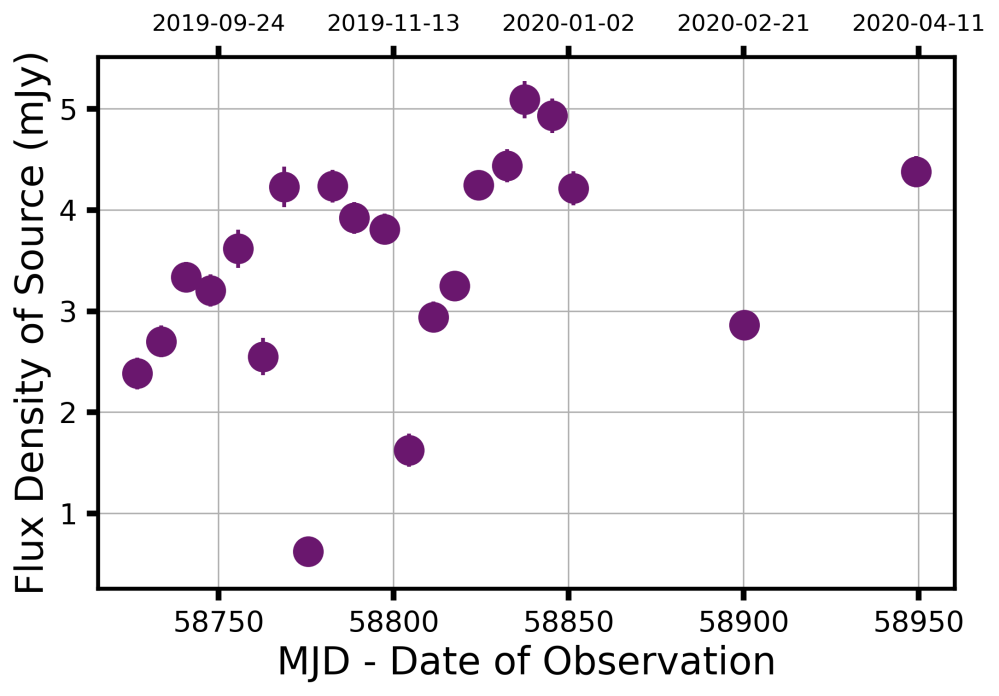
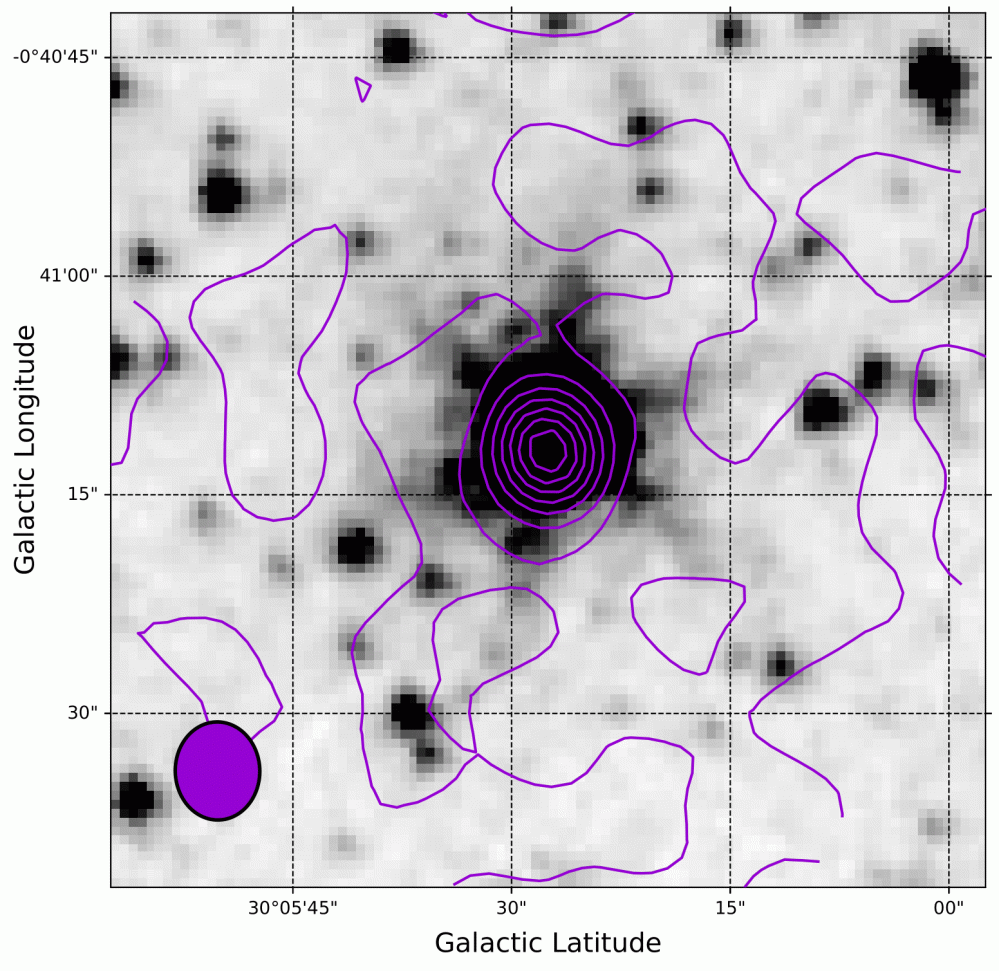
One specific examples I also wanted to highlight is that you found an OH maser star - that means a really puffed up, giant red star whose light activates a kind of 'laser in space' for particular hydroxyl molecules. The variability you see in its light curve here is very weird as well - it could be due to an unseen binary, or something to do with the density of molecules around the star.
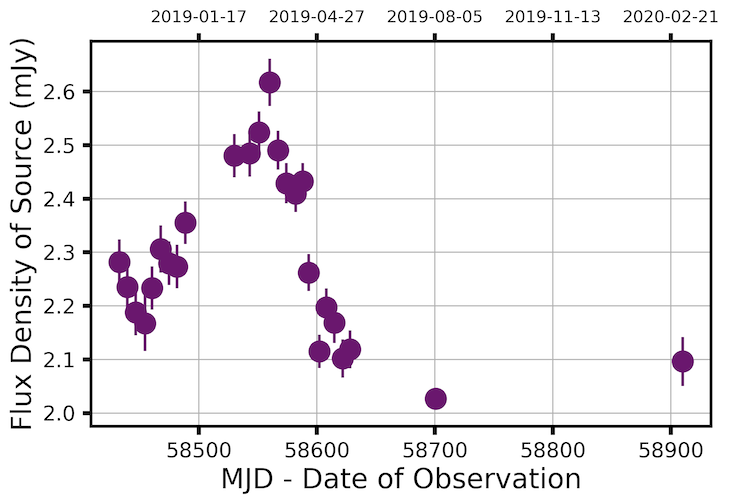
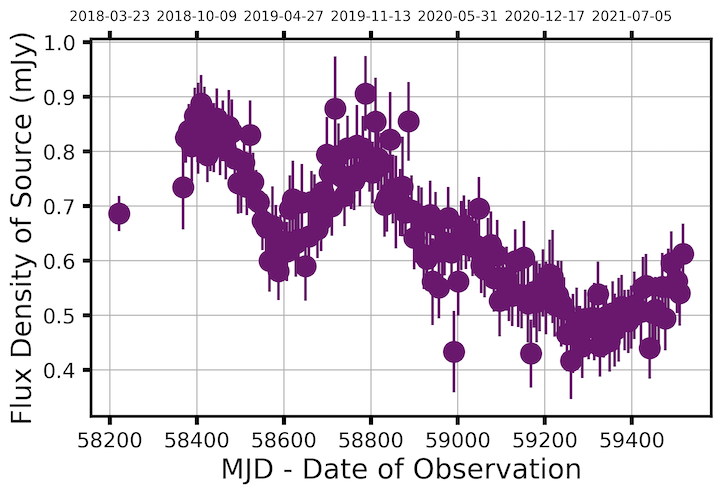
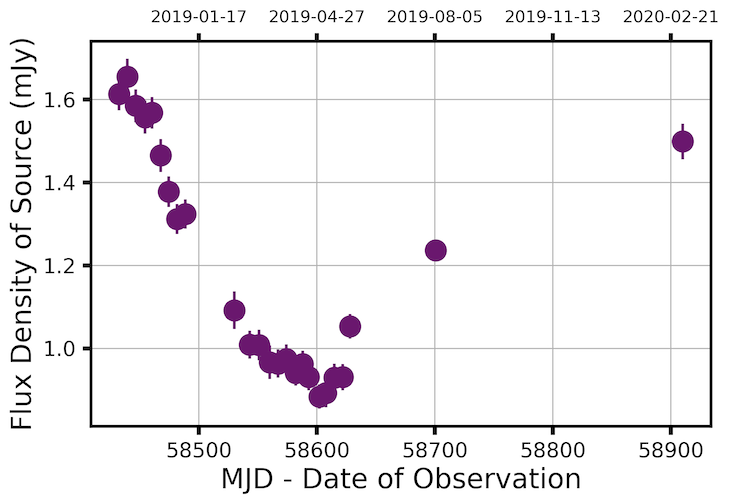
Here are some examples of some of the most striking sources you found that we think are mostly AGN!
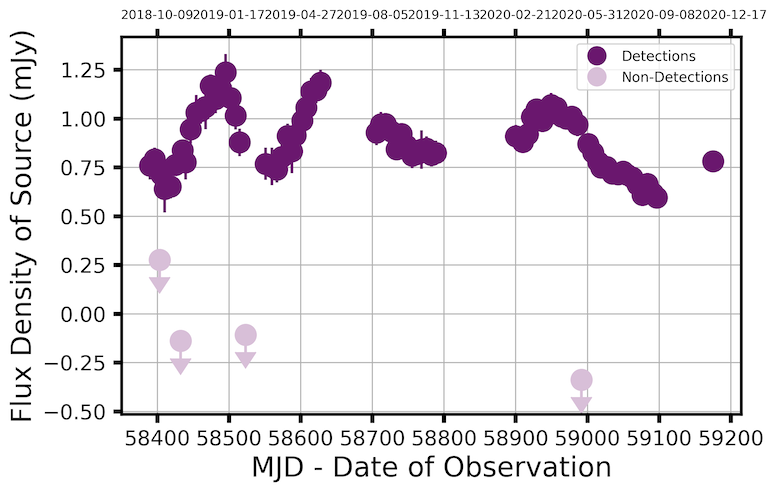
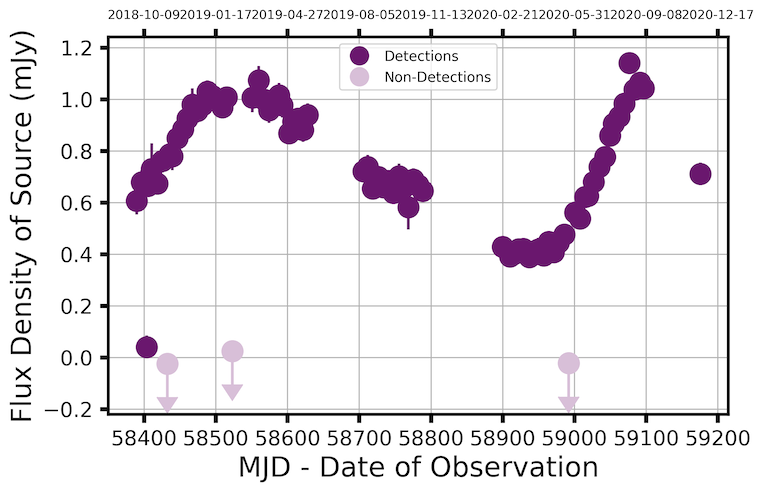
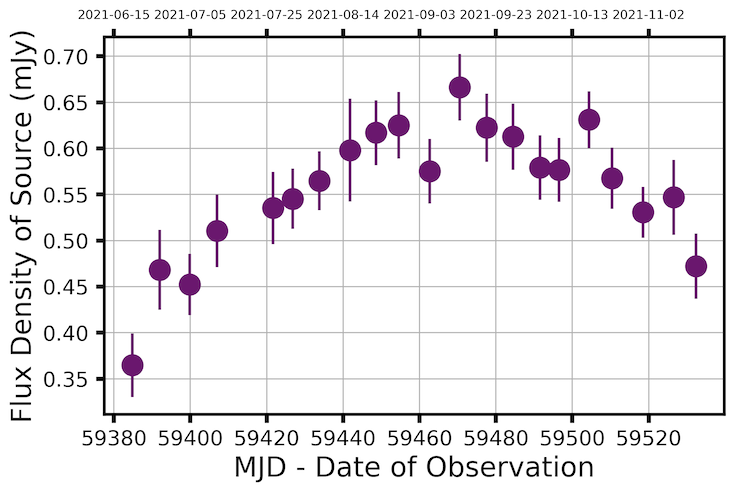
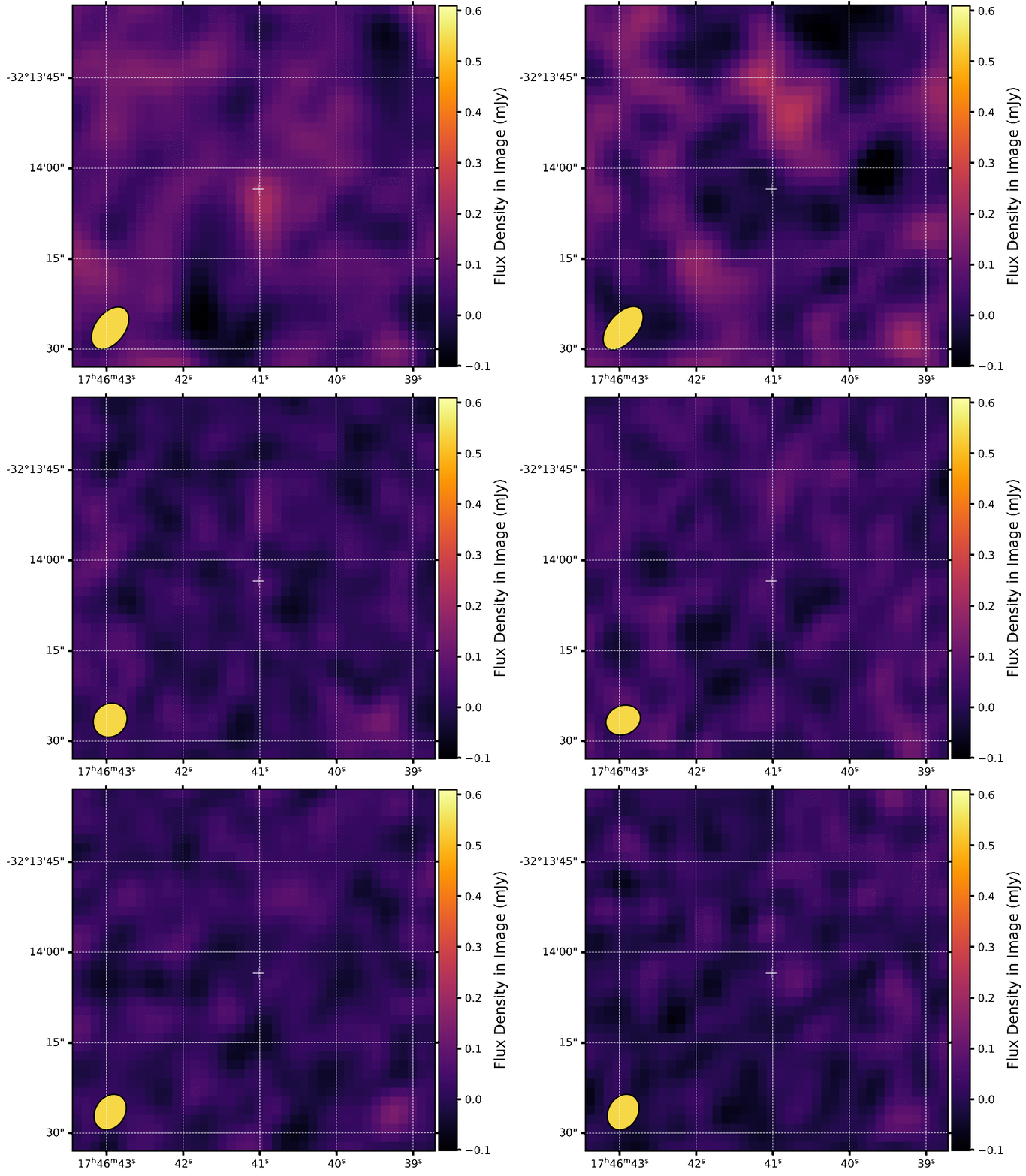
Also, the nearby red dwarf (not the TV show!) that was first found in our data last year (gif below) was also picked up by you volunteers. I (Alex) am personally biased to this system as it's the first I found so it was great to see you 'spot it' as well. The paper I've been writing has been accepted for publication and you can read the archived version here!

Finally, the huge success of this first stage of BfS:MKT has prompted us to gather more data from our colleagues who work with MeerKAT data, which we hope to get to you soon! This includes yet-more data from the ThunderKAT team, as well as from other teams who use MeerKAT to find out more about galaxies, the Universe and more!
Precursor Results
The method we use to find our variables and transients is relatively young but already showing real promise. In just the past couple of years we've found:
- Over 20 interesting sources in our most frequently visited field surrounding the black hole GX339-4.
- A flaring star system (probably a binary!) in long term observations of one patch of the sky. This was the first transient ever found with MeerKAT.
- Over 50 distant, variable galaxies seen by the Very Large Array in New Mexico.
As a team, ThunderKAT also does amazing targetted observations of X-ray binaries, white dwarf binaries and cosmic explosions. Here are just a couple of our results, with plenty more to come:
- The collapse of a massive star that occured ~6 billion years ago: https://ui.adsabs.harvard.edu/abs/2020MNRAS.496.3326R/abstract
- The apparent (but not actual!) superluminal motion of radio jets from an X-ray binary: https://ui.adsabs.harvard.edu/abs/2020NatAs...4..697B/abstract
- A large sample of cataclysmic variables: https://ui.adsabs.harvard.edu/abs/2020MNRAS.496.2542H/abstract