


Finished! Looks like this project is out of data at the moment!
Thank you for your efforts! We've completed the classification stage for this project! To browse other active projects that still need your classifications, check out zooniverse.org/projects.
Research
What am I looking for?
Looking at the sky with radio telescopes provides a unique insight into a range of exciting and exotic phenomena. From stellar flares on nearby stars to exploding supernovae in a different galaxy, radio transients can be as varied as they are interesting. We use the term radio transient as a catch-all for everything that might be interesting and varying in the radio sky, but here's a sample of some of the interesting radio transients we know about:
- Black holes, neutron stars and white dwarfs in binaries shooting out long columns of hot particles that we see as jets
- Stellar flares from nearby stars that are crucial for our understanding of planet habitability and the processes on and inside stars
- Supernovae and their remnants can glow in the radio and help us understand the complex physics behind these cosmic explosions
- Colliding neutron stars can produce small-scale supernovae called kilonovae which are detectable with the LIGO and Virgo gravitational wave detectors.
- Mysterious, bright, fast radio bursts (see the original Bursts from Space project for more on these)
- Distant galaxies and their active centres which give us clues as to formation and growth of supermassive black holes, as well as the effects of intergalactic dust on radio waves.
For more on some of the types of radio transients we're hunting for, see the Education page.
For examples of things we've found using this method already, see the Results page
What am I looking at?
There are two good ways of detecting the variability of our potential radio transients and we want to see which ways work best for finding these elusive beasts, as well as which methods are well suited for screening out any non-interesting or non-astrophysical effects.

Images - these are exactly what they sound like: images of the radio sources we see in our telescope images. From this we can see if the source in question is some extended blobby galaxy, a small dot ("unresolved point source") or some processing issue.
Light curves - a light curve describes how the brightness of an object changes over time. As we're interested in how variable or transient our radio sources are, these are a primary tool for finding new interesting objects.

In this project we'll show you both light curves and images to determine if a source is radio-variable or transient. We are also working on adding new workflows that utilise multiple images. Stay tuned.
The telescope

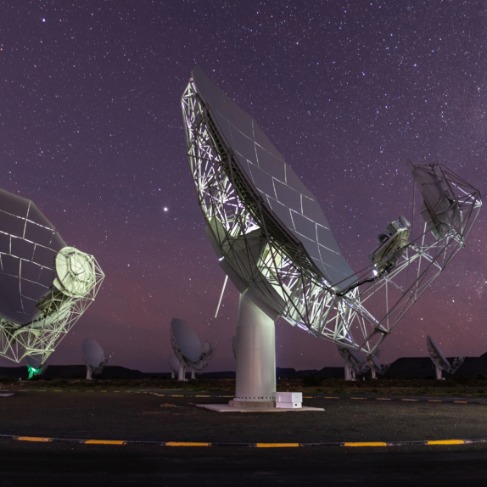
Image of the MeerKAT Telescope. Credits - SARAO
Our data comes from the MeerKAT telescope located in the Karoo region of South Africa - think 64 giant TV dishes in the desert all working together to pick up faint signals. The telescope started operation in 2018 and has been revolutionising our understanding of the radio sky ever since. It's large field-of-view (bigger than the size of the Moon in the sky) and high sensitivity allow us to find transients that were simply undetectable before. In time, MeerKAT will be incorporated into the upcoming Square Kilometre Array - the largest telescopic operation ever.
You can learn more about MeerKAT here: https://www.sarao.ac.za/science/meerkat/
ThunderKAT is the survey project whose data we are using. ThunderKAT regularly observes certain patches of the sky to explore known interesting radio sources in our galaxy - things like known black holes or neutron stars. However, thanks to the telescope's large field of view, there's lots of interesting stuff going on around those known sources. So to squeeze out as much interesting science as possible out of the images we take, we need you to help us find new transients!
Why we need you
The radio sky that our telescopes see is full of thousands of potentially interesting sources - many more than our project scientists can look through. We need your help to sort through candidate events and tell us which seem the most interesting and scientifically relevant. Then we can figure out what kinds of transients are more common and gain a better picture of the variable radio sky.
Why not use computers?
Computers are good at lots of things. What computers are not good at includes things humans can be very good at e.g. subtle pattern recognition and nuance. For example, there are lots of data processing and telescopic effects that a computer would (and do!) detect as interesting astrophysical sources. Humans are much better at understanding these "systematic" effects and screening them out from the really interesting astronomy.