


Finished! Looks like this project is out of data at the moment!
Thank you for your efforts! We've completed the classification stage for this project! To browse other active projects that still need your classifications, check out zooniverse.org/projects.
FAQ
What is a radio telescope?
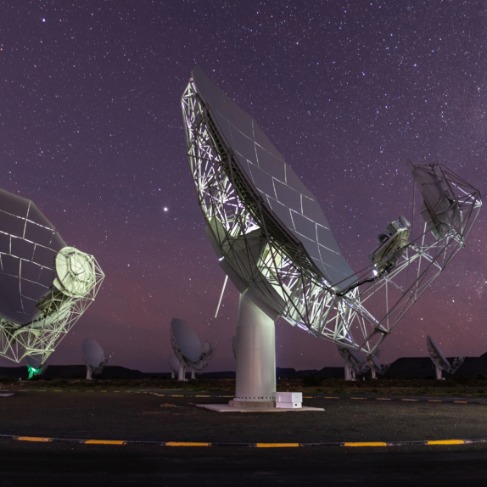
A radio telescope is quite different looking to an optical telescope. They look more like satellite receiver dishes than telescopes and this is because that's sort of what they are. Instead of picking up visible light waves, they are designed to detect electromagnetic radiation at much lower frequencies - radio frequencies. As the name implies, radio waves we get from space are at the same frequency as the waves we humans use to broadcast radio, TV, phone signals etc.
Why is it called MeerKAT?
The KAT part stands for Karoo Array Telescope, because the telescope is an array of dishes found in the Karoo region of South Africa. The "meer" part is the Afrikaans word for "more", as MeerKAT is an upgrade to the original KAT-7 (7 dishes). It is definitely a complete coincidence that meerkats, the incredibly cute animals, live in the area.
I don't know what to put!?
We have several people look at each of the sources we're showing you, so don't worry too much. Just try your best with each source and if you're really unsure or if it's a really unqiue looking source then consider using the Talk option.
Why do we need you?
The radio sky that our telescopes see is full of thousands of potentially interesting sources - many more than our project scientists can look through. We need your help to sort through candidate events and tell us which seem the most interesting and scientifically relevant. Then we can figure out what kinds of transients are more common and gain a better picture of the variable radio sky.
Why not use computers?
Computers are good at lots of things. What computers are not good at includes things humans can be very good at e.g. subtle pattern recognition and nuance. For example, there are lots of data processing and telescopic effects that a computer would (and do!) detect as interesting astrophysical sources. Humans are much better at understanding these "systematic" effects and screening them out from the really interesting astronomy.
What will we do with the results?
We will be combining your hard work with our expertise to follow-up any unique, interesting sources we find to discover never-before-seen radio transients. We will also use your classifications to train machine learning models to help process our data. Finally, we'll be publishing papers using these classifications and use them to help understand our science and our telescope in more detail.