


Please help us by filling out this short feedback form: https://forms.gle/UDVevDRNumajSt2A7
Research
A case study on pollen color in Geranium maculatum
 | Recent work from our research group at the University of Georgia has shown that our native species, Geranium maculatum, has plants with purple pollen at high elevations and yellow pollen at low elevations; a trend that has not been observed in other plant species. This made us curious about what else we could learn about flower color from Geranium? So we decided to dig deeper. |
A deeper dive into flower color of Geranium
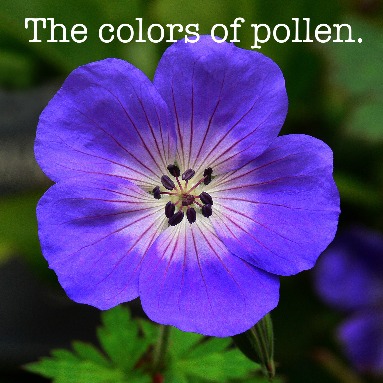
There are over 400 species of Geranium around the world. Chances are, you've seen them at your local hardware or garden store. If you take a closer look, it turns out that many species of Geranium have pollen that is colored red, blue, purple, black, and more! This made us curious to see if there might be similar trends in the geographic distribution of pollen color in other species of Geranium, just like we see in Geranium maculatum.
Using crowdsourced images to evaluate pollen color!
| To better understand why we see this variation in pollen color, we plan to use images from iNaturalist to determine the geographic distribution of pollen color across Geranium. iNaturalist is an online platform with a smartphone application that allows anyone to record observations in nature. To date, there are over 200,000 images of Geranium plants taken by over 85,000 people across the world . |  |
Though botanists have described pollen color for many species, sometimes the plants they described do not represent all of the color variation we see in nature. Using images from iNaturalist, we want to see if some of these species actually have multiple colors of pollen. Using coordinate data from iNaturalist that tells us where these plants are located, we can also test to see if there is a correlation between the environment the plants are in and the color of their pollen.
Why does the color of pollen matter?
 | In order to answer this question, first, we need to talk about what pollen is and what it does (other than cause seasonal allergies). Just like humans, plants have gametes -- sperm and eggs. Pollen grains contain the male gametes required for plant reproduction. When pollen lands on the stigma of a flower, the sperm cells travel through a pollen tube to reach the egg. Once the sperm and egg fuse, a zygote forms which eventually develops into a mature seed. |
Pollen has to safely be carried by pollinators to its final destination for successful reproduction. Recent (unpublished) work from our group has shown that pollinators do not have a preference for pollen color at high elevations. Therefore, we think that pollen color might be an adaptation to the intense environmental conditions experienced at high elevations. For every 1000 feet of elevation gain, the sun's UV rays intensify by ~8-10% and the temperature drops ~3.6 degrees Fahrenheit. Based on the number of plants with purple pollen in mountainous regions, we think the compounds that make pollen colorful might help pollen survive the intense conditions faced in high elevations.
A quick introduction to flower anatomy
 |
|