



Welcome to Beluga Bits in the Classroom! This is a classroom-friendly version of the Beluga Bits project where you can learn about beluga whales and begin your journey as a citizen scientist. If you would like to join citizen scientists from around the world participating on the main Beluga Bits project, click here! Please note: researchers will respond to Beluga Bits in the Classroom Talk forums when they can, but cannot guarantee how frequently this will occur. If you need assistance, please check the main Beluga Bits project or reach out to a researcher directly. Thank you for your patience!
Research
Do you want to learn more about beluga whales?
Welcome to Beluga Bits in the Classroom! This is the classroom-friendly version of the popular citizen science-based project Beluga Bits. Here you will examine underwater photos of wild beluga whales to learn more about their life history, social structure, and the estuary they call home.
So much we don't know
Hudson Bay is home to more than 50,000 beluga during the summer! Along the western side of Hudson Bay, there are 3 major river estuaries where beluga gather in the thousands every summer. They spend the winter in waters that are covered in ice and are hundreds of kilometres to the north. When the sea ice melts in the spring each year beluga travel to estuaries but it is not fully clear what benefits they gain in these areas. The estuaries may provide a safe refuge from killer whales, they may provide warmer water to help moult their skin, or it may be a combination of these and other factors. One thing we do know is that in the Churchill River Estuary beluga whales are close enough to peek into their underwater world and ask questions about beluga social structure, interactions with small boats, and their natural history. Here on Beluga Bits in the Classroom, you will begin learning about beluga whales and get started on your journey as a citizen scientist!
How we get beluga photographs
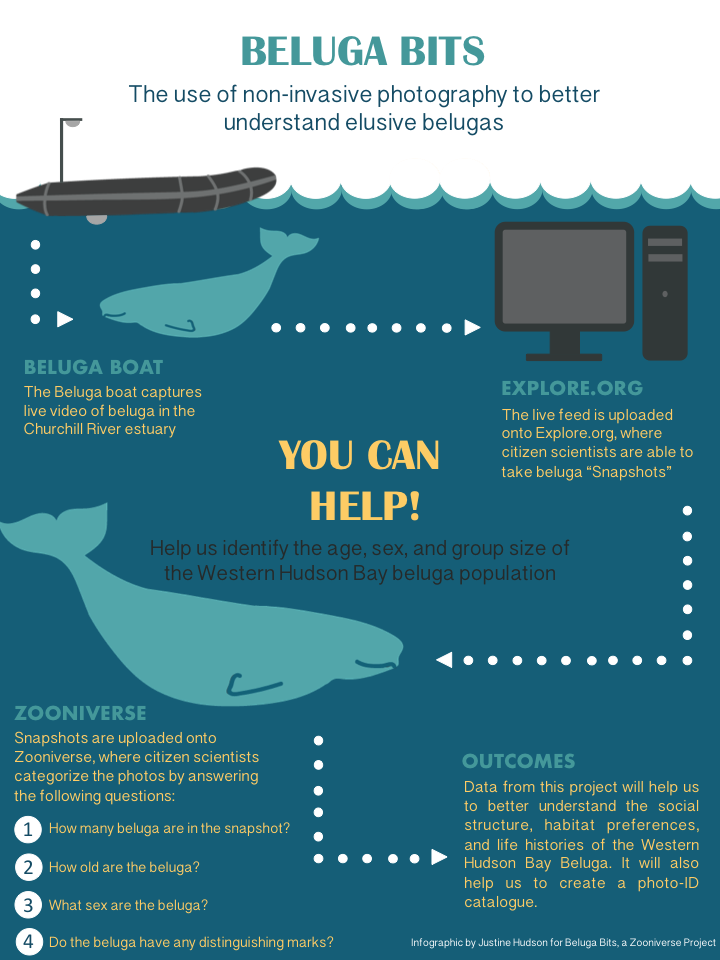
How can I contribute to beluga whale research?
You can join us on the main Beluga Bits project to help us learn more about these amazing whales! Thousands of citizen scientists from around the world are involved in helping us classify photos of beluga whales. Here you will find live workflows that reflect current data and research questions we have. You can also check out the Results page for exciting project updates and new findings!
What is the Beluga Bits project interested in
1. Social Structure
- Are the same groups of animals always seen together?
Using the age and sex results we hope to answer this. We predict that we will only see calves with groups of females but we are also interested in related questions like if only adult males form groups or do male groups include all age classes? - Are the same individuals always seen together?
Using the data on marked individuals we hope to answer this and build a picture of which animals are socially connected to which other animals. For example, if we see a marked calf with a female in one year then see it again in subsequent years, it could indicate a matrilineal pod structure (females are the core of a group), which is seen in many whale species.
2. Life History
- How often do females have calves?
Although examination of the reproductive tracts of beluga whales suggests that females will have a calf every two to three years on average, there some uncertainty in this estimate. Using the data on marked females with calves we hope to understand the calving rate better and that will help to estimate the population growth rate. - What sort of threats face beluga whales?
The types of scars on whales can be very informative. For example, in bowhead whales, researchers have documented increases in predation by killer whales from rake marks. - How strong is the urge to return to this estuary (site fidelity)
We think that beluga return to the same estuary each year and because of this we might be able to manage the population based on these Estuaries. However, it is difficult to figure this out. One way is to put satellite transmitters on beluga and track where they are going but so far no transmitter has lasted an entire year. We hope that by identifying marked individuals year after year we can figure this question out.
3. Habitat Use
- Do belugas of a certain age or sex tend to use the same underwater habitat?
When the beluga boat is driving around the estuary it is also collecting GPS locations of its position. We will then link the classified photos to a location in the river. This will allow us to look at questions related to habitat use like do beluga tend to be found at a certain water depth maybe just in areas with a particular bottom (sand, gravel, boulders).
4. What Else?
- The great thing with these underwater photos is that they provide us with a glimpse into an estuary ecosystem. This means that we come across other organisms that live in these areas such as jellyfish while searching for beluga whales. There are so many ways to understand the health of water, ocean, and marine ecosystems, and monitoring populations of creatures like jellyfish is one way to do this.