



Please read the tutorial & field guide & watch 'how-to' videos on the FAQ page (under 'About') before transcribing data!
This project requires a computer / laptop / tablet, it is not suitable for mobile phones.
Research
Climate change poses a critical challenge for Ireland's economy, environment and society. To respond effectively to this challenge, we need to understand how our climate is changing and the impacts it has on Ireland. This project aims to do that by providing access to valuable data that will improve our understanding of how rainfall patterns have changed over longer timescales and provide context for the changes we see in our current climate and possible future climate.
Why is this project so important?
Met Éireann’s archive contains an extensive collection of historical weather observations that include meteorological registers, rainfall registers, climatological reports, weather diaries, monthly weather bulletins and maps. These handwritten paper records are at risk of being lost due to the vulnerability of the original paper documents. By creating a digital copy of these records and extracting the data contained in them we can use the data to monitor climate variability and change, support effective climate risk management and improve climate model projections.
What is climate data rescue?
Climate data rescue involves the preservation of historical meteorological data at risk of being lost due to the vulnerability of the original paper record, accidental damage or poor storage conditions (World Meteorological Organization, 2024). The main components of the data rescue process include
- Archiving of historical records and manuscripts;
- Creating digital image files;
- Transcription from paper to digital format; and
- Digital storage and data accessibility.
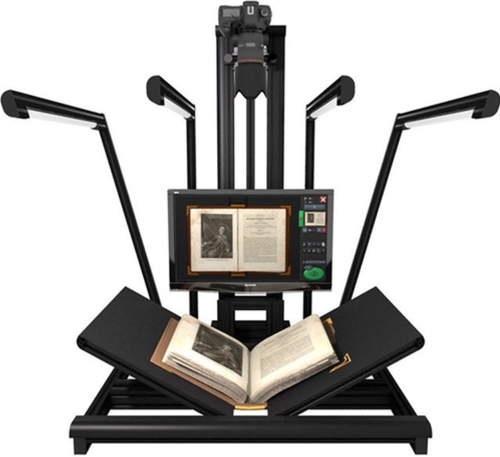
Metis EDS Gamma Professional Digital Scanner.
Who collected weather observations?
Scientists and weather observers recorded weather observations for Ireland as far back as the 17th and 18th centuries. In Ireland, the oldest known weather record includes daily barometer observations and weather remarks for the period January to April 1676, taken from a letter written from an observer in Dublin to the Philosophical Transactions of the Royal Society of London.
In 1787, Richard Kirwan established the first Irish meteorological station at Cavendish Row, Dublin. These records are the earliest surviving observations compiled with the aid of accurate instruments. Kirwan maintained the observations until 1808, by which time regular meteorological observations had commenced at the National Botanic Gardens. In 1829, the Ordnance Survey Office located in Phoenix Park, Dublin began recording systematic meteorological measurements providing continuous readings up to the present day.
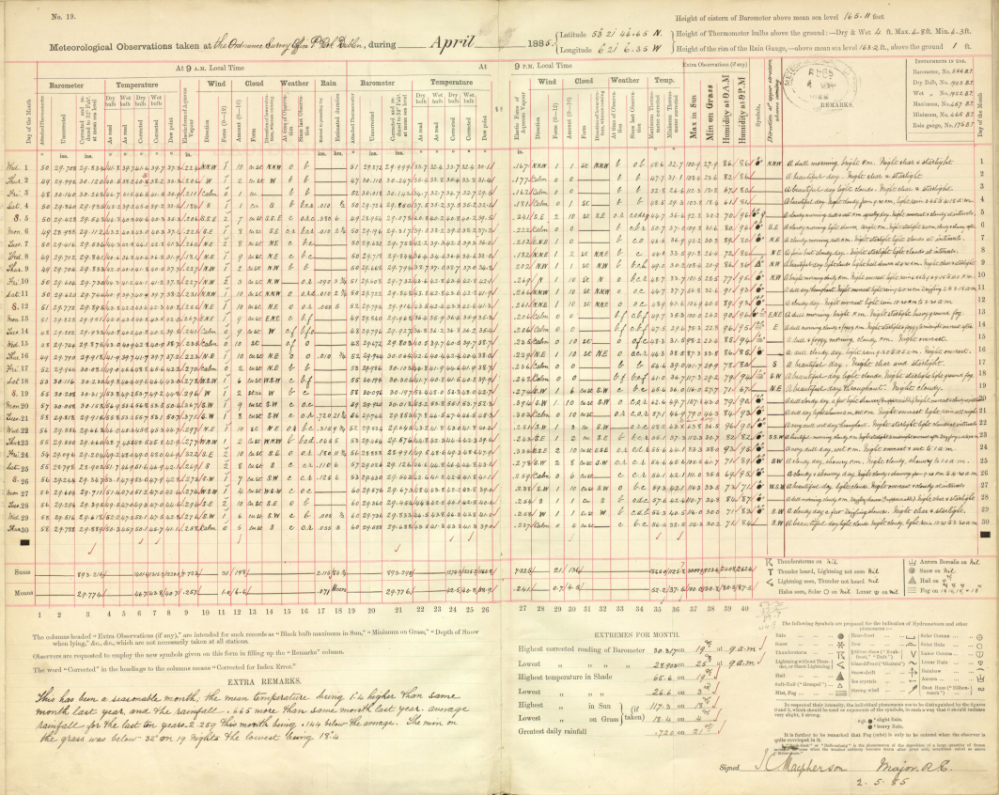
Record from Phoenix Park April 1885.
In 1859, George James Symons, working with a network of voluntary observers, set up a system for gathering and publishing rainfall records from across Britain and Ireland. In 1900, the network founded by Symons became known as the British Rainfall Organisation and was later (in 1919) formally transferred to the aegis of the British Meteorological Office.
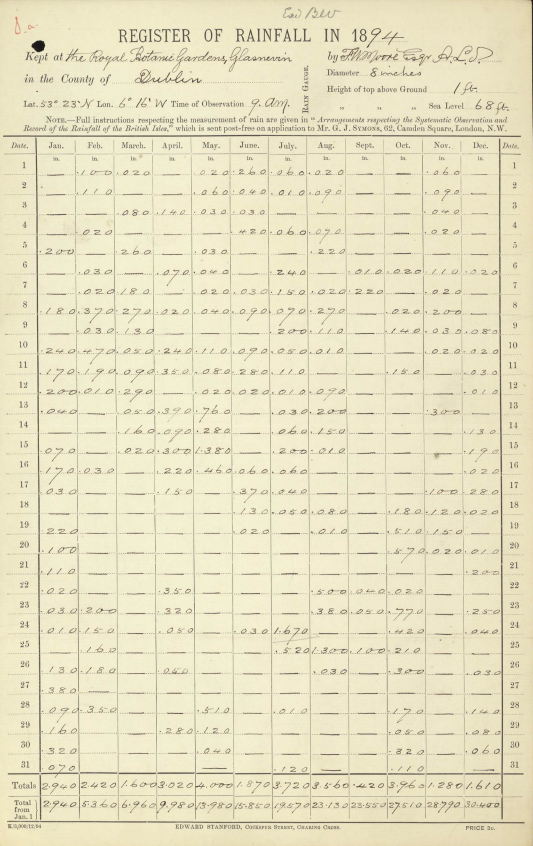
Example of a whole year rainfall record from the Royal Botanic Gardens, Glasnevin in 1894.
In 1868, the Met Office equipped seven observatories, including two in Ireland, with autographic instruments, providing the first continuous record of a variety of meteorological parameters at a number of locations. The records, along with the Phoenix Park records, which were maintained by the Royal Engineers, represent the early efforts of the British Meteorological Office to establish a network of meteorological stations across Britain and Ireland.

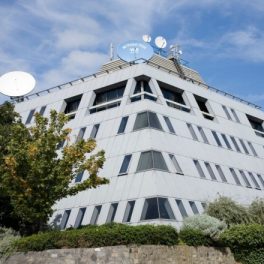
Met Éireann's History
The Irish Meteorological Service, later Met Éireann, was established in December 1936 and subsequently took over responsibility for the network of Irish stations from the British Meteorological Office. The registers that pre-date the establishment of the Irish Meteorological Service were later transferred from the British Meteorological Office to the current service in Ireland. The substantial paper records are carefully preserved in Met Éireann's archives, but until now have largely remained in paper format for years prior to 1941.