


Finished! Looks like this project is out of data at the moment!
After 2 incredible years, Get to Know Medieval Londoners is finally complete! A huge and heartfelt thank you to everyone who worked on this project. Stay tuned for data processing updates. Check our Announcements board for a new volunteer opportunity!
Education
The Husting Court
The Husting Court was one of the main courts in the city of London. Historians are still unsure exactly when Londoners first held it, but it was certainly in place by the mid-eleventh century. Our earliest court documents stretch back to the 1200s. The court handled a variety of legal issues, including those related to the transfer of land and buildings, recovery of a widow's dower (her share of her husband's estate), and the enrollment of wills.
It met every Monday in the Guildhall, alternating between hearing Pleas of Land and Common Pleas each week. Sitting on the court were several civic officials. First was the Mayor, the highest elected office in London's government who had a range of administrative, legal, and ceremonial responsibilities. With him were the city's two Sheriffs, officials with a variety of legal and administrative duties. If the Mayor could not attend, six Aldermen could stand in for him. The Aldermen were one of London's oldest mechanisms of self-government, with each of the city's wards electing their own from among the wealthier and more influential residents, who then usually served for life.
The Husting Court was one among many courts in London, which also included the Mayor's Court, Sheriff's Court, neighborhood wardmotes, and various other church and royal courts.
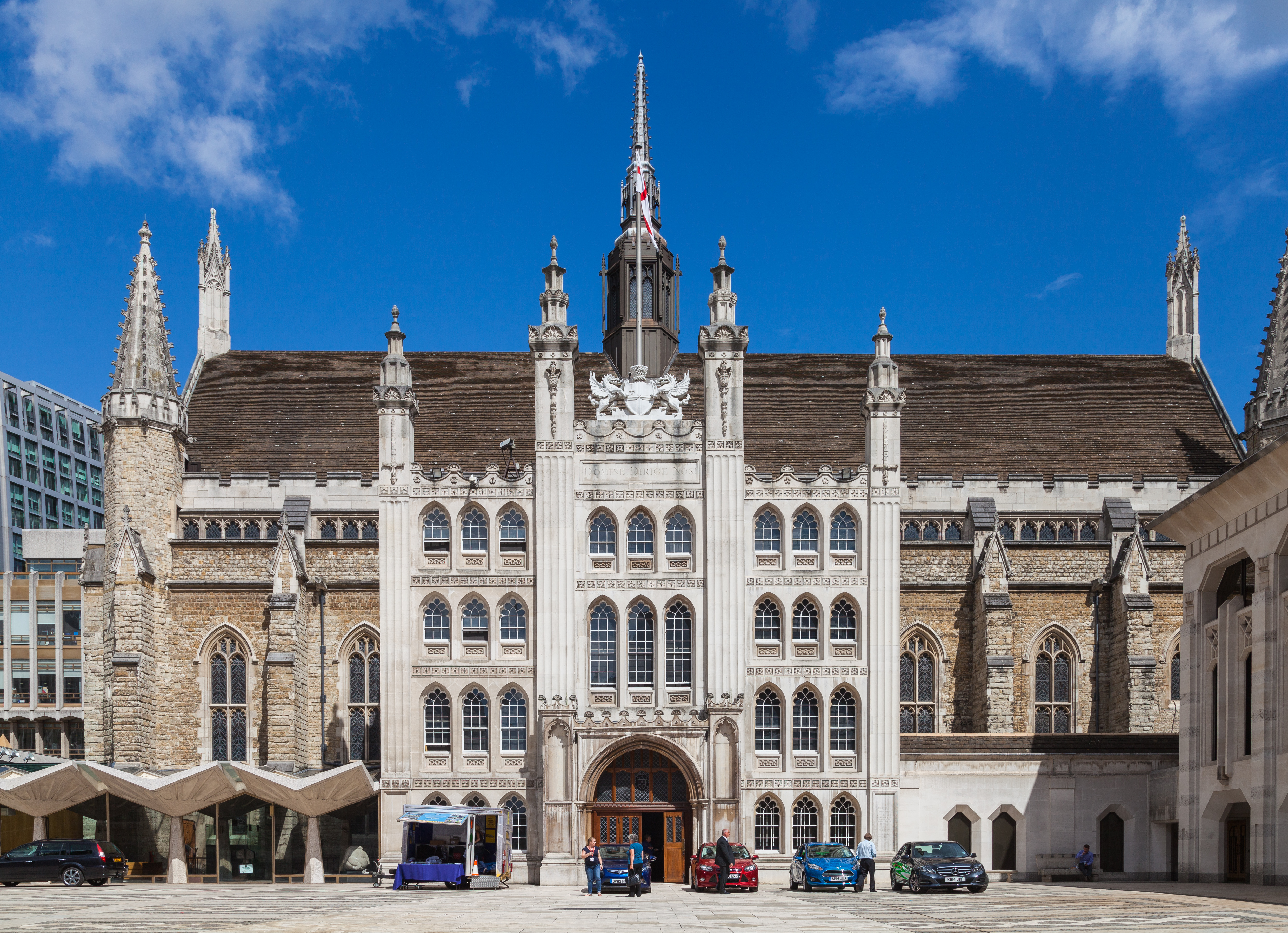
Figure 2: A photo of the modern guildhall. This building dates from the early fifteenth century and has undergone extensive restoration since then, especially after the Great Fire of London in 1666. (Source: Wikimedia Commons)
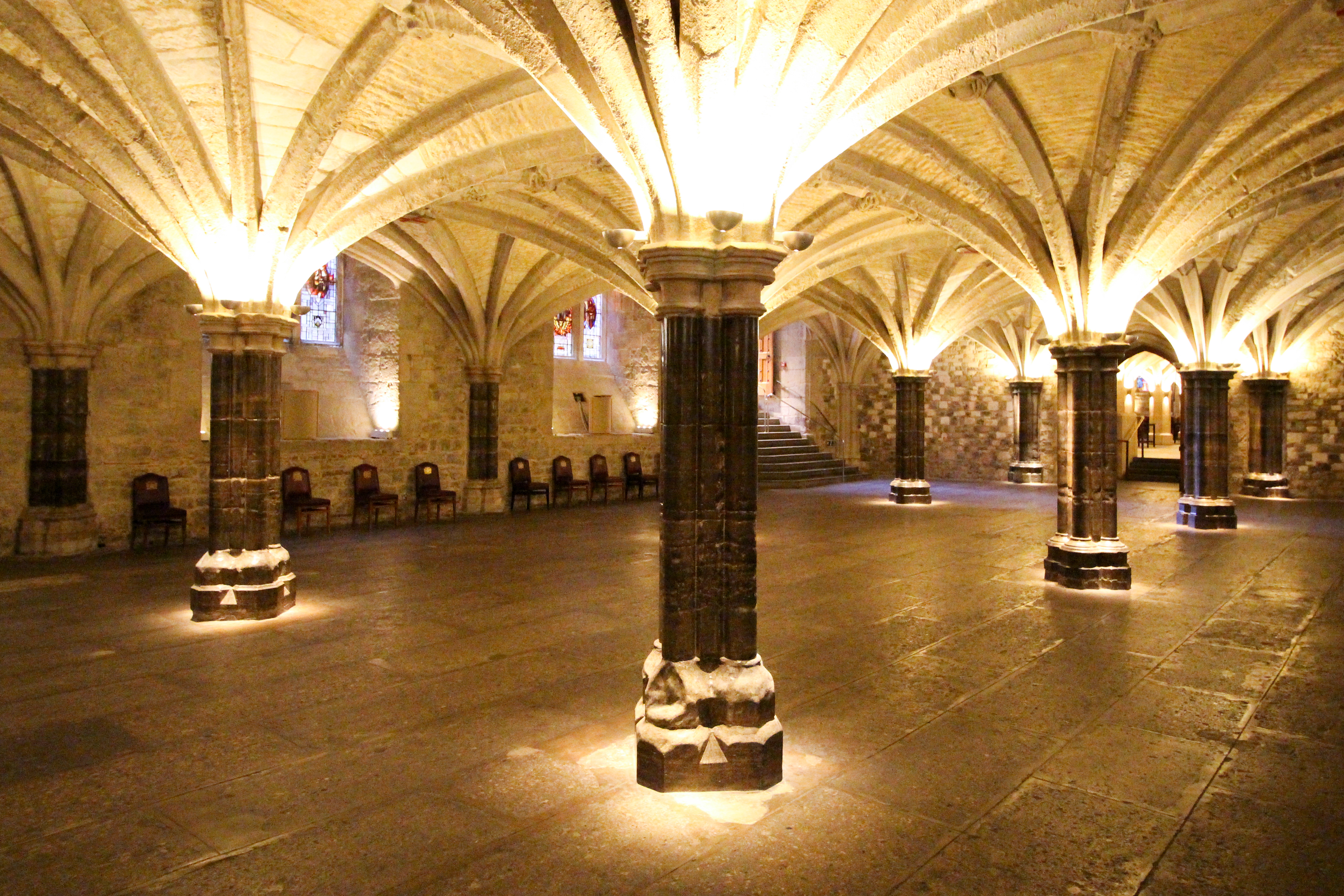
Figure 3: The Guildhall's crypt, one of the oldest parts of the building and a space that still preserves its medieval architecture. (Source: Wikimedia Commons)
"The Civic Courts of the City of London: Court of Husting CLA/023," London Metropolitan Archives.
Original Manuscripts
The main types of documents that survive from the Husting Court are deeds and wills, both of which had to be formally enrolled with the court. This material is currently held in the London Metropolitan Archives, or LMA. While the Husting wills were published in the late nineteenth century and are currently available online, the deeds have received no such treatment.
The manuscripts themselves are made of sheep skin scraped of hair and cured to form parchment. The ink used was made up of such ingredients as the gallnuts attached to the bark of trees. Long sheets of parchment with writing were sewn together at the top and bottom so that the entire document could easily be rolled up. Producing parchment, which was a long and labor-intensive process, required specialized skills and training. You can occasionally see small holes in the documents (Figure 7), some the result of damage to the parchments and others the remnants of imperfections in the animal skin (you can tell the difference by checking which holes the scribe avoided, as those already existed).
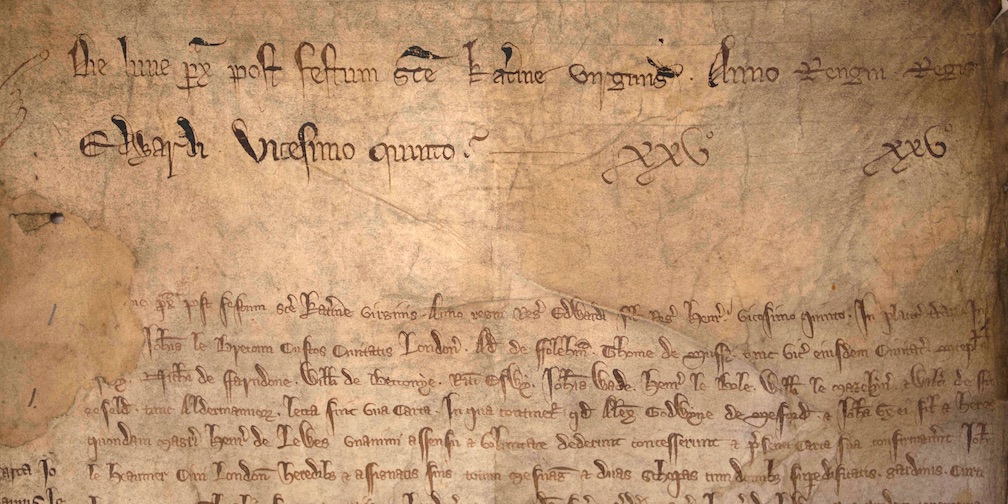
Figure 4: The beginning deeds recorded on a parchment roll. There is a heading at the top in a larger script, and then the main text begins below it. If you look closely, you can see a small illustration of a hand in the top left corner that points to the start of the text. (Source: LMA, HR 26 m.1)
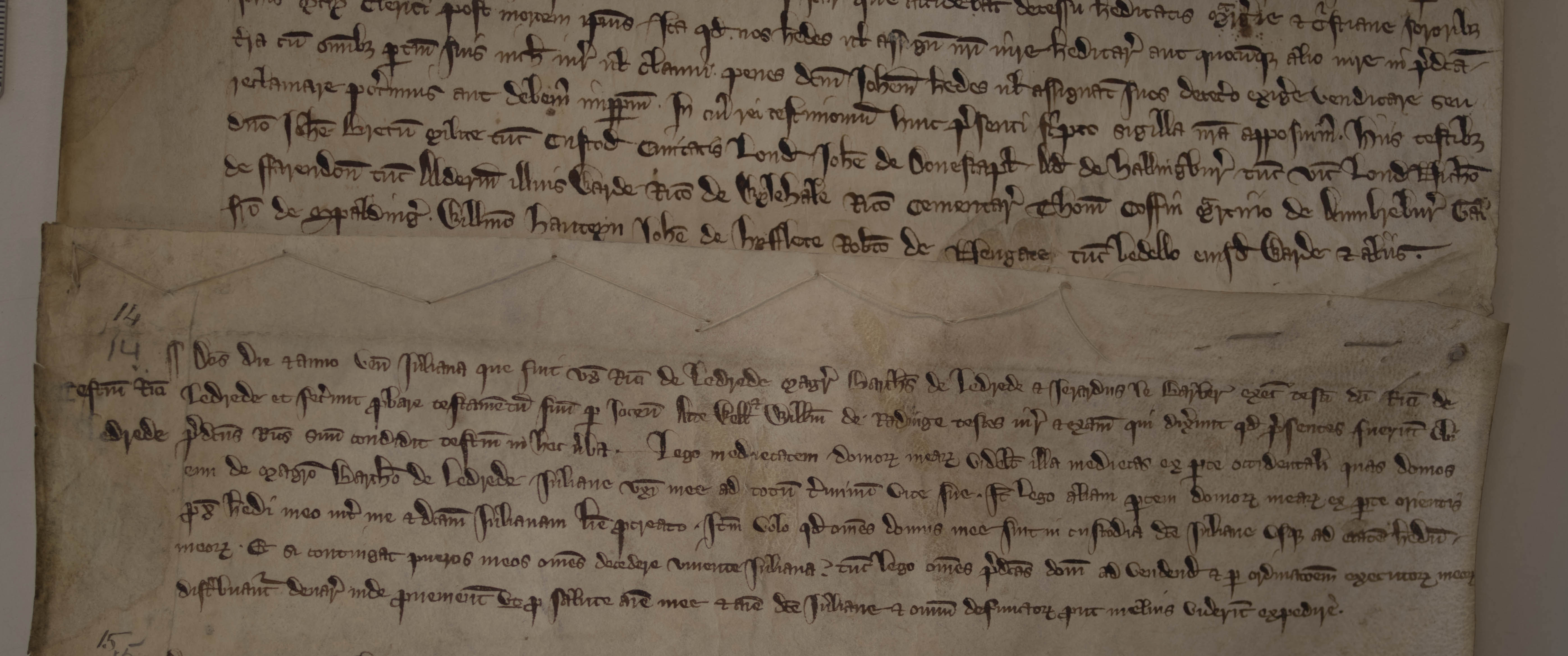
Figure 5: A seam between two sheets of parchment stitched together with thread. (Source: LMA, HR 26 m.4, 5)
The scribe responsible for these documents would have been a town clerk, someone trained to read and write in Latin. Because most of the entries had a similar format and could get repetitive, the clerk used abbreviations to save time. The script is called English Court Hand which developed in the twelfth century and lasted throughout the rest of the medieval period. More specifically, the deeds are written in a form of Cursiva Anglicana, which arose in the thirteenth century. It has distinctive tall, curved ascenders (on letter like the lowercase b, d, h, and l), and is overall quite round and fluid.
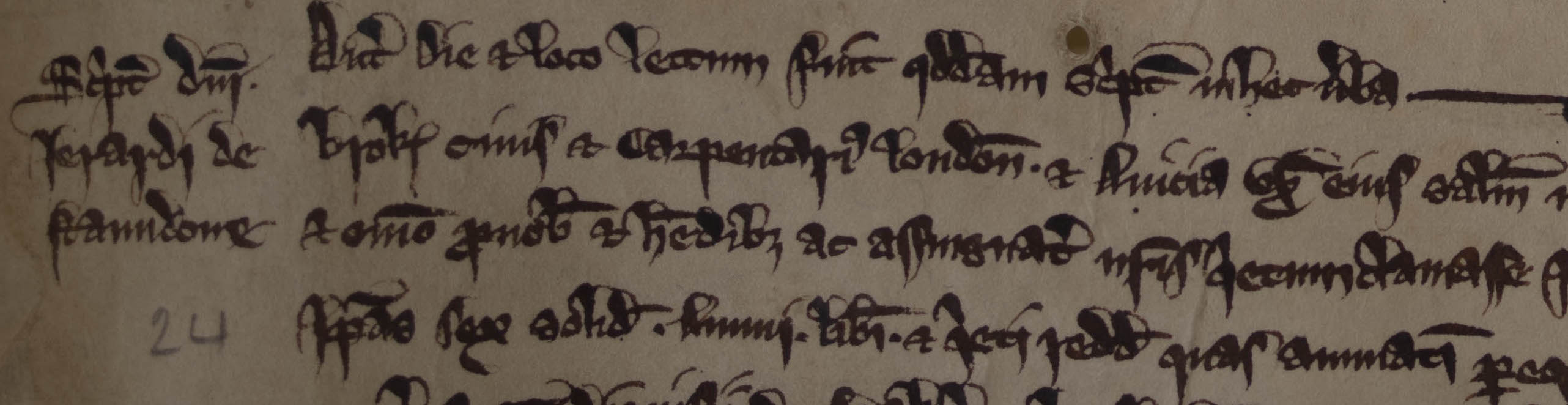
Figure 6: A close-up of a late 13th century script. (Source: LMA, HR 26 m.6)

Figure 7: Small holes in the parchment that the scribe has avoided. (Source: LMA, HR 26 m.6)
Further reading:
London Metropolitan Archives Collection: COURT OF HUSTING, CITY OF LONDON
Handwriting Styles, University of Nottingham Research Guide
Gothic Cursiva Anglicana, School of Advanced Study, University of London
Paleography Resources
The National Archives Paleography Tutorial
Interactive Paleography Exercises from the University of Nottingham
Digitized Manuscripts at the University of Houston O'Quinn Law Library
University of Chicago Library Medieval Manuscript Research Guide
The Transcription Process
In the 1980s, researchers who were part of a project called The Social and Economic Study of Medieval London c. 1100-1666 began looking at the history of property in selected parishes in London, especially those centered on the market area of Cheapside. They were interested how specific properties, mostly residential, changed hands over several centuries and how the city's physical environment developed during that time period. They examined the original deeds (like those in Figures 4, 5, 6, and 7) and created expert transcriptions and translations on index cards.
Most of the transcriptions were done by the project's lead researchers: Derek Keene and Vanessa Harding, with help from Martha Carlin, John Stedman, David Crouch, and Joanna Mattingly. It is their handwriting that you will see on most of the cards. Derek Keene, who unfortunately passed away in 2021, was an expert on English urban history who was a founding director of the Centre for Metropolitan History at the Institute of Historical Research (IHR) in London, which came to house the Social and Economic Study. Vanessa Harding is currently Professor of London history at Birkbeck College, University of London. The two scholars wrote extensively about the topography of London and property-holding within the city, but the deed cards were never published.
Since the end of the Social and Economic Study in 1988, the cards have been stored at the IHR, in file cabinets inaccessible to the public. There are so many cards that the regulars have begun to affectionately refer to the stacks of cabinets as "The Great Wall of Cheapside", after the area of the city that the researchers initially focused on. The cards were used to produce several studies and publications under the umbrella of the Social and Economic Study, see the full list on the "Property" page of Medieval Londoners.
Keene and Harding compiled information from these deed transcriptions and created the Historical Gazetteer of London Before the Great Fire, a detailed history of individual properties in five parishes. These micro-histories trace the ownership of a property through several centuries as it passes between family members, business associates, and entirely new tenants.
Social and Economic Study of Medieval London, c. 1100-1666
Prosopography
A prosopography is, in essence, a collective biography. Within the field of history, it is a methodology that scholars employ to better understand the lives of individuals who belong to a certain social group by compiling data about a large number of people in the group. This enables scholars to make certain generalizations and comparisons about the group's commercial, legal, political, and religious activities, where they lived, or how wealthy they were.
Prosopography is particularly useful when there is very little information available about specific people who lived in a specific place and time, say, young women in London between 1400 and 1450. Because of social conditions during that time, young women rarely learned to read or write, and thus did not leave many sources about their lives. A prosopographical approach to this problem would look for references to young women in a variety of contemporary documents, such as marriage records, wills, and property deeds, and compile as much information as possible from those sources to gain an understanding of what life may have been like for a woman who belonged to this group.
While prosopography is not a perfect method, it is incredibly useful for understanding the middle ages. In most cases, we will only know certain details about an individual's life if they were important enough during their lifetime to appear in multiple documents, to write letters that were preserved, or if a contemporary wrote a biography of them. People like this usually come from the wealthier sections of society. Prosopography is so useful because it allows scholars to study parts of society that rarely make it into the documentary record, including (but not limited to), women, those of lower socioeconomic status, and religious minorities.
The Medieval Londoners Project, which is the parent project for Get to Know Medieval Londoners, helps to facilitate prosopography through its open-access database. Anyone can access the database and search for Londoners based on a variety of factors, such as occupation, civic office, or parish, and thus create a collective biography for those sections of London society.
Get to Know Medieval Londoners aims to contribute to this project by creating data that will end up as part of the Medieval Londoners Database and thus facilitate future prosopographical research.
"Prosopography: Definition", Modern History Research Unit, University of Oxford