


Finished! Looks like this project is out of data at the moment!
A big thank you to all the amazing volunteers that classified images for us! Stay tuned for the results! 😃
Research
What's a greater bilby?
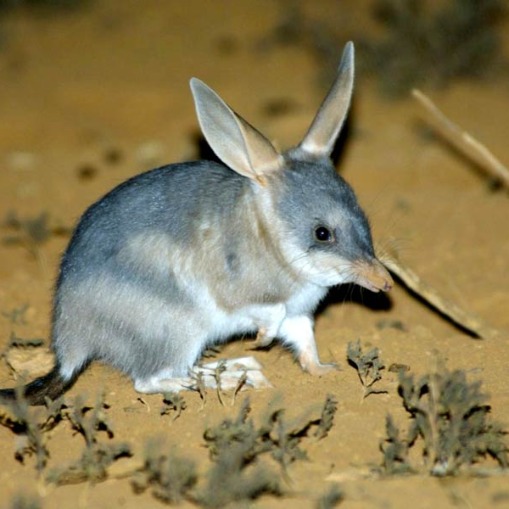
A greater bilby (Macrotis lagotis) is an Australian burrowing marsupial. Bilbies are closely related to bandicoots, and are instantly recognisable with long rabbit-like ears, and a distinct black and white tail. Bilbies are perfectly adapted for life in the Australian desert, getting all the water they need from their diet of roots, seeds, and insects. Bilbies also dig deep burrows to shelter from the heat during the day, only emerging from their burrows at night.
A bilby burrowing in the sanctuary. Bilbies are expert excavators, creating and using many burrows across their range.
Due to the successful establishment of European red foxes (Vulpes vulpes) and feral cats (Felis catus) in Australia, most species which are the perfect meal size for a fox or cat, also known as the 'critical weight range', have declined. Bilbies fall within this critical weight range, and have consequently declined across their formerly widespread range. Other threats to the bilby include diet competition with introduced herbivores (e.g. rabbits), climate change and the increased frequency of drought, and changes to traditional fire regimes. Bilbies are currently vulnerable to extinction, and are a nationally threatened species.

The bilby's range in Australia pre- and post-European settlement (adapted from Bradley et al. 2015). European settlers introduced species such as the European red fox to Australia which are now widespread and pose a significant threat to naive native species, such as the bilby. The estimated percent decline of bilbies from each state is noted on the map.
The Greater Bilby Sanctuary Project
The greater bilby sanctuary project was established to provide a semi-wild population of bilbies for conservation breeding and release. The fenced sanctuary is at Taronga Western Plains Zoo, in Dubbo, New South Wales (indicated on the map above). You can find out more about Taronga and the work being done to conserve species here. Prior to bilby release, introduced foxes and rabbits were removed from the fenced sanctuary. This was necessary to allow bilbies to establish. The fence prevents introduced predators and herbivores from re-establishing. Ongoing maintenance ensures the fence remains impervious, and any unexpected incursions are monitored closely using a variety of methods, including a camera trap grid.

The bilby sanctuary fenceline. The sanctuary contains 110-ha of tussock grassland and woodland habitat for the bilby in an introduced-predator-free area.
Bilbies are a difficult species to study in wild settings; bilbies are active at night, live in burrows during the day, and can rapidly cover large distances, at night. We used the release of bilbies to this semi-wild fenced sanctuary as an opportunity to better understand bilby ecology and behaviour, and to develop effective conservation tools for the species.
A greater bilby up close and personal captured on camera traps in the pre-release yard. Camera trap data is helping us better understand bilby behaviour.
Bilby supplementary feeding strategy and camera trap monitoring
To alleviate the effects of drought we decided to provide feed to bilbies released. We are using camera trap data to monitor bilby use of supplementary feed and to test whether bilbies would use this resource, and, if so, how it is used by bilbies released. Ultimately, we want to know whether this tool might be an effective method for supporting bilby populations. It is crucial that we develop effective tools to combat the increased frequency and severity of drought in Australia, and its impacts on threatened species, such as the bilby.
How can you help?
Camera traps trigger, and will take images each time an animal, human or object (e.g. vehicles) moves into the field of view. Changes in temperature can also trigger camera traps which leads to "hot grass" images with no animals present. Each of our camera traps spread across the sanctuary can have 1000's of images per month! Turning these raw images into valuable data is a big task, and this is where we need your help! For each image we would like you to classify the animals you see. We have provided a list of species that you are likely to see, and a tutorial to guide you through the process of classifying images.
Bilby keeper, Steve Kleinig describes our monitoring efforts in the semi-wild bilby sanctuary and how this is allowing us to passively monitor the bilby population as conditions change.Bilby distribution map from:
Bradley, K., Lees, C., Lundie-Jenkins, G., Copley, P., Paltridge, R., Dziminski, M., Southgate, R., Nally, S., and Kemp L. (Eds.) (2015). 2015 Greater Bilby Conservation Summit and Interim Conservation Plan: an Initiative of the Save the Bilby Fund. IUCN SSC Conservation Breeding Specialist Group, Apple Valley, MN