


Finished! Looks like this project is out of data at the moment!
A big thank you to all the amazing volunteers that classified images for us! Stay tuned for the results! 😃
FAQ
Frequently Asked Questions:
1. What's this project about?
2. How can I help?
3. Why can't I select 'I don't know' for images?
4. Why can I see reflective tape on a bilby tail tracker attachment?
5. Is it a wallaby or is it a kangaroo?
6. Why can I see a cage-trap in some images?
7. How do I know whether or not an animal is interacting with the feed site?
8. What will you use the data for?
9. Where can I access the results for this project?
1. What's this project about?
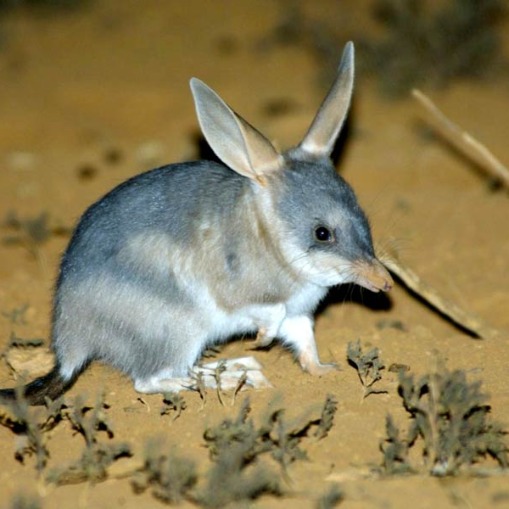
In 2019, the first bilbies were released to the semi-wild sanctuary at Taronga Western Plains Zoo, for the purposes of establishing a conservation breeding and release program for the species. Bilbies within the semi-wild sanctuary are monitored passively via a grid of camera traps across the site, and by tagging bilbies with devices to track their movements from release. We are studying bilbies to increase our understanding on bilby ecology and behaviour and are developing tools to effectively conserve the species.
2. How can I help?
We need your help to identify bilbies and other species by classifying camera trap images. If you spot a bilby or other animal you may be asked some follow-up questions such as "is this bilby carrying a tracking device?" and "is this animal interacting with the feed site?". As half of our sites did not have feed buried (i.e. our control sites), you won't be asked about the animal's behaviour at these sites.
3. Why can't I select 'I don't know' for images?
We understand that some images may be more difficult to classify, particularly if only a small portion of the animal is captured, but it is far better for us if you can take your best guess at what animal has been captured rather than selecting 'I don't know'. Even with the trickiest of images we get some information from your guess and with several volunteers classifying each image we can work out some information on the likely features of the animal seen (e.g. whether it was a smaller or a larger animal, whether it was feathered or furred). The project team at Snapshot Serengeti describe this well here.
4. Why can I see reflective tape on a bilby tail tracker attachment?
Bilbies of the same sex are fairly non-distinct and individuals can look very similar. So how do we tell them apart? For the bilbies that we are tracking, each individual will have their own reflective tape marking in a unique position on the tail. This tells us who they are. So why is it important that we know who’s who? Our supplementary feeding strategy aims to support the bilby population. However, if only a few individuals are using this resource we may only be supporting a small fraction of the entire population. Ideally, all animals will have equal access to the supplementary food resource, and, as the conditions improve, bilbies will become less reliant on this resource.
If you clearly see a reflective tape marking on the tail of a bilby you can help us out by hashtagging the image. You can do this by choosing ‘Done & Talk’ after classifying a bilby with a tracking device attached, and adding your hashtag in the comments section. For example, if you see a circle in the centre of the tail you can hashtag #circle_centre . If you see a triangle at the base end of the tail you can hashtag #triangle_tailbase. If the marking is not clear, feel free to skip these images. Look out for the following markings and see if you can spot them in the images!
Circle
Triangle
Stripe (can be vertical, horizontal or diagonal)
Two circles
Donut
Letters: "C", "J", "P", "X", "V", "D" and "B"
Plus symbol: "+"
We have also provided some example images in our field guide under the 'Get to know the bilbies' tab. You can access the field guide at any time by clicking on the 'Field Guide' tab at the right-hand side of your screen.
5. Is it a wallaby or is it a kangaroo?
Within our fenced sanctuary we do not have any species of kangaroo. All macropods seen are wallabies. We have two species of wallaby. These are the red-neck wallaby (Notamacropus rufogriseus) and the swamp wallaby (Wallabia bicolor). Generally, red-neck wallabies are larger than swamp wallabies, and usually have lighter coloured, reddish fur. Swamp wallabies have mostly dark coloured black-grey fur with distinct dark and light markings on their face. Importantly, individuals within each species can vary in colouration and size. Red-neck wallabies are sexually dimorphic, meaning that males are much larger than females. Large male red-neck wallabies can look very similar to some kangaroo species! For the purposes of this project, you do not need to identify each species of wallaby. You only need to select ‘Wallaby’.
6. Why can I see a cage-trap in some images?
You may have already spotted some of our traps at the feed sites. As part of our monitoring efforts we occasionally trap bilbies within the sanctuary. This gives us vital information on what the population is doing. We can collect a lot of information from trapping a bilby including: scoring body condition, confirming the presence of pouch young for females, assessing the welfare of bilbies carrying tracking devices, and collecting DNA from individuals born within the sanctuary for further research. We sometimes place traps at the feed sites as we know that bilbies frequent these sites, and we are often lucky in capturing bilbies. If you see a closed trap it is not in use. By leaving closed traps in areas where bilbies frequent, animals become more accustomed to the site and smells of a trap, and when we eventually open them bilbies may be more comfortable in entering the trap.
7. How do I know whether or not an animal is interacting with the feed site?
At our sites containing buried feed you will be asked whether or not an animal is interacting with the feed site. Feed is buried directly to the right of the site marker (pin or large rock with pink flagging tape). Even if you cannot see the site marker, the location of the feed should always be roughly in the centre field of view (FOV). To mark something as a site interaction the animal needs to be:
-
Moving slowly.
-
In the vicinity of the feed site marker (i.e. in the centre field of view).
However, point 2 is sometimes less clear cut, particularly if the animal seems to be close to the borders of the feed site and moving slowly. If this is the case, you can also look out for any behaviour that may indicate that the animal is interacting with the feed site such as:
- The animal has their head down to the ground in several images, and is clearly sniffing, digging or directly interacting with the site in some way.
If the animal satisfies at least 2/3 of these points this should be marked as a Yes for a site interaction. If only one of these points are satisfied then this should be marked as a No for a site interaction.
If you are unsure you can always contact us on Talk by choosing "Done & Talk" after classifying an image and we will do our best to help!
8. What will you use the data for?
We are using the camera trap data to monitor use of supplementary feed by bilbies and other sanctuary occupants, and the data will be used to test whether this tool is effective in supporting bilby populations during drought. The results of the supplementary feeding strategy will be presented as a chapter of Kate's PhD thesis, and data will assist with ongoing monitoring efforts within the sanctuary.
9. Where can I access the results for this project?
We intend to publish the results from this research in a peer-reviewed scientific journal. We will also publish some general results under a 'Results' tab in the about section when this becomes available.
Want to know more?
Please ask away on our relevant talk boards here. We also answer some more general FAQs and guidelines on our talk boards which you can access here.