


FAQ
Frequently Asked Questions
1. Infrared AND Optical, can I just mark one of them?
Answer: Of course yes! The reason we provide both images is to increase the likelihood to find host galaxies. In many cases, a galaxy might be visible in one waveband and too dark to be seen in the other.
2. So many tags to choose from and multiple choices, why?
Answer: We actually have selected them from a much larger plain English tag pool (If you're interested, you can read a summary of jargon tags we use in radio astronomy and another paper explaining how we connect these jargons with the tags you see). Another awkward thing is that we found each typical Radio-Loud AGN may need more than one tag to describe properly its morphological features.
3. What if I found non-centred objects rather interesting?
Answer: We fully understand as we usually met that situation as well. You can comment on that in our Talk Forum, describing why it gets your attention. Please include #AsideInterest in your comments, and we shall know that:)
4. Sometimes I see system-suggested hashtags pop up when I comment on images on the Talk forum. What are they?
In general, there are 10 suggested "#hashtags" (exemplar images observed by several different telescope arrays are shown below). They are sources with typical morphology or physical properties that might interest you AND radio astronomers. The discovery of these unusual objects shall help all of us to uncover the mysterious nature of these rare species! Please don't hesitate to alarm us on the Talk board if you find one:)
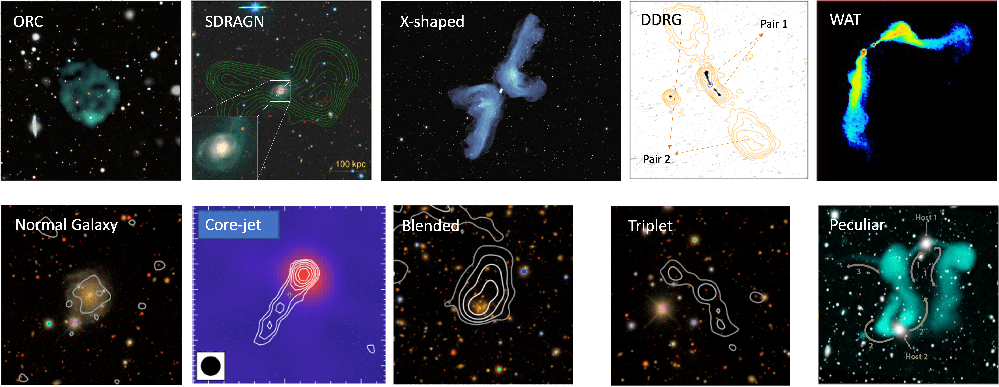
credit: SDRAGN: J1159+5820 from Gao+2023; X-shaped: PKS 2014-55 from Cotton+2022; DDRG: ILTJ115527.32+485039.0, a candidate from Mahatma+2019; WAT: VLA radio image of 3C 465; core-ject: object 3065 from Vardoulaki+2020; ORC and Peculiar: EMU radio images from Norris+2021; Radio emission from normal galaxies, Triplet and Blended come from real data of Radio Galaxy Zoo: EMU.
The 10 hashtags are:
-
Odd Radio Circle (#ORC): Odd Radio Circles (ORC) appear as circles that emit radio emissions. The first ORC was discovered by Dr Anna Kapinska in 2019 after looking at the pilot survey data of the EMU survey (same survey data YOU are looking at!). Several more ORCs have been discovered since then. Though several hypotheses have been proposed, none of them can explain the formation mechanism of all observed ORCs. A much larger sample of ORCs becomes necessary to examine these hypotheses or urge the foundation of a better ORC formation hypothesis.
-
Spiral host DRAGN (#spiral_host_dragn): Also known as SDRAGN. While gigantically elliptical galaxies host most radio galaxies, there are less than 50 candidate radio galaxies (at least 32 candidates were discovered with the help of RGZ volunteers; check out the discovery paper here!) whose host galaxies are spirals. A recent study claimed that most SDRAGNs are located at either poor galaxy clusters or galaxy groups, which suggests environment plays a significant role in SDRAGN formation. Future discovery of more SDRAGNs should help recover the complete picture of SDRAGN formation and evolution.
-
S/Z/X shaped radio galaxy (#S-X-Z-shaped): A radio galaxy's S, Z or X-shaped radio morphology usually implies the source has an unusual, perhaps turbulent past. The turbulence of the magnetic field, galaxy mergers, or even the re-triggering of active galactic nuclei might cause these unique radio morphologies. An X-shaped radio galaxy, for instance, may form because of (a) hydrodynamical backflows from the main jets of a source or (b) the reorientation of source jets. Future discovery of these objects should help find THE formation hypotheses of them.
-
Double-Double radio galaxy (#double-double): Double-Double Radio Galaxies (DDRG) are radio galaxies with two pairs of aligned radio lobes. It is believed that the radio emission of a typical DDRG is caused by having both of their remnant radio emission in the last active galaxy activity episode and its restarted radio jets visible in the radio waveband. Though recent studies suggest the formation of DDRGs may depend on intrinsic reasons (i.e.,stability of the galaxy accretion disk), further investigations are still necessary.
-
Wide/Narrow Angle Tailed (#WAT-NAT): Radio Galaxies with their jets bent that form either a C shape (Wide-Angle-Tailed) or U shape (Narrow-Angle-Tailed). Though the detailed source formation mechanism are still under investigation, there is a consensus that such distorted morphology may lie in the interaction between the radio galaxy itself and its surrounding dense Intracluster Medium (ICM). WATs and NATs are often seen as tracers of galaxy clusters.
-
Radio emission from normal galaxies (#traces_host_galaxy): The radio emission of a normal galaxy, including our Galaxy, is mainly synchrotron radiation from electrons with cosmic ray energies, diffusing throughout the galaxy and radiating as they are accelerated in a magnetic field. - An Introduction to Radio Astronomy Ch.13.1
-
Core-jet Structure (#core-jet): While the majority of radio galaxies have two-sided jets, some radio sources show a one-sided radio structure, known as core-jet radio sources.
-
Blended (#blended): A source with more than one infrared (IR) host associated with a radio peak or an island of radio emission. It can be associated with the whole radio structure, not only the peak of the radio emission.
-
Triplet radio source (#triple): A double source (pair of components) with an additional centrally located compact radio peak which is coincident with an infrared (IR) host. Radio emission can be separated or the IR host might be absent.
-
Peculiar Radio Source (#peculiar): Peculiar radio sources are generally radio objects with complex morphology that none of the source types mentioned earlier can adequately describe their profile. Thanks to the extraordinary data quality of EMU Pilot Survey, several objects of this kind have been discovered. However, a lot more of them are still waiting for your discovery!
5. I am not a native-English speaker. Is it possible to have a version written in my native language?
Answer: Possibly. Like LOFAR Galaxy Zoo, our team members come from various cultural backgrounds. We do have a translation plan to convert EMU Galaxy Zoo related articles into some other languages (i.e. Chinese, Urdu, Greek, German) and make them available to you soon. Alternatively, if you are happy to help out and translate them into your native language, please contact Hongming hongmingt@mail.tsinghua.edu.cn, and let's see what we can do together!
6. I would like to read previous RGZ blogs, where can I find them?
Answer: In case you're interested, we here list a number of blog posts related to Radio Galaxy Zoo, Radio Galaxy Zoo: LOFAR, and Gems of the Galaxy Zoos since late 2016. For more, please check out the Galaxy Zoo blog website.
Radio Galaxy Zoo
The Curious Lives of Radio Galaxies - Part I
The Curious Lives of Radio Galaxies - Part II
Radio Galaxy Zoo final sprint !
Radio Galaxy Zoo studies cluster environment impact on radio galaxy morphologies
Happy 5th birthday Radio Galaxy Zoo!
Radio Galaxy Zoo finds rare HyMoRS!
Shedding light on the mutual alignment of radio sources
RGZ team spotlight: Francesco de Gasperin
Can we reach 2 million classifications?
RGZ Team Spotlight: James Ansell
Happy 3rd birthday Radio Galaxy Zoo!
Radio Galaxy Zoo: LOFAR
Radio Galaxy Zoo: LOFAR – A short update
Radio Galaxy Zoo: LOFAR – The First Classification Results
Gems of the Galaxy Zoos
Zoo Gems – Hubble does Galaxy Zoo(s)