


Finished! Looks like this project is out of data at the moment!
Thank you for your efforts! We've completed the classification stage for this project! To browse other active projects that still need your classifications, check out zooniverse.org/projects.
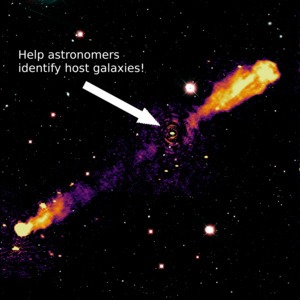
Help astronomers locate and identify supermassive black holes and starforming galaxies!
Learn moreYou can do real research by clicking to get started here!
Zooniverse Talk
Chat with the research team and other volunteers!
Radio Galaxy Zoo: LOFAR Statistics
View more statsAll Time Stats
Active Stats
Active stats provide information about currently active workflows and subjects.
Message from the researcher
Connect with the research team on Talk to learn more about this project!
About Radio Galaxy Zoo: LOFAR
The LOFAR project offers us an unprecedented view of what our skies look like at radio wavelengths. Never before have we been able to map such a large part of the radio sky at such high sensitivity. This allows scientists all over the world to answer many questions on the evolution of galaxies and the supermassive black holes that they harbour.
In order to prepare this new data for effective research, we first need to make an inventory of everything that we are seeing. The first data-set produced by the LOFAR survey contains about 350 thousand different sources, and the second data-set will contain more than four million. This means that scientists need to process an extremely large amount of data (the equivalent of about 10 million DVDs).
Much of this can be done automatically using sophisticated algorithms. But to date, we have yet to develop an algorithm that is better at identifying shapes than our very own human eyes. The most complex (and therefore interesting) objects still need to be identified by people. Because of the sheer amount of sources that need to be classified, it is not realistic for scientists to do this all on their own. That is where you and the team of Zooniverse volunteers come in!
Will you help astronomers sort through this fascinating, state of the art radio data? Who knows, maybe you’ll be the one to discover something new...

ESCAPE - The European Science Cluster of Astronomy & Particle Physics ESFRI Research Infrastructures has received funding from the European Union’s Horizon 2020 research and innovation programme under the Grant Agreement n° 824064.
We acknowledge support from the VIDI research programme with project number 639.042.729 (PI: van Weeren), which is financed by the Netherlands Organisation for Scientific Research (NWO)
For more on the LOFAR surveys see https://lofar-surveys.org/ . The acknowledgements related to the LOFAR Survey team can be accessed here
We kindly acknowledge the Legacy survey from which the optical images are taken. A full acknowlegement can be read here.