


Research
Exploring the Radio Sky
Welcome to Radio Galaxy Zoo EMU (RGZ EMU), the newest in a series of citizen science projects to study galaxies with strong radio emission. Since 2013, we have worked with over 12,000 citizen scientists to learn about these fascinating objects, and to take deep dives into some of the most interesting ones (e.g., a giant wide-angle-tail radio galaxy found unexpectedly in a poor cluster of galaxies). RGZ EMU uses images from the new Evolutionary Map of the Universe (EMU) survey, which started in December 2022 on the Australian SKA Pathfinder (ASKAP) telescope array. Eventually, EMU will detect over 40 million objects, so there’s a lot of work to do! Our starting point is the EMU Pilot Survey (Norris et al. 2021), and we will import new EMU data as time goes on 😃
The most powerful radio galaxies are powered by Super-Massive-Black-Holes in their centers, with a billion times the mass of the Sun. Jets of material spew out of these central regions at extremely high speeds, often in two opposite directions. They interact with the material surrounding the galaxy, and create a wide variety of interesting structures that teach us about the physical laws governing jet behaviour and the properties of the surrounding medium. RGZ EMU also contains a large number of Star-Forming Galaxies, whose radio emission extends over the same area as the starlight seen in the optical. The radio emission arises from all the supernova explosions and other processes accompanying the formation of its stars. Separating powerful radio galaxies from star-forming-galaxies is one of the major goals of RGZ EMU.
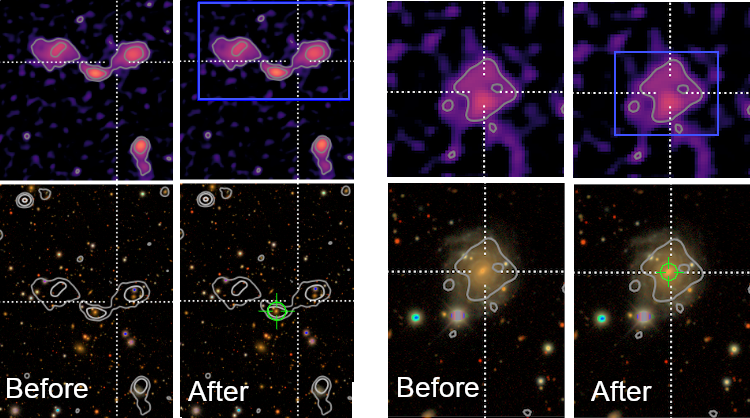
RGZ EMU contains radio pictures, that is, what the sky would look like if our eyes were sensitive to radio radiation. To highlight the regions of brightest radio emission we enclose them in contours, with more contours indicating increasingly brighter radio emission. The top row in the examples below, and when you are classifying, are the radio pictures. Other rows show optical or infrared pictures of the same area of sky, with the same radio contours superposed so you can see their relationship.
LEFT: A powerful radio galaxy in RGZ EMU before and after its citizen scientist markup. The blue box indicates that everything in it likely comes from the same galaxy, and the green marker indicates that likely host galaxy. Radio emission outside the box was judged to be completely unrelated.
RIGHT: A star-forming-galaxy in RGZ EMU, again, before and after the citizen scientist markup.
We need your help! Why?
What are we looking at?
Look at the first example above. There are four bright radio patches and numerous faint ones in the image. But which ones belong together, likely having originated from the same optical galaxy? The citizen scientist above indicated that the three bright patches near the top belonged together, and that the optical galaxy sitting on the center patch was the culprit! This is where we need human judgement to recognize what makes up a radio source and identify its origins. Then, we need you to provide some descriptions of what's in the box, so we can group similar objects together and test our physical models of how they form and evolve. For this purpose we'll ask you to choose appropriate tags - in this case bent and tail would probably be good tags.
To find the best set of tags, our team developed a new method that matched tags up with the questions astronomers ask about these sources. You can read about it in this press release, in a short paper outlining the method for the first time or the full astronomy article!
Hunting the Unexpected
Some of the most exciting results from our first Radio Galaxy Zoo were finding rare and unexpected radio galaxies (see, e.g., this list of unusual radio galaxies combining RGZ and Galaxy Zoo). Not only were these interesting in their own right, but they helped RGZ project scientists hone their own searches for these novel objects, and use them to train computer programs using deep learning to start finding them automatically. Here's some fun examples of rare objects that we found from our brief preparatory work for RGZ EMU (the same data you will be working on):
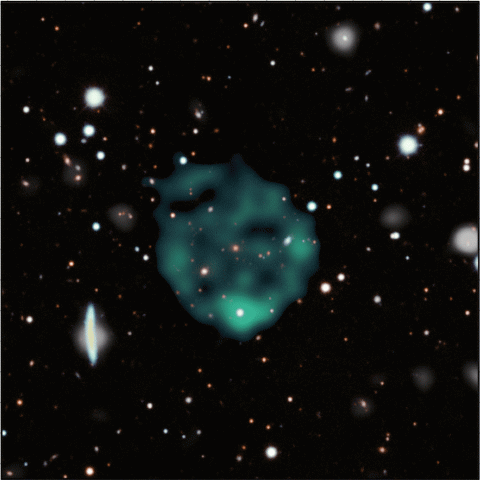
Odd Radio Circle (credit: Figure 25 of Norris et al. 2021). The origin of these objects is under hot debate!
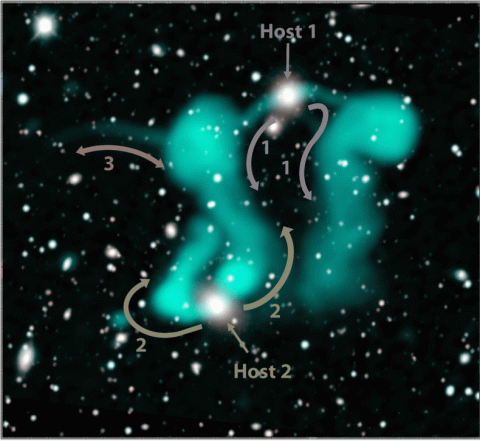
Peculiar Radio Source (credit: Figure 21 of Norris et al. 2021) a group of distorted radio components nicknamed “the dancing ghosts”. Curiously, there are two host galaxies at the centres of the narrow jets shooting out radio plasmas that are likely interacting with each other to give the unusual structure.
We really need you, our citizen-science collaborators, to continue making these important discoveries of unusual objects -- they have something new and important to teach us. Please chat with us via the RGZ EMU Talk forum and we can explore them together!
Getting started
Whether you’re new to Radio Galaxy Zoo, or an old-time hand, please view our tutorials. There’s enough new and different about Radio Galaxy Zoo: EMU that this will give you a good start.
When you start, the first step for each image you're given is called “Radio Galaxy Assembly / Host Identification,” in which you’ll indicate which patches of radio emission belong with each other, and which optical/infrared galaxy is the “host.” Then, the second step, called “Radio Galaxy Classification,” is where you’ll pick which descriptive tags are appropriate for each source. There are text-based tutorials associated with each of these steps. You can revisit them any time using the “Tutorial” button.
If at any time, you need to see some examples, or get tips, just press "Need some help with this task?" button, or open the Field Guide (far right in the classification window). And, by all means, if you find some objects that are quite different from all the other ones you’ve been looking at, things that just don’t fit any of the tags we’ve provided, please make use of the Talk feature, and we’ll take a look! You can also add your own #hashtag in the discussion, ( e.g. #SmileyFaceShaped) or use ones that others have mentioned; this helps us sort through all the discoveries.
In addition to our scientific investigations, RGZ EMU has an education and outreach program. Please check it out!
OK, welcome aboard! Get started by going back to the homepage and clicking Get Started. Thanks, and happy hunting!
This work uses data obtained from Inyarrimanha Ilgari Bundara/the Murchison Radio-astronomy Observatory. We acknowledge the Wajarri Yamaji People as the Traditional Owners and native title holders of the Observatory site. CSIRO’s ASKAP radio telescope is part of the Australia Telescope National Facility (https://ror.org/05qajvd42).