


Research
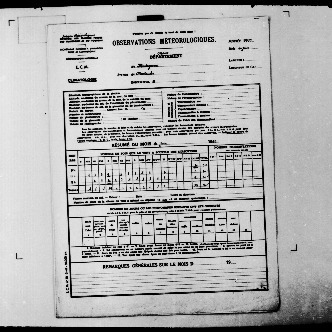
The ACMAD collection is a collection of c.4 million images of historical weather data from 43 African countries. Originally rescued by the Royal Meteorological Institute of Belgium (RMI) and the World Meteorological Organisation working in partnership with African Centre of Meteorological Applications for Development (ACMAD)in the late 1980s. These were imaged and saved onto microfilm and microfiches. Many of the original paper documents are believed to have been destroyed after this process and the microfilm and microfiche were feared to have degraded over time due to poor storage conditions. However, copies of the images were found on micro-film in a climate controlled cabinet in RMI. Further rescue efforts were carried out as priority in 2021 by the European Union's Copernicus Climate Change Service to save the images onto a tape archive, therefore preventing the data from being lost forever from the decaying film and fiche. The Copernicus Climate Change Service holds these data and has the agreement to rescue and make available these records to the research community. But first we need to catalogue and understand the quality of the images and this is where you come in.
Access to historical weather data is essential if we are to understand weather and climatic events of the past and constrain projections of the future. Globally there are billions of weather observations from the 18th, 19th and early 20th centuries that are still not available in machine readable format and are at risk of being lost forever. In places like Africa access to historical weather data is particularly poor with large parts of the continent having no available weather data at all currently available to researchers. Making historical data available from Africa will enable better understanding and certainty about how the climate is changing across the continent. It will also allow some of the most vulnerable people on the planet to climate change to better adapt to and prepare for the changes happening around them.

Before we start digitising the data we need to better catalogue the images. We need to confirm all the images that have the station name, month and year recorded on them. Without these pieces of information, the corresponding weather observations are of no value. We know from initial analysis that despite being provided with a list of all the station names and periods of record from each country in the collection, these are in many cases erroneous. Undertaking the task identifying station names and dates will allow us to find the stations that were left off the list. It will also allow us to rename the files which are currently random alphanumeric strings (e.g. FILM_MADAGASCAR_002_615.JPG) to station name and date (e.g. Andapa_June_1956.jpg) allowing a better cataloguing of the collection.
We also need to make sure that the images are of a suitable quality. We need to identify images with quality issues such as damage, poor contrast, and the most common issue darkness. The cause of many of these issues may have been caused by poor handling of the original forms, and damage to the microfilm which the images were saved on before being rescued and saved as digital images. Undertaking the task on image quality will allow us to tag images with quality indicators. This might be done via further modifying the image name e.g. Andapa_June_1956_Good_Quality.jpg.
This is where we need your help. By helping us to catalogue the collection we will be able to identify the images that are suitable for further data rescue projects, and those which are unsuitable and may need work done in order for their quality to be improved. Most importantly you will be contributing towards making weather data available for a region of the planet that is highly vulnerable to climate change.
The ACMAD collection will be made available via a Data Image Repository which is being built by the Copernicus Climate Change Service. This will be an open repository. For the repository holdings for ACMAD to be usable we need your help.