


Help catalogue vital meteorological data from across Africa as a vital step towards making it available for climate research.
Learn moreThere are two workflows to choose from. If you wish to name and date the forms click the first workflow. If you wish to help us identify poor quality images then click on the second workflow.
Zooniverse Talk
Chat with the research team and other volunteers!
Weather Archive Africa Statistics
View more statsAll Time Stats
Active Stats
Active stats provide information about currently active workflows and subjects.
Message from the researcher
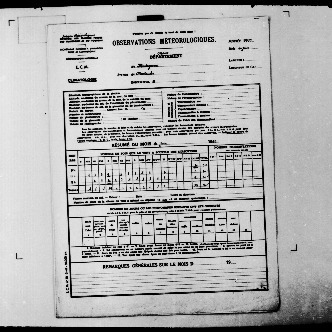
We need your help to catalogue and identify quality issues from millions of images of historical weather observations from across Africa. This will unlock the potential to then rescue these data and improve our understanding of climate change in Africa.
JP MonksAbout Weather Archive Africa
Access to historical weather data is crucial to our understanding of climate change in Africa. Compared to Europe and North America, Africa suffers from a sparsity of accessible climate and weather data. This means that climate research that is possible in other parts of the world is more difficult to complete. However we do have large amounts of African data that were originally written on old paper forms. The European Union’s Copernicus Climate Change Service recently reimaged these from images that had been saved to fiche and film which were rapidly degrading. The ICARUS climate research centre at Maynooth University and the Copernicus Climate Change Service are now interested in taking the next step for these to be digitised and used for essential research. The images being used in this project are taken from the ACMAD (African Centre of Meteorological Applications for Development) collection and are from stations from across 43 African countries.
We have two activities for you to complete as part of this project. Firstly we need to make sure the forms have the station name, date, and the actual data on it. Without these the data will be useless to researchers. Secondly we need to identify forms that have been damaged. Doing so can help us prioritise images that can be improved and also prioritise high quality images that can be digitised. By helping us to gather this information, you will be making a major contribution on the path towards understanding how the climate in one of the most vulnerable regions on the planet is changing.