


Finished! Looks like this project is out of data at the moment!
Research
Who are we?
Sagehen Creek Field Station is a research and teaching facility of the University of California at Berkeley. We are embedded within the Sagehen Experimental Forest, a 9000-acre headwater basin of the Truckee River, located north of Truckee, CA in the central Sierra Nevada.
Sagehen was started in 1951 specifically for fisheries and wildlife studies. Today, our research and education portfolio has expanded to include kid's programs, art, hydrology, forest health and much more, but wildlife biology is still a big emphasis here.
Much of what we know about wild trout was learned at Sagehen in the 1950's and 1960's. American marten have been studied and monitored in the basin since 1979; in fact, the first wolverine documented in California since 1922 showed up on a marten researcher's camera trap at Sagehen in 2008, and he has been photographed by camera traps in the area every year since. The Highway-89 Stewardship Team is using camera traps to discover how wildlife interacts with the highway that runs through the lower Sagehen basin. Researchers from the University of Nevada - Reno have studied cognition in Mountain Chickadees at Sagehen for over 20 years, discovering some amazing things about bird brains. Biologists have been tracking migratory bird productivity and survivorship at Sagehen since 1992, and monitoring bird response to the catastrophic Donner Ridge fire since 1960. And an iNaturalist volunteer documented the first otter ever recorded in the basin just last year...after almost 70 years of people looking in every corner of the basin. Amazing what's still out there, waiting to be uncovered!

The American Marten is a long-studied indicator species at Sagehen that lets us know how the system is doing: since the martens are at the top of the food chain, if they are happy that means that a lot of other things must be, too. You might even find one of these cute little guys in the photos.
You could help us make the next big discovery!
After you identify what's in the pictures, we can use a special algorithm with these un-baited camera trap photos to get population estimates of various wildlife species over time, learning how they use the landscape and how their populations respond to forest health treatments. We are expecting wildlife to benefit greatly--that's one of the big goals of our Sagehen Forest Project!

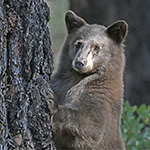
A nosy black bear checks out a camera trap at Sagehen.