


Finished! Looks like this project is out of data at the moment!
Research
Greater Sage-grouse Conservation and Behavior
Greater Sage-grouse: Umbrella species of the Western United States

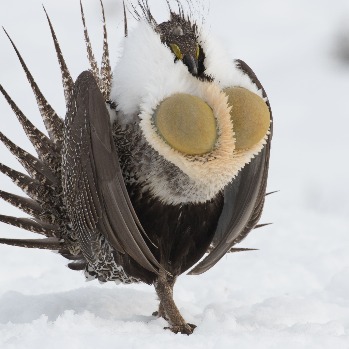
Greater sage-grouse are an important member of the fragile sage steppe ecosystem. Conservation of this species in sagebrush areas lends itself to the conservation of 350+ other species that share this habitat (including pronghorn, sage thrashers, and pygmy rabbits), thus earning the greater sage-grouse the label "umbrella species". The greater sage-grouse is a sage-brush obligate species, meaning that it depends on sagebrush for its diet, breeding locations (leks) and nesting habitat.
Our camera trap project will collect data on what times males attend leks, the areas on which males display in order to attract females. Females will mate with males here and then nest nearby. Understanding how the birds use leks will give scientists and conservation managers from agencies such as the Bureau for Land Management, a better idea of a) how many males are present on the lek throughout the season, b) what times of the season have the highest attendance, and c) what times of day have the highest attendance.
Camera Trap Research

We are using camera traps to monitor and collect data in California's Eastern Sierra. Cameras are deployed on grouse leks. The grouse in this area are part of the genetically distinct Bi-State Population. By monitoring the birds on their lekking grounds, we will collect information about what areas the birds use and when they use them. Previous studies (including those from our own research group, see Results tab) with similar methods have shown that the birds do not just occupy the lek during peak display hours (around dawn), but rather may return throughout the day and even throughout the night. This behavior may be important in conservation efforts as it gives managers a better idea of the greater sage-grouse's needs during a critical period of their life history. Further, the data collected from this project may serve as a jumping off point for more questions regarding lek breeding behaviors not only in sage-grouse but many other species with similar breeding strategies.
Community and Citizen Science in the Eastern Sierra
Our camera traps also play a role in a citizen science project involving community members in the Eastern Sierra, primarily high school students. Students are responsible for deploying cameras and using Zooniverse to classify data.
In the winter and spring of 2017, we started this project in the Long Valley area working with students from the surrounding area. The project was used as a case study for researchers from UC Davis's Youth-focused Community and Citizen Science program
This project aims to allow students to gain environmental science agency. In the spring of 2017, we started this project in Long Valley.
Students have also joined graduate student researchers in the field. In the next year, students will also be able to conduct their own research projects alongside graduate student researchers and agency wildlife biologists. Stay tuned for more updates!

More Grouse Research in the Patricelli Lab
Biomarkers of sage-grouse health and habitat, performance on the lek and landscape level conservation

Eric Tymstra, PhD candidate and the lead researcher on the camera trap project, is investigating the role of dietary quality on male performance on the lek. He observes males on the lek every day during the field season and then collects fecal (poop!) and vegetation samples to compare dietary quality and stress hormones to on-lek performance. This work is being done in collaboration with Professor Jennifer Forbey from Boise State University, and her graduate student Chelsea Merriman, as well as Dr. Peter Coates from the U.S. Geological Survey and his research group.
This will provide Eric, and conservation managers, with data on how sagebrush quality affects population dynamics of sage-grouse.
Impact of Noise on Sage-grouse
Sage-grouse habitat overlaps extensively with land used by humans for energy, agriculture and settlement. As such, sage-grouse are increasingly exposed to anthropogenic noise (noise pollution). Sage-grouse, and many other species, rely on acoustic communication to court mates and thus may be particularly vulnerable to noise pollution. The Patricelli lab, with former graduate student Dr. Jessica Blickley, investigated the effects of noise from energy-development on sage-grouse breeding behaviors. The lab found a decline in male attendance on leks exposed to experimental energy-development noise, as well as evidence of increased stress and altered behaviors. To read more about noise effects on sage-grouse and other species, visit the lab's website.
Attack of the Fembots: Social Landscapes and Mate Choice

The Patricelli Lab at UC Davis is involved in animal behavior research. In winter and spring, Professor Patricelli and research scientist Dr. Alan Krakauer, along with UC Davis graduate students, travel to the field to study the mating behaviors of greater sage-grouse. Dr. Patricelli is known for using "fembots" in her research. These robots, made from taxidermied females that died from vehicle strikes or natural causes, allow researchers to manipulate the social environment that birds experience. Alan Krakauer has played a critical role in all the research in the lab, including investigations of sound production mechanisms and "handedness" in male displays. Dr. Anna Perry, who recently finished her PhD in the lab, used fembots to manipulate male social stimulus and measured male responses. Ryane Logsdon, a current PhD student in the lab, has used the fembots to investigate the role of the physical structure of the lek in the social environment of the lek.
If you have more questions, feel free to contact Eric at eftymstra@ucdavis.edu.