


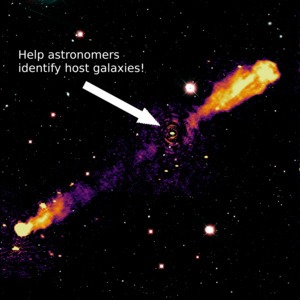
Abgeschlossen! Für dieses Projekt gibt es im Moment keine Daten mehr!
Thank you for your efforts! We've completed the classification stage for this project! To browse other active projects that still need your classifications, check out zooniverse.org/projects.
Das Team
Erik Osinga (Project Manager)

I am a last-year PhD candidate at the University of Leiden. I am mainly interested in galaxy clusters, which are giant groups of galaxies that form the largest gravitationally bound objects in the Universe. To study galaxy clusters successfully, it is important to know which radio sources belong to a cluster and which ones do not. We can only associate a radio source to a galaxy cluster if we know their distance and to calculate the distance of the radio sources, we need to observe the galaxy that hosts the radio source. This is why finding the optical counterpart of the radio sources is critical!
Martin Hardcastle (Project Scientist)

I'm Professor of Astrophysics at the University of Hertfordshire in the UK, and work mostly on radio-loud active galaxies, where the radio emission is due to powerful jets coming from close to a galaxy's central black hole. These interact with the environment to make complex structures, many of which you'll see in this project. By creating large samples of active galaxies we can assess what effect they have on their environment and how they evolve over cosmic time.
Hugh Dickinson

I'm a postdoctoral researcher working at the Open University in the UK. Over the years I've worked on all sorts of topics related to astrophysics. I started off searching for elusive Very High Energy (VHE) gamma-ray emission from X-ray binaries, which sometimes look a bit like scaled-down versions of the radio galaxies this project focusses on. Later, I investigated the VHE emission from active galaxies with jets that point straight towards us, which we call Blazars. Nowadays, I research how star formation in galaxies proceeded at different stages in the history of the Universe.
Jonny Pierce

I work as a postdoctoral research fellow in astronomy at the University of Hertfordshire (UK). My main research interest is investigating the general properties of active galactic nuclei (AGN) with radio-emitting jets, with a particular focus on the more poorly understood lower-luminosity objects that make up the majority of the population. Using optical images to identify large samples of galaxies that host these radio AGN is vital for advancing our knowledge in this area, and your classifications will help us to do this!
Rafaël Mostert

As a PhD student at Leiden University & ASTRON, I try to find physically distinct radio galaxy populations by clustering radio galaxies based on their morphology. Studying different populations can give us insight into the different stages within a galaxy's life-cycle.
In order to do proper clustering, it is essential to have correctly associated radio components.
Roland Timmerman

I am a PhD student at the Leiden Observatory. I've been working with radio observations throughout my education and current career. At the moment, I am using LOFAR observations to study the feedback processes between galaxy clusters and the supermassive black holes within them. This feedback is believed to be essential to our understanding of how galaxy clusters form and evolve, but there are still many open questions.
Valentina Missaglia

I am currently a PhD student at the University of Turin, Italy. My research project focuses on the analysis of radio-loud active galaxies as seen in LOFAR. In particular, I am interested in radio sources with bent jets (i.e., the so called wide-angle tail radio galaxies, WATs). As part of this project, you will see many of this peculiar sources with low luminosity tails that only LOFAR can detect! Associating the components correlated with the radio source will help us to have a better idea of the extension of these sources.
Błażej Nikiel-Wroczyński

I work as an Assistant Professor of Astronomy at the Jagiellonian University in Kraków, Poland.
As an astrophysicist, I mostly seek radio-emitting, compact galaxy groups, and other, low-quantity
systems of interacting galaxies. Galaxy groups are very common in the Universe, yet our knowledge
about their emission at radio wavelengths is rather scarce. Extending it can only be done by the means
of analysis of a large sample of such objects, and looking for common and uncommon features of the ones
included in.
Aleksander Kurek

I got my PhD degree in 2017 at the Jagiellonian University. Since then
I work at LOFARs PL611 station maintaining the software and reasearching
pulsars and galaxies.
Stanislaw Ryś

I've been a doctor of astronomy since 1991. I took part in the GB3 survey data reduction and worked on models of asymmetry observed in double radio structures. Currently I am working on data reduction of the Torun Polarimetric Survey (ToPoS).
Isabella Prandoni

I'm a senior astronomer at the Radioastronomy Institute (INAF) in Italy. I mostly work with deep radio surveys, like the LOFAR survey you are dealing with right now. In particular I'm interested in better understanding the physics and cosmic evolution of active galactic nuclei and star-forming galaxies. With your help we will be able to associate the radio emission to a host galaxy and get a better view of the mechanisms responsible for such emission: stars or super-massive black holes.
John Quinn

I am an Associate Professor of Physics at University College Dublin where I conduct research in High-Energy Astrophysics. I am primarily a gamma-ray astronomer and have just recently started to do radio astronomy with LOFAR. My research focuses on a subset of Active Galaxies known as Blazars, which are believed to be galaxies, powered by supermassive black holes, with powerful jets pointed towards the Earth. There are many unanswered questions about how Active Galaxies form and evolve, and this project will provide us with important pieces of the puzzle.
Sean Mooney

Sean is in the final year of his PhD in astrophysics at University College Dublin. Radio galaxies come in all shapes and sizes, and Sean's research has focused on trying to understand why this is. Your clicks help shed light on this question.
Francesco de Gasperin

I am a Junior Professor at the Observatory of the Hamburg University. My research is mainly based on developing and exploiting new technologies in radio-astronomy to study active galactic nuclei (AGN), galaxy clusters, galaxies and ultimately everything which emits radio waves. I am specialized in the observations at ultra-low frequencies (<100 MHz), the longest wavelengths that we can observe from ground based telescopes.
Marcus Brüggen

I am Professor of Astrophysics at the University of Hamburg in Germany. I specialise in high-energy astrophysics and astrophysical fluid dynamics. I have been involved in LOFAR right from the start and I am looking for strange radio sources in the sky that are related to galaxy clusters. I am also interested in data science and the possibilities to harness artificial intelligence for applications in astronomy.
Nitesh Bhardwaj

Hi, my name is Nitesh Bhardwaj and I am pursuing my doctorate at the University of Bielefeld. My research includes working with LOFAR data with current focus on identifying instrumental effects and systematics in order to make the present as well as future LOFAR observations more suitable for cosmological analysis.
Thilo Siewert

Thilo Siewert is a PhD Student at Bielefeld University and works on cosmological measurements of the LOFAR Two-Metre Sky Survey.
Dominik Schwarz

Dominik Schwarz is a cosmologist at Bielefeld University and is interested to use Radio Galaxy Zoo results as a basis for tracing the evolution of the large scale structure of the Universe.
Matthias Hoeft and Alexander Drabent

We are the LOFAR science group at the Thuringian State Observatory (TLS) in Tautenburg, Germany. The Tautenburg station (DE603) was among the first built
international LOFAR stations. We lead the data processing for LOFAR at the Forschungszentrum Jülich (North Rhine-Westphalia, Germany), using the on-site supercomputing facilities. Currently, more than 15 PB of LOFAR data is stored at the data archive in Jülich. Our research is focused on the particle acceleration mechanisms that cause radio emission in clusters of galaxies.
Virginia Cuciti

I am a postdoctoral researcher at the University of Hamburg. My research activity is mainly focused on galaxy clusters. I am particularly interested in diffuse radio sources, such as radio halos or relics. These sources can be as large as millions of light years and they are associated with the hot gas permeating the cluster. They arise as a consequence of mergers between clusters, which are the most energetic event happening in the Universe after the Big Bang.
Marek Jamrozy

I work at the Jagiellonian University in Kraków, Poland. My interests are focused on active galaxies, radio galaxies and their evolution, as well as high energy astrophysics.
Cyril Tasse, Etienne Bonnassieux, Nicole Nesvadba, Herve Dole
Acknowledgements
ESCAPE - The European Science Cluster of Astronomy & Particle Physics ESFRI Research Infrastructures has received funding from the European Union’s Horizon 2020 research and innovation programme under the Grant Agreement n° 824064.
We acknowledge support from the VIDI research programme with project number 639.042.729 (PI: van Weeren), which is financed by the Netherlands Organisation for Scientific Research (NWO)
The acknowledgements related to the LOFAR-survey team can be accessed here
We kindly acknowledge the Legacy survey from which the optical images are taken. A full acknowlegement can be read here.
We thank Simin Tong and Yinhao Wu for the translation of the project to Chinese.




- katurs@katurs

- katurs@katurs