


Finished! Looks like this project is out of data at the moment!
WOW - thank you so much to our AMAZING volunteers. This project's classification effort is complete! To browse other active projects that still need your classifications, check out zooniverse.org/projects
Research
Cross-habitat subsidies are essential to the function of ecosystems (Leroux and Loreau, 2008). Subsidies are a flow of nutrients and energy from one system to another that influences the dynamics of the system where they are received. People often think of these subsidies moving only in one direction, for example focusing on how aquatic ecosystems are supported by inputs from their catchments (the land around them). This makes sense: rain or snow falling on the land eventually flows into the water, bringing dissolved nutrients and pieces of material with it (Johnson et al., 2009). At moderate levels, these subsidies support the plants and algae that provide a strong base for aquatic food webs. When they increase, though, terrestrial subsidies can contribute to eutrophication or the oversupply of nutrients that causes pollution, overgrowth, and damage to aquatic systems (Caires et al., 2013).
In the past several decades, however, we have begun to understand that terrestrial environments also receive reciprocal subsidies from adjacent bodies of water! (Gratton et al., 2008; Nakano and Murakami, 2001; Schindler and Smits, 2017; Vander Zanden and Gratton, 2011). These lake-to-land subsidies 'repackage' nutrients from other parts of the watershed into dense, easy-to-digest forms (Bartels et al., 2012), and especially in low-productivity alpine regions, they can be a major part of the support to terrestrial systems (Nakano and Murakami, 2001) despite being relatively low in volume.
These subsidies are carried by insects like flies, dragonflies, beetles, and others whose young stages eat in the lake, but whose emergent adult stages are airborne and travel onto the land. One review showed that over 95% of emerging insect biomass does not return to streams, but remains in the terrestrial system (Wesner et al., 2019). These insects that swarm and die over land are a crucial food resource for terrestrial predators (Epanchin et al., 2010), and also directly support primary and secondary terrestrial production near the shore by enriching soil (Dreyer et al., 2012; Piovia-Scott et al., 2016). Aquatic subsidies can even alter the interactions between herbivores and terrestrial plants (Bultman et al., 2014; Graf et al., 2017; Yang, 2008) and affect the health of terrestrial predators (Fritz et al., 2017).
We want to understand how multiple, interacting stressors might be affecting this important link between lakes and the land around them. The stressors in our study are global (climate change) and local (introduction of predatory fish). Both these factors can impact subsidies on their own, but it's not well understood how they might work together. We studied this question by collecting samples from lakes both with and without introduced predatory fish, across a gradient of temperatures and elevations in California's Sierra Nevada mountains.
The predatory fish present in lakes in the Sierra Nevada mountain range are primarily golden and rainbow trout, and were introduced for recreational purposes over the past century via ground transport from hatcheries or by airplanes dropping trout fingerlings over the lakes. Our sticky trap cards were placed around lakes both with and without predatory fish, along 50m transects, or straight lines, leading away from the lakeshore. We also selected lakes at a range of elevations (10,000-11,500 ft) whose different temperatures can give us a clue of what may happen under future climate scenarios.
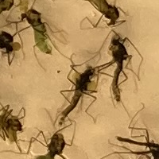
Our sticky card traps are intended to catch emerging aquatic insects so we can understand if there is a difference between insect populations between cold and warm lakes, with and without fish. We're asking for your help to figure out how many insects, and what kind of insects, were coming out of each of our lakes - and how far they travel from the shore during each season so we can measure and quantify the impacts of introduced trout. Thanks so much for helping us answer these important questions!