


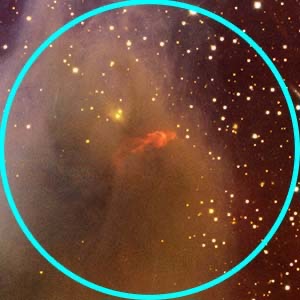
Finished! Looks like this project is out of data at the moment!
Thank you to everyone who came to our talk on July 20th, 2026! If you missed it you can watch the recording here.
Research
How (and Where) Do Stars Form?
Stars, and the planets that orbit around them, form inside giant clouds of gas known as "molecular clouds." Our team is studying how stars form in several molecular clouds that are relatively nearby our solar system.

The two images above show an accurate artist's conception of the layout of our galaxy, the Milky Way. This image was created by the careful mapping of stars, dust, and gas inside our galaxy. The Milky Way is a barred spiral galaxy, dominated by two large spiral arms– the Scutum-Centaurus and Perseus Arms. Our Sun is located in a smaller arm known as the Orion Spur (marked with a green arrow in the image on the left, and zoomed in on the right). Notice that there are many dark clouds of gas near the Sun, in the Orion Spur and other spiral arms. These are the molecular clouds where stars are forming. They look dark because of dust in the clouds that blocks starlight. We are searching many of these molecular clouds looking for stars that are forming right now.
What are Herbig-Haro Objects?

This is an image of NGC 1333, a nebula inside of which new stars are forming. It is part of the Perseus molecular cloud, so named because it is seen in the direction of the constellation of Perseus. Look closely at the image. Notice the deep-red blobs. These are called "Herbig-Haro" (HH) objects, named after the two astronomers who first studied them. These are the objects we're looking for. Let's zoom in and take a closer look.

Some of the HH objects– like the ones near the bottom of the image– are distorted but in a straight line. Notice that they have complicated shapes. Others are diffuse, looking like wisps of smoke. What's going on here?

HH objects are produced by jets of gas coming from "protostars" that are forming inside the nebula. The picture on the left is an artist's conception of what it looks like. The protostar itself is usually embedded inside a dusty nebula and can't be seen. But the jets can break out of the nebula and extend far beyond it. The image on the right shows a real HH object– HH34– which is located in the Orion Nebula. You can see one of the jets, which is the red line extending down from the protostar at the center. (There is also likely another jet above it, but it is obscured by dust.) Notice that you can also see two "shocks" that look like semicircles at the top and bottom of the image. These occur where the jet collides with the gas surrounding it. These are also HH objects. Their complex shapes depend not only on the speed and energy of the jet but also the size and density of the gas cloud surrounding it. What's important about HH objects is that they are proof that protostars are forming in the nebula, even if we can't see them directly.
How do we make color images?
To create the color images you'll study, we took pictures of each nebula with three filters: g-band, i-band, and hydrogen-alpha (N662). The g-band filter shows the range of light that our eyes would see as green or blue. The i-band filter shows a range of light that our eyes can't see, known as "near infrared". Hydrogen Alpha is a "narrowband" filter designed to the pass the red light produced by warm hydrogen gas. (More about the filters can be learned here). To make the final color image, the g-band image is made blue, the i-band is made yellow, and the hydrogen alpha is made red. They are then added together. Here is an example for the HH object HH417:

Notice that the stars are visible in all three images, but the HH object can only be seen in the hydrogen-alpha (red) image. This makes it deep red in the final color image.
How do we find Herbig-Haro objects?
What's important about how our images are made is that HH objects will look deep red. Thus, if it is not deep red that means it cannot be a Herbig-Haro object. Let's look at another example.
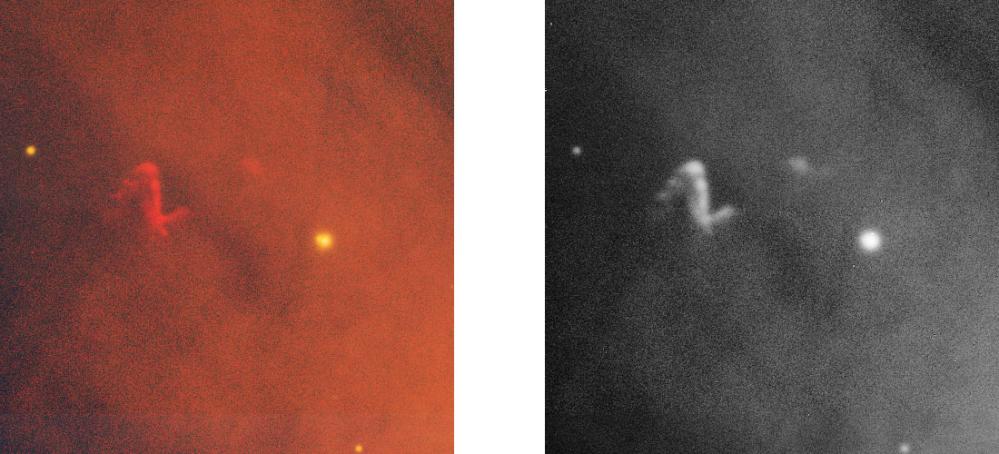
This is an image of HH79. It has two parts– the Z shape and the fainter blob just to the right of it. The deep red color again comes from heated hydrogen gas inside it. But many objects in the universe produce this light. So to be sure they are indeed HH objects we also take images using a special "Sulphur II" filter, usually written as [SII]. The black and white image on the right was taken with this filter. While sulphur atoms are not as common as hydrogen in space, they glow when a protostar's jet slams into them, producing a shock. If we see an object that is deep red in the color image and it appears in the [SII] image, then we can be sure it is an HH object. Even though they also appear in the [SII] image, the orange objects in the color image are stars, not HH objects.
The Dark Energy Camera
HH objects are hard to find. In fact, only about a thousand of them have been discovered! Why is that? They are usually very faint, meaning we need large telescopes to see them. Historically, big telescopes were built to "zoom in" and show only a very small area of the sky. The molecular clouds in which protostars are forming are usually very big, some over a hundred light years across. So it was hard to search these large molecular clouds using big telescopes. But that changed with the construction of the Dark Energy Camera, which is installed on the Blanco 4-meter telescope at Cerro Tololo Interamerican Observatory.

The image on the left shows DECam mounted atop the Blanco telescope. Weighing around 4 tons, it is one of the largest cameras ever built! The images it produces are huge too, about 520 million pixels (or "megapixels"). The image on the right shows one of the color images produced with DECam for our project. It shows an area of the sky about 14 times the size of a full moon. Because they have so many pixels, each image produced by DECam is divided into about 2000 smaller "cutout" images, which are the ones you'll explore. The green square in the image on the right shows how big the cutouts are. The two images above of HH79 are examples of cutouts. Many of these images have not yet been looked at, so you may be the first to discover new HH objects in them. Have fun!