


Finished! Looks like this project is out of data at the moment!
Thank you to everyone who came to our talk on July 20th, 2026! If you missed it you can watch the recording here.
FAQ
Frequently Asked Questions
What is the task I have been asked to do?
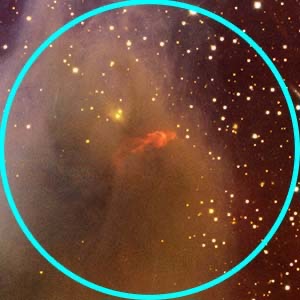
You will be looking for Herbig-Haro objects in images taken with the Dark Energy Camera on the Blanco 4-meter telescope. You will be presented with two images: a color image and a black and white image taken with a special "Sulphur II" filter. You are looking for objects that are deep red in the color image and are also visible in the black and white image. If you find an object you will mark the location and size of the object in the image.
How do I know if it really is a Herbig-Haro object?
There are many things you will see in the images that are either not real (i.e., they are defects in the image) or they are real but not Herbig-Haro objects. Please do the tutorial and look at the field guide to see examples of real and bogus objects.
What if I get it "wrong"?
No worries! These images will be seen by many different people, so don't worry if you think you have made a mistake or aren't completely sure. When in doubt about an object, mark its location and we'll look closer at it.
Why do you need my help? Can't a computer do this?
Perhaps because of our history as hunter-gatherers, the human brain is effective at detecting distinct objects in complex environments. Currently AI and other software are not able to discover HH objects nearly as effectively as people can. In particular software is more fallible to "false positives", where artifacts (described in the tutorial and field guide) are mistakenly labeled as real. It takes more time to check the false positives than it is worth.
Why are the "sulphur two" images black and white?
To make a color image we need to use two or more filters. The black and white images are made using only the sulphur two [SII] filter.
Why are some of the images partially or completely black?
Each image you look at is a cutout from a larger image that looks something like this:

Notice that the edges of the image have an unusual jagged shape. In a perfect world the image would be a circle, but the light-detecting parts of the camera (known as the CCDs) are rectangular. They are stacked together like tiles are mosaicked in, say, a bathroom floor. Notice that two CCDs (i.e., tiles) are missing– one along the left edge and one on the bottom. These two CCDs are broken in the camera.
Each "cutout" image that you look at is a tiny portion of this larger image– the size of a cutout is shown in the image above as a green square. There are about 2000 cutouts from each large image. When the cutout images are made they are sometimes extracted from the edge of the image, or where a CCD "tile" is missing. These cutouts therefore can look partially or completely black.
What happens if I find a Herbig-Haro object?
If enough people identify something as possibly being a Herbig-Haro object, it will be sent to our team to confirm.
How will I be credited for my discoveries?
We have compiled a list of Zooniverse explorers who completed 10 or more identifications. They are listed on the results page. While we cannot include the list in the publications themselves, an acknowledgement with a link to this page will be included in every paper that uses the results from this project.
Who found the most Herbig-Haro objects? Can you tell me which ones I found?
We don't wish to identify who found which HH objects first, as it is mostly a matter of luck. Instead we followed up on the fields where three or more people said that they saw an HH object. Many of these were no HH objects (in fact 169 were new!) and in some fields were HH objects that were already known. The goal here was to do as thorough a job we all could to ensure we found everything we could, so that means not finding an HH object in an image is just as important as finding one.
Who completed the most classifications?
To discourage people from racing through the images, we didn't keep stats on who searched how many images. Again the goal here is to carefully look at all the images and make sure there is or isn't an HH object visible.
Is it possible to get a Herbig-Haro object named after myself?
The International Astronomical Union (IAU), the governing body of astronomy that is responsible for names, doesn't assign individual names to objects outside of the solar system. So we are unable to assign personalized names to HH objects. This also means that any services that claim to be able to name a star (or any other celestial object) after you is a scam. These names are not recognized by the IAU or professional astronomers.
Will there be more data?
Unfortunately at this time we do not have any scheduled observations to obtain more data for this project. If we do resume observations we will let you know! We hope to continue this project but we may not be able to do so. The telescope we use is funded by the U.S. National Science Foundation (NSF), and as of June 2025 the presidential budget request calls for deep cuts to funding to the NSF. If approved by congress it could mean that the telescope we use for this project will likely be closed. If you would like for projects like these to continue, please ask congress to support astronomy! This link will describe how U.S. citizens can ask their representatives to support funding for NASA and the NSF, the two primary funders of astronomy research in the U.S.
Can I find out where in the sky an object is?
While we fully understand that some of you would like to do external checks using astronomical catalogs, our data are proprietary and we don't want to get "scooped" by other groups using our data. The coordinates will be provided in the final publications.
Where can I see images of the star-forming regions we searched?
Links to these images are included in the results section.
Why are they called Herbig-Haro objects?
They are named after the astronomers George Herbig and Guillermo Haro, who were the first to study these objects.