


Finished! Looks like this project is out of data at the moment!
25/04/23: We're thrilled to present our first set of publications based on your classifications! A HUGE thank you to everyone who got involved with the project and for all your efforts! You can find out more about these first results on our results page.
Results
First results from the Cosmological Jellyfish project
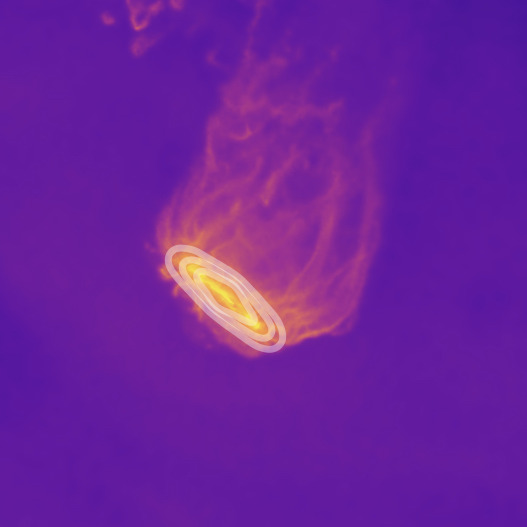
Thanks to the efforts of our dedicated volunteers, we now have nearly 90000 images classified! Of these, over 5000 were classified as jellyfish galaxies, providing us a sample covering an unprecedented range of masses, found in a wide range of environments and across many epochs.
The first set of publications using these results were released in April, 2023. Here's what we have found so far:
-
Jellyfish galaxies with the IllustrisTNG simulations -- Citizen-science results towards large distances, low-mass hosts, and high redshifts
Zinger, Elad; Joshi, Gandhali; Pillepich, Annalisa; Rohr, Eric; Nelson, Dylan
This is our flagship paper describing the project and the process of aggregating your classifications into robust results. With these results, not only were we able to find an unprecedented sample of jellyfish galaxies, we were also able to highlight jellyfish galaxies in three regimes that are so far relatively unexplored: i) In low mass host groups and clusters and ii) at large distances from the hosts, where ram-pressure stripping is expected to be much weaker; and iii) at early times in the age of the Universe, where galaxies in general are more difficult to observe. Although most of the jellyfish galaxies were indeed found at late times and close to the centres of massive hosts, we show that these under-explored regimes may also be important in understanding the formation of jellyfish galaxies. -
Jellyfish galaxies with the IllustrisTNG simulations -- When, where, and for how long does ram pressure stripping of cold gas occur?
Rohr, Eric; Pillepich, Annalisa; Nelson, Dylan; Zinger, Elad; Joshi, Gandhali; Ayromlou, Mohommadreza
The images that were classified in this project often included the same galaxy, imaged at different times during its history. In this paper, we identify over 500 unique galaxies that went through a jellyfish phase for some part of their history and follow their evolution before and after they became part of their host clusters. This allows us to answer the questions -- when and from how far away does ram-pressure stripping begin to act on these galaxies in such environments, how long does it last, and what happens to the cold gas in the jellyfish galaxies, which is the fuel for star-formation. We find that stripping can occur for long periods of time, up to 1.5-8 Gyrs, and can result in a lot of cold gas being deposited into the host clusters. -
Jellyfish galaxies with the IllustrisTNG simulations -- No enhanced population-wide star formation according to TNG50
Göller, Junia; Joshi, Gandhali; Rohr, Eric; Zinger, Elad; Pillepich, Annalisa
While ram-pressure stripping is expected to remove gas from jellyfish galaxies thus depleting them of the fuel for star-formation, it is also possible that for short periods of time, the increased pressure can actually compress the gas in these galaxies resulting in bursts of star-formation. In this paper, we explore whether jellyfish galaxies show enhanced rates of star-formation both at the population-wide level and at an individual level. We find that while there is no such enhancement for the jellyfish galaxy sample as a whole, individual galaxies can indeed show incredible starbursts during their orbits within their host clusters. Moreover, we also show that the gas that is stripped and found in the tails of the jellyfish galaxies typically does not produce stars, although we do find a handful of galaxies that are exceptions to this trend.