


Finished! Looks like this project is out of data at the moment!
25/04/23: We're thrilled to present our first set of publications based on your classifications! A HUGE thank you to everyone who got involved with the project and for all your efforts! You can find out more about these first results on our results page.
FAQ
The science behind Jellyfish galaxies:
Why study Jellyfish galaxies at all?
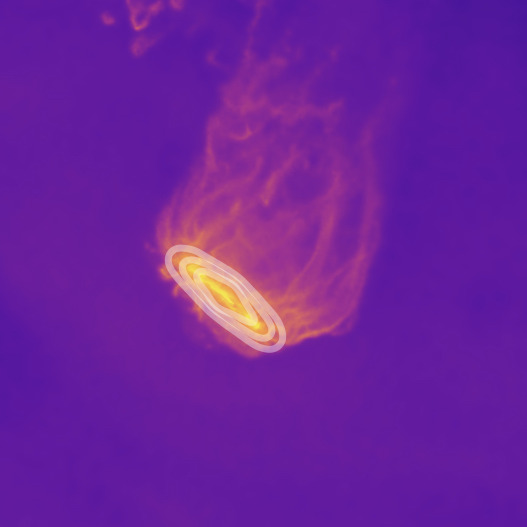
Galaxies are often found in large groups called galaxy clusters. Such clusters are typically filled with very thin gas, and astronomers have long assumed that when galaxies move within such a cluster, the thin gas can make them feel a "headwind". A bit over ten years ago, astronomers first observed what was later named a "jellyfish galaxy": a galaxy that has been subjected to intergalactic headwinds so strong that most of its gas is now streaming behind it – in the same way that long hair, or a scarf, might stream behind a person riding a bike or motorbike. Jellyfish galaxies are rare, but by now, large surveys have managed to observe more than a dozen examples.
We'd love to learn more about these galaxies. But it is only in the last decade or so that computer simulations of cosmic evolution have become detailed enough to show us what happens when jellyfish galaxies form (see the Research section if you want to learn more). So it is only now that we are able to study in detail the formation of jellyfish galaxies – and that is where we need your help!
Why classify simulations and not observations?
Both can and are done within the astronomical community, and both are necessary to understand the workings of the Universe. But for our group, the most exciting classifications right now concern our simulations. Simulations can overcome some of the challenges that affect astronomical observations. For example, the evolution of galaxies that we study occurs over hundreds of millions or even billions of years, which means it's impossible to observe a single galaxy undergoing this transformation. That is not a problem for simulations, where we know all the information about the galaxy and its surroundings over time, and can therefore understand how it evolves and becomes the type of galaxy that is observed in the Universe.
Computer simulations of cosmic evolution have only become powerful enough to include comparatively small details, like streaming gas in jellyfish galaxies, in the last decade or so. One of the largest and most detailed of these simulations is one that our group is involved in, called IllustrisTNG. In our simulation, we created a virtual universe following the same laws of physics as our own cosmos. In this virtual universe, stars and galaxies form, and interact. But before we can examine what our simulation tells us about the evolution of jellyfish galaxies, we need to identify which of the thousands of galaxies in our virtual universe are jellyfish galaxies in the first place! That is where we need your help. Once we know which are the jellyfish galaxies in our simulation, we'll take a closer look and find out how they were formed, how they evolved to look like jellyfish in the first place – and what went differently for the galaxies that do not look like jellyfish!
About the images:
What do the images show?
Each image shows one or more galaxies from a simulation, seen from a random direction (as in astronomical observations). Each image shows the distribution of gas and stars within and around a galaxy of interest: the galaxy we are interested in is shown at the centre of the figure.
How many galaxies are there in this project?
There are a total of nearly 38000 galaxies to be classified.
Where do the images come from?
The images in this project are not taken from astronomical observations of the real sky, but are drawn from cosmological simulations developed in our extended team: the IllustrisTNG suite of simulations. You can find more details in the "Research" section.
What are the thick white lines in the images? Why are there no stars in the images?
The thick white lines (or contours) in each image show the projected density of stars. From the smallest contour to the largest, the contours show the regions from high to low density of stars. Thus, the contours give you an idea of where the stellar body of the galaxy lies and how it is distributed.
What do the colours represent in the images?
Colours represent the projected density of the gas, with yellow/blue indicating high/low density gas. Usually, within and surrounding a galaxy, you will mostly see yellow, orange or magenta colours, due to the large amounts of gas within the galaxy. Blue indicates a significantly lower amount of gas, and you can usually see it at large distances from a galaxy. Sometimes, the whole image is simply full of gas!
About the classification:
Is there a training course?
There is no separate training course. Instead, when you first begin classifying the images, you will be shown some images that have already been identified by our team in a pilot study. These will include examples of both Jellyfish and non-Jellyfish galaxies. You will get feedback on your classification of these 'training' images, which will appear less and less frequently the more images you classify.
You ask me to decide whether a galaxy looks like a Jellyfish: what do you mean?
Briefly, we really simply want to know whether you think the shape of the colours in the image remind you of a jellyfish in the sea. Typical features to look at for determining this similarity include the presence of a tail, and the direction of the tail. For more information and examples, see the "Tutorial" tab on the classification page. The same information is also available in the "Field Guide" and the Research section.
I see many objects in a single image: what should I focus on?
Please always answer the question by looking at the galaxy at the centre of the image.
I am not sure whether a galaxy looks like a Jellyfish or not: what should I do?
First of all, don't worry! There are definitely many cases where it is hard to make a distinction between the two. Our aim is to get a consensus on each galaxy from a number of volunteers (at least 20) rather than rely on a single classification. The final analysis will take into account the level of agreement between classifiers, and in fact, there is even valuable information to be gained from the galaxies that are difficult to classify!
If I think I made a mistake, can I change my answer?
You won't be able to change your answer directly if you make a mistake, but don't worry! In principle, if you classify all galaxies in our sample, you will then be shown galaxies that you have already classified: however, given the large number of images, it is improbable that you will be able to go back to the same galaxy and thus change your answer. We prefer that you inspect new and different images rather than worrying about any single one.
I do not seem to find many Jellyfish galaxies: am I doing something wrong?
No, and do not worry about your answers. In fact, jellyfish galaxies are not common - most of the galaxies you will encounter here will not be jellyfish galaxies (though they may be very interesting for other reasons!). However, if you are not sure about your classification, please look at the "Tutorial" for examples of jellyfish- and non-jellyfish galaxies.
In some images I see gas everywhere: what am I supposed to look at?
Indeed, sometimes the colours representing gas are everywhere and with very messy distributions. In these cases, please just focus on the object at the centre of the image and see whether you can identify gas that seems related to that object (i.e. attached to the white contours): therefore proceed by following the usual instructions e.g. in the "Tutorial". Sometimes, however, it may be impossible to say whether the central galaxy looks like a jellyfish. This is not an issue for us. If you are unsure, indicate those galaxies as non-jellyfish.
How can I obtain more information about the classification?
You can obtain information about the classification and many examples in the "Tutorial". The same information is also available in the "Field Guide" and the Research section.
How will you use my answers?
Your answers will be statistically analysed to obtain catalogues that tell us whether or nor a galaxy looks like a jellyfish with some degree of confidence. The classification results will then be used to compare the origin, evolution, properties, and environment of galaxies that look like jellyfish with those that definitely do not: this will help us understand why jellyfish galaxies form in first place and why others never look like jellyfish objects. All these results will form the basis of scientific studies that we will publish in peer-review journals.
Technical issues:
There are a lot of images to classify: is there an easy way to give my answer without using the mouse?
Yes, and based on our experience, it is faster to classify if you use the keyboard. You can navigate through the 'yes' or 'no' answers by pressing the tab button and you can move to the next image by hitting the space button.
Can I do the classification from my cellphone?
Yes, you can! Without installing additional applications, you can simply visit this project using a browser on your phone and classify jellyfish galaxies in exactly the same way as you would on your computer. In fact, in many cases, your cell phone will likely allow you to classify the pictures particularly quickly and conveniently!