


Finished! Looks like this project is out of data at the moment!
25/04/23: We're thrilled to present our first set of publications based on your classifications! A HUGE thank you to everyone who got involved with the project and for all your efforts! You can find out more about these first results on our results page.
Help us find galaxies that look like jellyfish! This will help us understand how they interact with their environment
Learn moreWe will show you an image with a galaxy at its center and you will have to decide whether the galaxy looks like a jellyfish or not. You will find detailed information on what is considered a Jellyfish galaxy, both in the Tutorial and in the Field Guide. If you'd like to learn more about why we want to study these galaxies, you can read about it under the "About" tab. When you're ready to start classifying, the first few images you will see have already been classified by our team and we will give you feedback on your classifications to give you an idea of what we're looking for. These training images will appear less and less frequently as you get the hang of it. Let's get started!
Zooniverse Talk
Chat with the research team and other volunteers!
Cosmological jellyfish Statistics
View more statsAll Time Stats
Active Stats
Active stats provide information about currently active workflows and subjects.
Message from the researcher
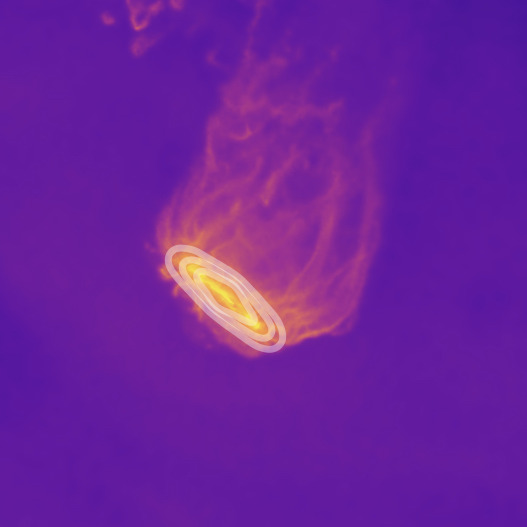
There's nothing quite like the human eye to identify unique shapes. We hope you'll join this endeavour to look for Jellyfish galaxies so we can understand them better!
Cosmological jellyfishAbout Cosmological jellyfish
We are a group of researchers at the Max Planck Institute of Astronomy using simulations of the Universe to study the various ways in which galaxies in the Universe evolve, both through their own internal processes, and under the influence of their environment.
Galaxies in the Universe can come in many forms and shapes.
Some of them can show very asymmetric distributions, with long tails of material that depart from their main body made of stars and cosmic gas. This jellyfish-like shape, we think, is associated to certain physical processes that govern the interaction of galaxies with their surroundings.
To pin these processes down, we need to be able to distinguish between galaxies that appear "normal" and those that appear like "jellyfish". And we can do this both with galaxies observed in the real Universe as well as with those simulated at supercomputers.
Help us find galaxies that look like jellyfish!