


Finished! Looks like this project is out of data at the moment!
25/04/23: We're thrilled to present our first set of publications based on your classifications! A HUGE thank you to everyone who got involved with the project and for all your efforts! You can find out more about these first results on our results page.
Research
Help us find galaxies that look like Jellyfish!
We are a group of researchers at the Max Planck Institute of Astronomy and we work on understanding the formation and evolution of galaxies in the Universe using state-of-the art cosmological simulations. For this project, we're interested in understanding how galaxies interact with their environment and what impact these interactions have on them.
The idea
Galaxies come in many shapes and forms. In fact, galaxies are made of both stars and gas, and the shapes of these two parts can be very different from each other.
In this project, we are interested in the shape of the gas in the galaxy. In some cases, the gas of a galaxy exhibits one or more "tails" of gas that stem from the main body of the galaxy and stretch in one preferred direction. Such galaxies almost look like jellyfish in the sea! See the movie below!
What do we mean by jellyfish galaxies? | ||
|---|---|---|
 | |
In this project, we are interested in identifying these types of galaxies. Identifying galaxies that look like jellyfish is easy to do by eye, but can be hard to do automatically. Help us find the Jellyfish galaxies from among the thousands of galaxies in our simulation!
If you want to know more about jellyfish galaxies, how they are formed, and why we are studying them, see the section "What are Jellyfish Galaxies and why do gas tails form?" below.
How to find Jellyfish galaxies
To study Jellyfish galaxies we are using the galaxy population from the IllustrisTNG numerical simulation (see below if you are interested!).
For the classification, we will show you an image with a galaxy at its centre and your task is simple: Does the galaxy looks like a jellyfish or not?
Important: For each image, classify only the galaxy at the centre of the image.
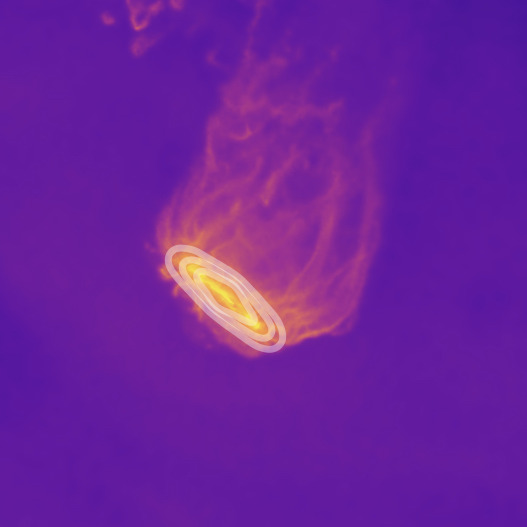
Important: When classifying, focus on the shape of the gas: this is shown in colours from blue to magenta to yellow, to indicate low to intermediate to high density gas.
Of course, galaxies are also made up of stars (indeed, they are usually detected based on the light from their stars), and to classify a galaxy correctly, you also need to know how the stars are distributed. We show how the stars are distributed in the galaxy with thick white contour lines.
What do the images show? | ||
|---|---|---|
| |
In the movie below, we show some example classifications of Jellyfish galaxies and *non-*jellyfish galaxies, all taken from our pilot study, in which a few scientists in our group classified a smaller sample of images in the same way as you will here.
Example classifications | ||
|---|---|---|
| |
Important: Jellyfish galaxies are not common - most of the galaxies you will encounter here will not be Jellyfish galaxies (though they may be very interesting for other reasons!)
Step by step tutorial
Let's go step by step! Let us show you some more examples to get you oriented.
Jellyfish galaxies
The following galaxies are, we think, excellent examples of galaxies that look like jellyfish.
Remember: gas tails can come in many shapes and sizes.
Some Jellyfish galaxies have thin tails that extend far beyond the main stellar body of the galaxy (that is, beyond the thick white contours).
Others may appear as disc-like objects where the gas tails drape away from the main galaxy body like a tablecloth.
Some tails may appear very prominent, in yellow or orange colours, while others may look very weak (magenta or blue) and can be hard to separate from the background.
| ![ImageCollectionFolder[700123]_Zooniverse_Jellyfish_191003_08253758.png](https://thumbnails.zooniverse.org/999x/panoptes-uploads.zooniverse.org/production/project_attached_image/135bd156-8f20-4df1-900c-9c6985aeb65d.png) | |
Non-jellyfish galaxies
However, galaxies that show jellyfish-like features as the ones above are not very common.
In most cases, you will see maps of galaxies that do not resemble a jellyfish. This can happen for a variety of reasons.
Below we have grouped together examples of galaxies that, in our view, should not be identified as Jellyfish galaxies, each grouped according to some of the typical characteristics you might encounter.
Non-jellyfish galaxies: No Tails!
The following are examples of galaxies that do not look like jellyfish because the gas in and around their body is pretty much round and symmetric and does not show any strong tails that stretch in any particular direction.
| ![ImageCollectionFolder[700123]_Zooniverse_NonJellyfish_Sym_NoTail_191007_15180568.png](https://thumbnails.zooniverse.org/999x/panoptes-uploads.zooniverse.org/production/project_attached_image/a8ca41c7-bdd6-4344-aa41-8cb0cf160364.png) | |
Non-jellyfish galaxies: cases of very little gas
In some cases, galaxies may show such little amounts of gas that a classification is not possible at all, or very difficult.
A few of these are shown below: do not worry! Just do your best!
| ![ImageCollectionFolder[700123]_Zooniverse_NonJellyfish_LittleGas_191003_08290649.png](https://thumbnails.zooniverse.org/999x/panoptes-uploads.zooniverse.org/production/project_attached_image/104d803d-0fa1-40cd-8ace-7a3e0ddceabd.png) | |
Non-Jellyfish galaxies: Tails that are not part of the galaxy
Sometimes a galaxy may show some sort tails, but these are not attached to the galaxy's body. In our view, such images should not be classified as Jellyfish-galaxies. See some cases below:
| ![ImageCollectionFolder[700123]_Zooniverse_NonJellyfish_Asym_TailDisconnected_191003_08272879.png](https://thumbnails.zooniverse.org/999x/panoptes-uploads.zooniverse.org/production/project_attached_image/5e308c1c-8dfa-4fd5-aa81-6dff1ed4c9e4.png) | |
Non-jellyfish galaxies: Tails in several different directions
It can happen that a galaxy clearly shows gas that extends far beyond its body, but the tails all point in different directions. For example, galaxies with two distinct tails pointing in opposite directions (180 degrees separation). In fact, in these cases, other physical phenomena are at play, but we are not interested in them for this project.
If many tails are found pointing in various different directions, they are likely formed through processes other than the one we are studying. Hence, these images would not be classified as Jellyfish-galaxies.
Some examples of these are below:
| ![ImageCollectionFolder[700123]_Zooniverse_NonJellyfish_TailMultidirection_191003_08283427.png](https://thumbnails.zooniverse.org/999x/panoptes-uploads.zooniverse.org/production/project_attached_image/d5dc68c0-8cf3-4f58-a20e-77a9ae5511e7.png) | |
Non-jellyfish galaxies: cases of galaxies with neighbours
Galaxies are rarely found on their own!
You can find images with more than one galaxy in them, i.e. with multiple sets of thick white contours.
The presence of a close neighbour may affect the galaxy at the centre of the image. In these cases where galaxies seem to interact with one another, other physical phenomena are taking place, but we are not interested in them for this project.
If there is one (or more) other galaxy in the image that may seem to be affecting the galaxy at the centre, do not classify the galaxy in the centre as a jellyfish, even if it may look like one.
| ![ImageCollectionFolder[700123]_Zooniverse_NonJellyfish_Neighbor_191003_0827488.png](https://thumbnails.zooniverse.org/999x/panoptes-uploads.zooniverse.org/production/project_attached_image/a022a950-3334-4cd2-94ec-d8658f9a8afd.png) | |
Non-jellyfish galaxies: Just a big Mess!
You will encounter many situations where the image is full of gas, everywhere and in very messy configurations, both within and around the galaxy at the centre.
In these cases, it may be impossible to say whether the central galaxy looks like a jellyfish. So go with your gut. If you think that the central galaxy looks like a jellyfish despite the mess, go for it! If you are unsure, classify the galaxy as a non-jellyfish.
| ![ImageCollectionFolder[700123]_Zooniverse_NonJellyfish_Mess_191003_08284988.png](https://thumbnails.zooniverse.org/999x/panoptes-uploads.zooniverse.org/production/project_attached_image/09dbee66-19d4-4e3e-b8a7-0e94563f9603.png) | |
Important: We have given you examples of galaxies that clearly look like jellyfish or that do not. But Nature is often messy! In many cases the distinction between Jellyfish and non-Jellyfish is not clear. Do your best and do not worry! The aim here is to get an average consensus rather than rely on a single classification for each image. The analysis will take into account the level of agreement amongst the classifiers and in fact, it is valuable for us to know which galaxies are difficult to classify.
You are now ready to start classifying galaxies!
If, during the classification process, you need help, consult the tutorial or the field guide tab on the right!
What are Jellyfish Galaxies and why do gas tails form?
What are Jellyfish Galaxies?
Observations of the night sky have revealed that galaxies sometimes have peculiar shapes, with tails of gas extending out of a galaxy's body and resembling the tentacles of a jellyfish.
Three examples of real Jellyfish galaxies are shown below. These images are obtained by combining at least two different kinds of observations - the stars appear as a hazy white disk, while the gas has been coloured either red or blue for emphasis.
Galaxies that resemble jellyfish are usually found to be satellites within massive clusters of galaxies, namely galaxies that orbit at very large speed around more massive ones. The direction of the tail(s) gives an appearance of motion to these galaxies; in fact, the distinctive "jellyfish" shape is thought to be a result of their motion within the gaseous environment of the cluster.
 ESO 137-001 (NASA) ESO 137-001 (NASA) |  NGC 4569 (VESTIGE) NGC 4569 (VESTIGE) |  JO204 (MUSE) JO204 (MUSE) |
If you want to learn more about observations of Jellyfish Galaxies, check out the GASP and VESTIGE projects.
How do the tails of Jellyfish Galaxies form?
Imagine you are in a fast car driving down the road. If you stick your head out the window (do not try this!!), your very long hair - you have long hair in this scenario - will fly in the wind, flapping back in a direction opposite to the motion of the car. This is similar to how the trailing gas tails form in galaxies.
A demonstration of this can be seen in the following simple simulation example: a dense cloud of gas (red) is travelling from right to left through a region of low-density gas (blue). The "camera" of this movie is travelling at the same initial speed as the gas cloud, so it appears not to move.
Due to the motion of the gas cloud through the surrounding gas, it experiences a pressure or wind. With respect to the cloud, the wind is coming from left to right. This phenomenon is known as "ram-pressure" (when you stick your head out the window of a fast-driving car, the wind you feel on your face is the ram-pressure). This pressure deforms the gas cloud and leads to the formation of gas tails which extend behind the gas cloud. Since the "camera" is moving at the initial speed of the cloud, as the cloud slows down and deforms, it appears as though it's moving to the right - but in the stationary general frame of reference, the cloud is still moving right to left, albeit slower.
simulation of gas cloud motion |
|---|
 |
In galaxies, the gas is held together by the combined force of gravity from the stars and the gas. If the force exerted by the "wind" formed by the galaxy's motion (the ram-pressure) exceeds that of the gravitational force, the gas is removed from the galaxy and forms an extended tail. The stars are not affected by the wind due to their much higher density and relatively small size (compared to the galaxy). Like hair flapping in the wind, the gas tails indicate the direction of motion of the galaxy.
Jellyfish galaxies can teach us a great deal about the formation and evolution of galaxies and of the environment in which they reside. By studying the details of the gas stripping process we can learn about the conditions of the gas within galaxies, as well as the properties of the gaseous medium around them.
The gas in a galaxy is the fuel for forming new stars and if that gas is removed, the galaxy will no longer be able to form new stars. Understanding the processes in which gas can be removed is necessary to understanding why some galaxies stop forming stars.
Recent observations have also shown that in some Jellyfish galaxies, the process of star formation has been enhanced, rather than reduced. In some cases, indications of recent star formation have also been observed in the gas tails themselves.
To address these interesting questions, and many others, we wish to study Jellyfish galaxies. But before we can study them, we must first find them!
Our approach to the scientific question
To study Jellyfish galaxies we are using numerical models. In particular, we use the results of the IllustrisTNG cosmological simulations. In cosmological simulations, we use high-performance computers to simulate a model of our universe, starting from the Big Bang, all the way to the present day. Within these simulations, galaxies are formed naturally from the initial state of the universe and as a result, one can find a diverse population of galaxies of many different shapes and sizes. In the IllustrisTNG simulations, the galaxy populations have been found to resemble, to a high degree, the galaxies which we observe in our own sky, and in particular, many Jellyfish galaxies have also been identified.
In a pilot study carried out in our group, we identified roughly 800 Jellyfish galaxies from an initial pool of about 2600 satellite galaxies, by visual classification. The results of the study are presented in the paper Yun et al., 2019. We discovered that given an image of a galaxy, identifying whether or not it is a Jellyfish galaxy is relatively easy - the human brain is very good at identifying patterns and once you know what to look for, a decision can be made in split seconds.
Consider the following two images as an example: In the images, we show the gas distribution of two galaxies - colours designate the gas density from high (yellow) to low (blue), and the distribution of stars is shown by the white contours (which enclose 75%, 80%, and 85% of the stars). A quick glance is enough to find the typical gas tails which define the Jellyfish galaxy. However, constructing an automatic process to perform this classification proved to be much harder.
Jellyfish galaxy | non-Jellyfish galaxy | ||
|---|---|---|---|
|  |  | |
In our simulations we have several hundreds of thousands (100,000's) of satellite galaxies which we need to classify as jellyfish or not. And tackling such a large number of objects is only possible with your help! Once we identify the Jellyfish galaxies, there is so much we can learn about these galaxies and the way they form and evolve.
The following movie shows some of the Jellyfish galaxies we identified in our pilot study - help us discover more!
Jellyfish Galaxies from our pilot study | ||
|---|---|---|
| |