


Thank you for your amazing efforts. We have docked!
Research
This project aims to digitize the records from the research vessels Dan Moore, Eastward, and Cape Hatteras from the years 1964 to 2013. The records vary in content, from science logs to cruise reports and maps, all of which give insight into the region's natural history. The data collected can form the foundation for studies spanning fields as diverse as taxonomy, human health, ecology, conservation, and habitat management. While these records are available in print form (as well as other hard copy formats), the materials upon and within which they are stored are beginning to deteriorate and, because of the collection’s current uncatalogued, undigitized state, it is practically invisible to the the global community. Therefore, it is imperative that these records, and the treasure trove of information that they contain, be digitally transcribed before the data is lost. With your help we can accelerate access to these records and make this knowledge available to everyone. As we enter a time when regions all over our planet are changing at a historically unprecedented pace, digitizing this information has become more critical than ever.

The research vessel Eastward was operated out of the Duke University Marine Lab from 1964-1981. During this time, the vessel spent a total of 3,745 days at sea. It was replaced by the research vessel Cape Hatteras in 1982. Photo credit: Duke University Archives. Durham, North Carolina, USA.

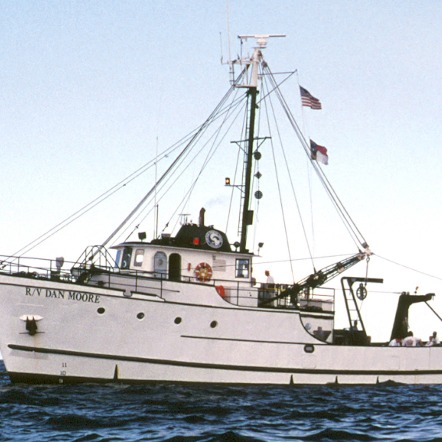
The research vessel Dan Moore operated out of Cape Fear Community College from 1982-2013. It was used for educational cruises and collected specimens primarily through trawling. It was replaced by the research vessel Cape Hatteras in 2013.

The research vessel Cape Hatteras, built in 1981, was owned by the National Science Foundation and operated by Duke University. In 2013 it was purchased by Cape Fear Community College.
Here is an example of an Eastward Science Log.

Here is an example of a Dan Moore Station Log.
