



Finished! Looks like this project is out of data at the moment!
Research
Scope of the Project
An "eclipsing binary" is a pair of stars that orbit one another, oriented so that one star occasionally blocks our view of the other star. With Eclipsing Binary Patrol, you will examine data from the NASA/MIT spacecraft called TESS (Transiting Exoplanets Survey Satellite) and help unravel the mysteries of these multiple-star systems. Together, we will discover new eclipsing binaries by sorting through the data to weed out imposters -- objects that seem to blink like an eclipsing binary but are not.
Have you already completed a classification in this project? Congratulations, you're now part of our team of volunteer scientists!
Why do we need more volunteer scientists like you on board? Data from TESS contains much information, but it is still quite hard for computers to understand when it's showing us sources we are not interested in, such as non-stellar objects or background noise.
With your help, we can separate the good candidates from the bad ones. We can also use these stars to search for exoplanets -- planets that orbit other stars beyond the Sun.
Are you ready to be part of something extraordinary? Feel free to start classifying now! Or read on to learn more about the science of multiple star systems and the planets that orbit in them. Together we can unlock incredible new insights into binary stars, marvelous objects that still contain many surprises even after hundreds of years of study.
Lightcurves
At Eclipsing Binary Patrol, you will help find new eclipsing binaries by inspecting "lightcurves". "Lightcurve" is a fancy term used by astronomers to describe a plot that shows observed brightness of a luminous object in the sky as a function of time. You will see these plots mentioned often at Eclipsing Binary Patrol. Additionally, you will inspect images of tiny regions of the sky containing each source we are interested in investigating.
Binary Stars
Many of the dots of light we see in the sky at night are actually binary stars -- systems of two stars held together by gravity and orbiting each other.
In fact, nearly half of the Sun-like stars are binaries and about one in ten of these are even higher-order systems (called multiple stellar systems)! The nearest star to the Sun -- Proxima Centauri -- is part of the Alpha Centauri triple system. Proxima Centauri is "only" 4.25 light years from Earth while Alpha Centauri A and Alpha Centauri B are slightly further away at a distance of 4.35 light years.
The complexity of multiple stellar systems makes them invaluable tools for studying various aspects of astrophysics. They help us investigate stellar structure, formation, and evolution, and even produce spectacular celestial phenomena such as supernovae, planetary nebulae, and gravitational waves. Multiple star systems also provide deeper insight into the formation, evolution and habitability of planets outside the Solar System, which are of increasing interest not only for astronomers but for the general public as well.
Multiple stellar systems are spread throughout the Universe and come in a wide variety of configurations. For example, the two stars in some binary systems can be far enough apart that we can identify them as separate points of light, sometimes even with just our naked eye. In other cases, the separation of the two stars is so small that the binarity of the system can be revealed only with the help of powerful telescopes. You can find more information about the different types of binary stars here.
Eclipsing Binary Stars (EBs)
Eclipsing Binaries (EBs) are a special subset of binary systems, and provide a vital foundation -- the so-called "royal road" -- of stellar astrophysics. EBs have long been a subject of intense studies that have benefited nearly every topic in astronomy. For example, Beta Persei -- an eclipsing binary archetype for Algol variables, and visible to the naked eye in the Northern Hemisphere -- has been monitored for hundreds and perhaps even thousands of years.
As we mentioned, an EB is a system where one of the stars passes in front of the other and periodically blocks the other's light. Because this special alignment is rare, each new EB we find can be highly valuable. Here, we will be looking at EBs observed from NASA's TESS mission.
Is there an easy way to visualize an eclipsing binary?
Yes, you can use this online EB simulator to create your own eclipsing binaries and inspect their lightcurves!
Does it matter if there are differences in size between the two stars orbiting each other?
Not at all - and indeed the two stars in a binary system will generally have different sizes, masses, and temperatures!
To help illustrate the concepts we've been discussing, let us consider the following example. Imagine a system with two stars that orbit each other in a circular orbit with a period of P. Let us also assume that one of the stars is larger, more massive, and hotter (the "primary" star) and the other is smaller, less massive and cooler (the "secondary" star). Finally, we see the system from the side, or "edge-on," such that it produces eclipses.
If we monitor the brightness of this system as a function of the time (i.e. measure the lightcurve), we will see deeper "primary" eclipses when the small star moves in front of the big star and blocks some of the light from the latter (at orbital phase 0, or the start of the period - please find more information on what is an orbital phase in the FAQ page), and shallower "secondary" eclipses when the small star moves behind the big star and we don't see the light it emits (at orbital phase 0.5, half a period after primary eclipses):

Alternatively, if the two components are identical -- a "twin" binary -- the primary and secondary eclipses will be identical as well:

You can use the EB simulator to explore the enormous lightcurve diversity between the two examples outlined above.
Are there star systems with more than two stars?
Yes, there are triple systems (like Alpha Centauri), systems with four stars, five stars, six stars, and potentially even higher-order systems (e.g. AR Cassiopeiae).
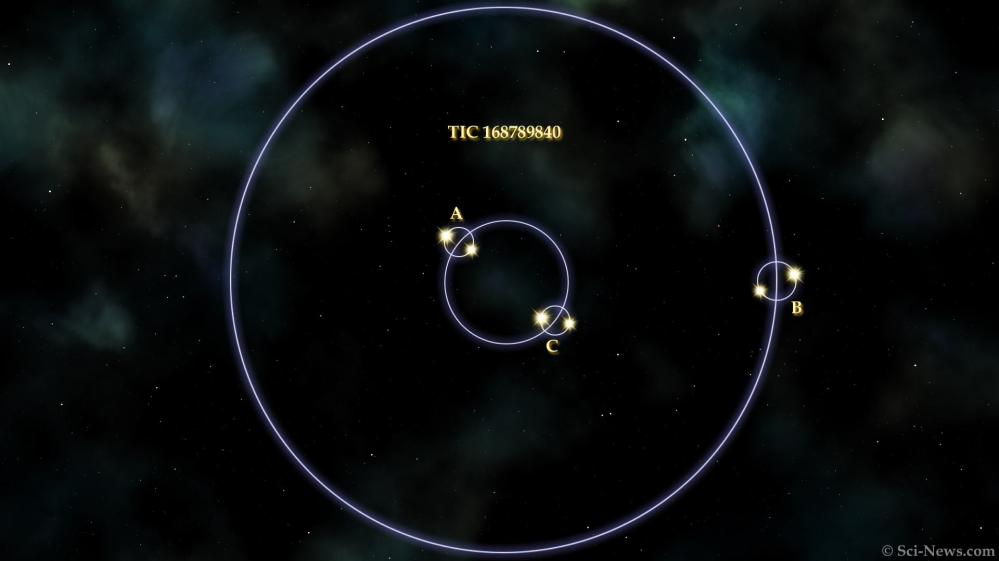
Importantly, as the number of stars in a particular system increases so does its complexity, such that certain orbital configurations effectively become physically impossible. Thus the architecture of multiple stellar systems is generally hierarchical. For example, triple systems often have a "2+1" configuration where a shorter-period binary star ("2") has a longer-period tertiary companion ("1"), while quadruple systems tend to come in a "2+2" configuration, i.e. two short-period binary systems orbit around each other on a long-period orbit. The first eclipsing sextuple system, TIC 168789840, is composed of three separate binary stars in a "2+2+2" configuration. In essence, here a "2+2" quadruple has a distant binary companion and, amazingly, all three binary components are eclipsing binaries!
What does this have to do with TESS? Isn't TESS gathering information on exoplanets?
NASA’s Transiting Exoplanet Survey Satellite (TESS) mission monitors the brightness of tens of millions of stars spread across the entire sky. Many of these are binary stars and a small fraction of these will be geometrically aligned to produce eclipses. Even though the fraction is small, the absolute numbers are still staggering -- we have hundreds of thousands of EBs in need of comprehensive analysis!
Here at Eclipsing Binary Patrol, we are closely scrutinizing the TESS lightcurves of these EBs for obvious or subtle issues that might have tricked the automated methods used for detecting them. The impact of these issues could be anywhere from relatively minor (e.g. the estimated period is off by a factor of 2) to potentially serious (e.g. the target star may not be the source of the detected eclipses) or even, well, catastrophic (e.g. this is not EB at all!). Together, we can make sure that objects we think that could be EBs REALLY are good candidates.
Are there exoplanets in eclipsing binary systems?
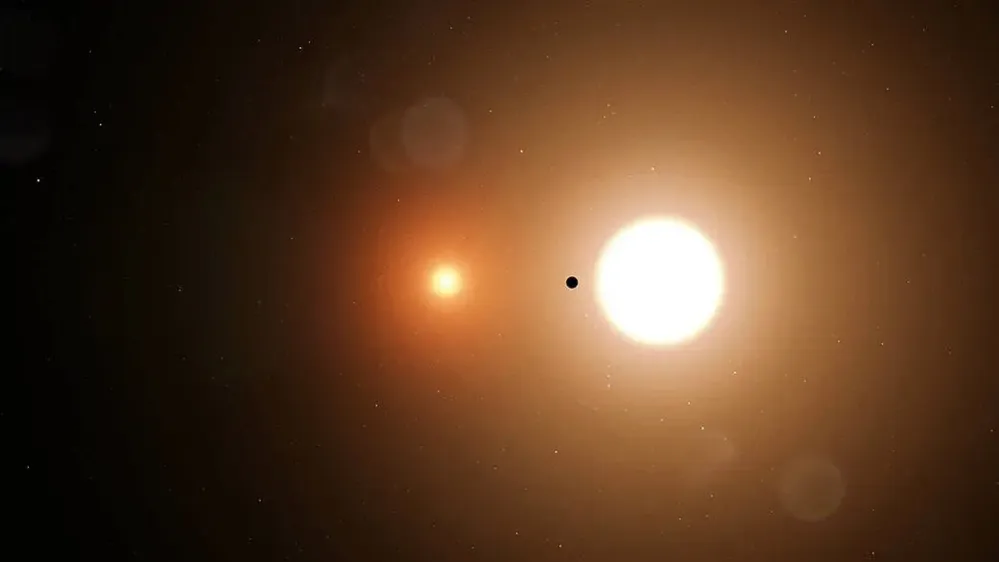
Yes, there are indeed a handful of planets discovered around eclipsing binary stars. The TESS mission has already helped us find them -- TOI 1338b and TIC 172900988 -- and where there are two, there are surely more. But to find the planets, we first need to find their parent binary stars. And one of the easiest methods to do so is to find eclipsing binaries!
The Science of Eclipsing Binary Stars and Exoplanets
What is a transiting exoplanet?
An exoplanet is a planet orbiting stars other than the Sun. A transiting exoplanet is an exoplanet that periodically blocks a small fraction of the light of its parent star as it orbits around the star.
What is TESS?
TESS is NASA's latest exoplanet mission designed to find thousands of transiting exoplanets. TESS is a space-based telescope that measures the brightness of millions of luminous objects in the sky, creating a data set that will be a challenge to fully understand without help from citizen scientists. TESS has been observing since 2018, tiling the sky with ~30-days sectors per hemisphere, per year. You can see one month of TESS observations here. The mission has already found thousands of transiting exoplanet candidates -- and is expected to find many more -- by detecting tiny dips in the brightness of distant stars produced by orbiting planets blocking a tiny part of the corresponding stellar disk--just like Venus transits the Sun as seen from Earth.
Is TESS the first mission of its kind?
No! There were other missions before TESS, like Kepler. Kepler and TESS are similar in purpose -- finding planets outside the Solar System -- yet different in design and goals. For example, Kepler searched a small portion of the sky for transiting exoplanets for four consecutive years (and discovered more than 4,000 of them) with a 1.4-m diameter mirror, whereas TESS is searching the whole sky with four 10.5-cm mirrors by observing a particular section of the sky for about a month then moving on to another section. The smaller telescope mirror size makes our quest harder as it induces more intensely an adverse effect known as “source confusion” (described below).
After two gyroscopes on the Kepler space telescope failed, it was repurposed as a new mission, called "K2," which searched a different part of the sky. Citizen scientists in the Planet Hunters project and the Exoplanet Explorers project have helped comb the data from both NASA's Kepler and K2 missions, and have discovered dozens of new exoplanets, including rare and intriguing objects like a planet with four suns in the sky, or Boyajian's star.
In our sister project Planet Patrol citizen scientists investigated thousands of TESS planet candidates in different catalogs, identified hundreds of impostors, and helped refine the analysis workflow.
What is "source confusion"?
One of the most common issues associated with astronomical observations is the so-called "source confusion" effect. You have probably noticed this effect when you are on the road at night. When very far away, an incoming car looks like a single point of light -- you cannot see both headlights. To resolve the two as separate points of light, you either need to wait for the car to come close enough, or use much bigger eyes.
Similarly, when there are multiple stars (or galaxies) close to each other on the sky, it can be hard to tell them apart in images from telescopes and one source can be easily confused with another. The smaller the telescope mirror, the worse the problem. This confusion is a major source of noise for TESS, and a major reason we need help from citizen scientists to decipher TESS data.
Here is an example of source confusion, showing two images of the same star (KOI-258) but taken from two different telescopes -- one with a 1.4-m diameter mirror (Kepler) and another with a 6.5-m diameter mirror (MMT). What Kepler sees as a single star (left) is in fact three stars!

Consider this scenario: if we only had the left image and noticed that the brightness of the target "star" changes periodically, it could imply a potential transiting planet! However, with the additional information provided in the right image, we’d have to determine which of the three stars is causing these brightness fluctuations. Is it a small planet orbiting a bright star, as the left image would have suggested, or could it be an eclipsing binary star lurking in the background, as the right image could imply? Alternatively, could it be something else entirely?

For the case of KOI-258, it turned out that the target is actually an eclipsing binary, not a star hosting a transiting planet.
Now, imagine pointing TESS's 10.5-cm telescope at KOI-258. We'd be in for a real challenge, trying to sort out what's what amidst the cosmic chaos! At Eclipsing Binary Patrol, we will tackle this challenge together.
Want to learn more? There’s much more information in our handy page of Frequently Asked Questions!