


Welcome! This project recently migrated onto Zooniverse’s new architecture. For details, see here.
FAQ
What are sunspots?
Sunspots are regions of strong magnetic field in the solar surface. They appear dark because they are cooler than their surroundings, though they are still quite hot, with typical temperatures of about 3000°C.
Why do we care about the number of sunspots?
Since sunspots are regions with strong magnetic field, their presence in great numbers signifies high magnetic activity on the Sun. Observations have revealed a roughly 11-year periodicity in the number of sunspots, though the exact period and the maximum number of sunspots are varying. By having information on the number of sunspots, we can estimate how magnetically active the Sun was.
Why do we count spots on old drawings and not high quality observations from a satellite?
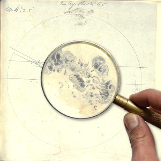
High quality digital data from satellites and ground-based telescopes exist only since the last 3 and 4 decades, respectively, while photographic observations from the ground extend back to the late 19th century. However, drawings of sunspots have been kept since early 1600's! Thus maintaining the counting of sunspots from drawings allows us to participate in what is termed the longest running experiment in astrophysics and maintain a, as much as possible, consistent and coherent dataset of solar activity covering over 4 centuries.
Why are some images in this project too small?
The pictures you'll see come in different sizes because they focus on individual sunspot groups taken from a larger solar image. As a result in some cases that the group is too small (typically consisting of only one sunspot) the image will also be small. We didn't make the images bigger because that might highlight other marks on the image, like smudges, instead of the sunspots, which would create confusion. Please also check the "Size of images" entry in the field guide.
What if I make a mistake in counting?
You have the flexibility to adjust your decision until you click "Done". Even after clicking "Done", if you question your choice, it is fine. The collective wisdom of the many volunteers and researchers ensures that together will lead to the right answer.
Didn't the observers go blind staring at the Sun to draw the sunspots?
It is crucial to emphasize the dangers of staring at the Sun with the naked eye.
Instead, these observers employed a safer method: they utilized a telescope to project the image of the Sun onto a piece of paper. By doing so, they were able to accurately depict what they saw without risking eye damage. This technique can be likened to tracing over an image using transparent paper.