Join us on Explore.org to watch live beluga footage from the Churchill River Estuary, streaming Monday through Friday for four hours each day
FAQ
Welcome to the Team
How does my contribution help researchers monitor belugas in Hudson Bay?
The estuaries of Hudson Bay are home to the largest summer aggregation of beluga in the world. Researchers are unsure as to why so many belugas aggregate in the area but it is thought that they use the area to moult, care for their young, avoid predation, or a combination of these factors.
By contributing to this project, you’re helping us determine who uses the estuaries, are they solely used by females with young calves? Do the same individuals return each year? By understanding who uses the estuaries, researchers can hypothesize which factors play an important role in habitat selection and can help better manage and protect the beluga population.
Are beluga endangered?
Beluga in Canada are managed and monitored in 8 subpopulations. Some of these are considered Endangered like the Saint Lawrence River beluga, Ungava Bay beluga, Cumberland Sound beluga, and Eastern Hudson Bay beluga. Others like the Eastern Beaufort Sea beluga and the Western Hudson Bay beluga are considered Not at Risk. Population reassessments happen every couple of years, the most recent of which was in 2020. You can look at the COSEWIC (Committee on the Status of Endangered Wildlife in Canada) report if you would like more details!
I’ve just discovered Beluga Bits - how do I participate?
First of all, thank you for your interest in contributing to our project! Our workflows change from time to time, depending on the questions we are focusing on and what data we have at a given time. The Tutorial and Field Guide are great resources for helping you navigate our workflows, providing useful diagrams and photos. If you are completing volunteer hours and will require a certificate or hours verification, please read the next section regarding volunteer hours.
Here is a glimpse at some of the workflows that you might be able to participate on:
General Photo Classification
This is our first line of questioning for new beluga photos! This workflow may change as we learn more and develop our tools for investigating beluga. Typically in this workflow, we ask volunteers a few questions about each photo:
- Are there any beluga in this photo? Please draw boxes around all the beluga that you see.
- Are there any jellyfish in this photo? Please draw boxes around all the jellyfish that you see.
- Do you see anything else interesting? Please draw boxes around anything else of interest that you can see.
These questions are the first step in helping us decide which photos should be looked at more closely in other workflows.
Beluga Boxes
Often we see beluga swimming in groups together and it can be challenging to ask questions about each individual within the group. This workflow will help us extract images of each whale you see to use for more detailed investigations (i.e., ID, body condition, health and much more)! We ask volunteers to:
- Draw a box around each beluga (or part of a beluga) that they can clearly see.
Is that a jellyfish?
In this workflow we are asking about the jellyfish that are sometimes seen in our photos. We ask volunteers to:
- Mark each jellyfish they see in the photo.
- Indicate which species of jellyfish it is.
Jellyfish make fun, occasional appearances and can provide insight on the health of the ecosystem.
Beluga Bodies
In this workflow we are beginning to ask questions about individual beluga, using boxes extracted from the "Beluga Boxes" and "General Photo Classification" workflows - thank you for your help generating these boxes! Here we are looking to categorize photos for future workflows - is the beluga clear enough that we can see markings? Can we look at its teeth and gums? To start this process, we are asking volunteers:
- Rate the quality of the photo, using the focal beluga for reference.
- What part/orientation of the focal whale is most in view?
- (If the view is head-on/mouth/face) Can you see the belugas teeth and/or gums?
- Which section(s) of the body can you see? (Selecting all that apply)
Ageing
In this workflow, we give volunteers one task:
- Use your best judgement to identify the age class of the beluga in the image.
- For each image, indicate which age class the beluga is (calf, yearling, sub-adult, adult, or can't say) - please refer to the Tutorial or Field Guide for help answering this question. This question will help us answer questions about beluga life history, habitat use, and social structure. The Talk section is another great resource for learning about determining beluga age (#calf, #young, #subadult, #adult).
Bits
In this workflow we are asking about whether beluga in the photos are male vs. female. We ask volunteers to:
- Mark each beluga where they can clearly see the genital area.
- Indicate whether that beluga is male vs. female.
This can help us consider questions about whether social structure and habitat use differs between the sexes. The Tutorial and Field Guide provide diagrams and pictures to help you decide whether a beluga is male vs. female.
Notch or Not
With this workflow we're trying to spot whales that have notches in their pectoral fins or flukes. These notches are permanent and can help us identify the same whales year after year!
We ask community scientists to:
- Determine if there are notches in the pectoral fins or flukes of the whale
- Tell us where the notches are located
Beluga Backs
This workflow was specifically designed to allow us to compare the whales we see in these underwater photographs to photographs that we take above water every season during fieldwork. We’re trying to identify unique whales so we can expand our catalog.
We ask community scientists to:
- Determine if there are scars on the dorsal side (back) of the whale
- Tell us which section(s) of the body has a scar – is it close to its head, along its dorsal ridge (hard section of their back towards the center), or towards its tail?
I am completing volunteer hours for school/scholarships/skill development - can I receive recognition of the hours I contribute to Beluga Bits?
Zooniverse now provides certificates for volunteers to download immediately. Click on your Username in the upper right corner, then Home, click More Stats, change the project and date range if needed, and then Generate Volunteer Certificate. It's that easy!
We can also provide a certificate verifying the hours you have contributed towards Beluga Bits but it will take a few days to process. There are a few helpful things to keep in mind if you would like a certificate:
- You must be signed in using a username for us to track the time you have contributed to the project. If you are unregistered, we have no way to know the actual time you have contributed.
- We are able to calculate time you have spent on the project using time-stamp data we request from the Zooniverse. That way we are able to calculate exactly how long you have worked on the project for.
- Because we calculate time based on the time-stamp, it is difficult to say exactly how many classifications you need to do to reach an hours worth of time. The time will vary based on which workflow you are working on and how quickly you are able to complete classifications. If you are working towards a goal of a certain number of volunteer hours (5 hours, 13 hours etc.) we recommend keeping track of your own time as well so we can verify if our time estimate seems accurate.
- It can take some time to process the data and calculate your hours, so letting us know ahead of time and giving as much notice as possible is appreciated.
Please message user KaseyAPC if you would like to request a certificate or have any other questions!
Here is an example of what your certificate will look like!

Ageing and Bits
How do you determine age class?
This is applicable to the Ageing workflow.
Body colour and size are your best tools when determining the age class of a beluga. Beluga are born a dark and uniform grey colour, as they grow older whales get lighter until they reach maturity when they can be a brilliant white colour. This means the easiest way to tell ages apart is when you have adults and calves next to each other so you can compare relative colour and size.
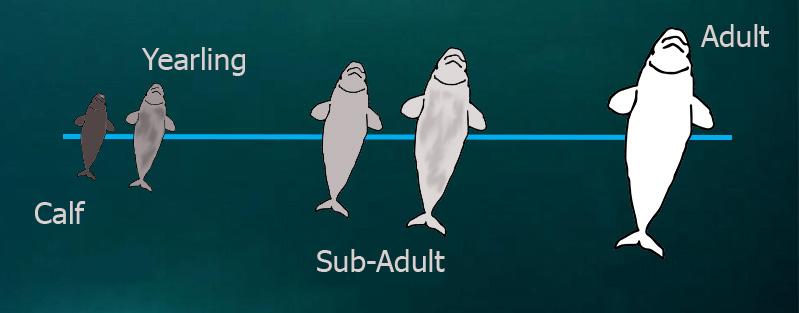
However, in our new Ageing workflow we are using photos that have been clipped out from our General Classification workflow, so they should only contain one beluga at a time. If you cannot compare size and colour with another beluga in the image, there are other things you can look out for!
Newborn calves or calves of the year are uniformly dark grey and are rarely (if ever) seen alone. You may see the body of an adult clipped out in an image of a calf. They swim very close to the mother and will be about 1/3 the size of her. You may also see fetal folds, which look like large rolls or wrinkles on the calves’ body.

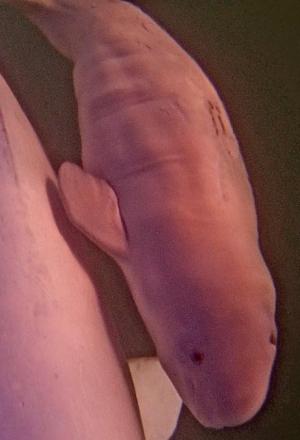
Examples with fetal folds:
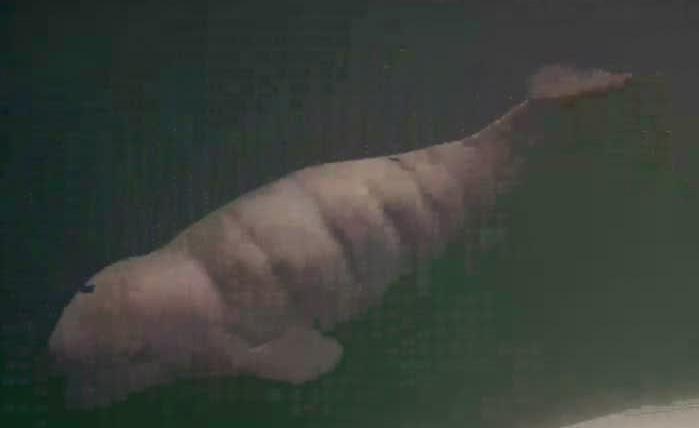
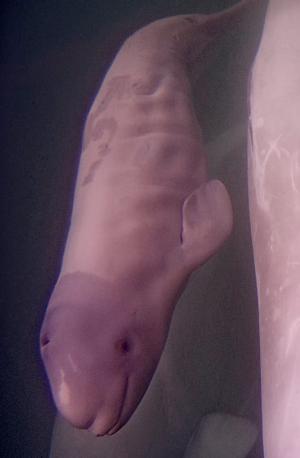
Notice how in each example you can see a sliver of the adult body as well, indicating they are swimming quite close to an adult.
Yearlings are a lighter grey, and may have a marbled or mottled colouration. They still will swim close to the accompanying adult but will be 1/3 to 1/2 the size of the adult. The adult may not always be pictured with a yearling.
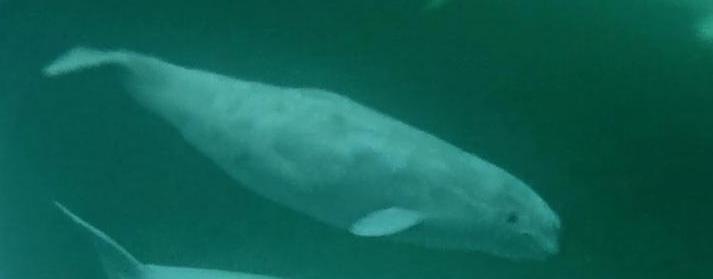
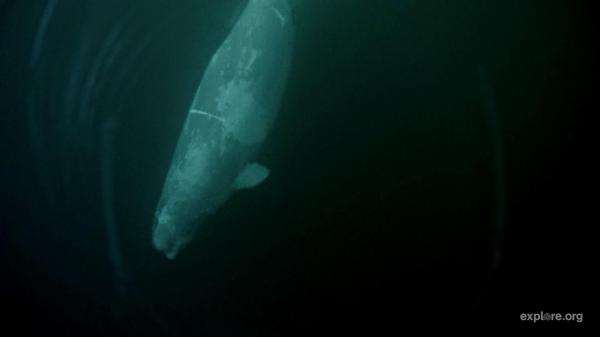
Another indication of a yearling beluga are dark circles around the eyes:
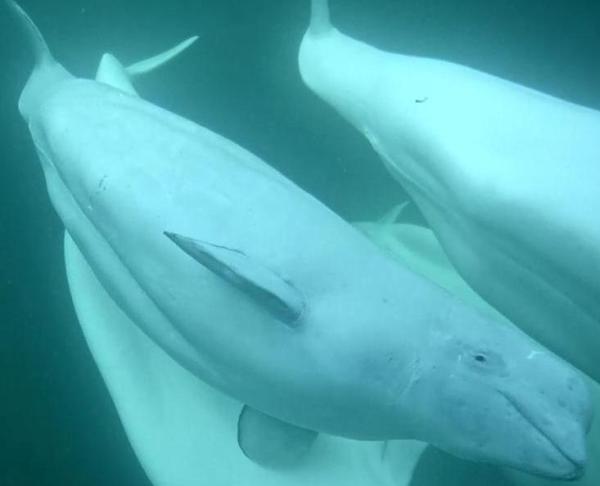
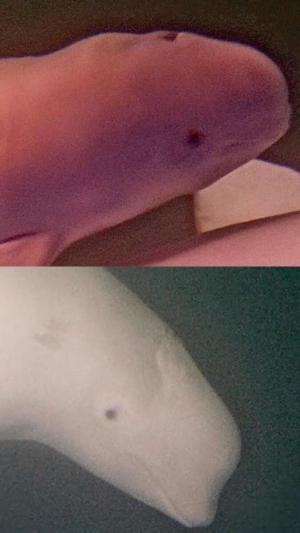
In general, younger beluga (calves and yearlings) also have a less pronounced melon and beak than adult beluga. Adult beluga will have a large, bulbous melon with a distinct divot leading towards their beak. Calves faces look rounder, with a less pronounced beak:
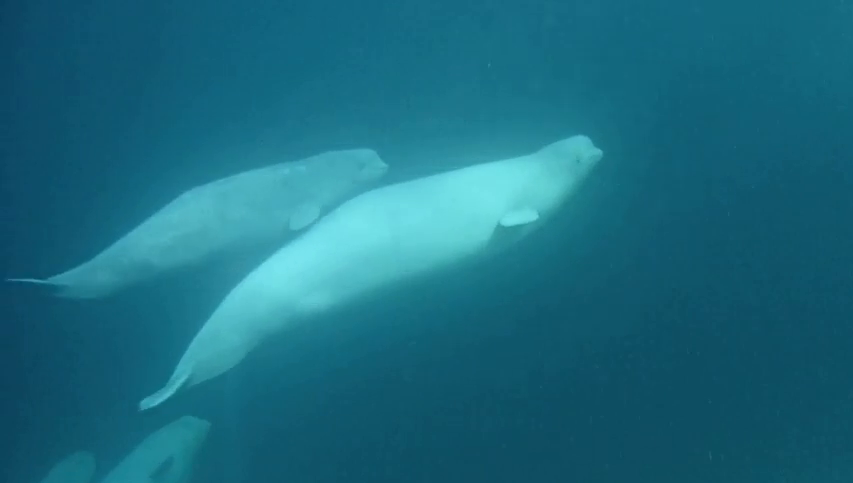
This may be less pronounced, but still noticeable in yearling beluga, for example in this image:
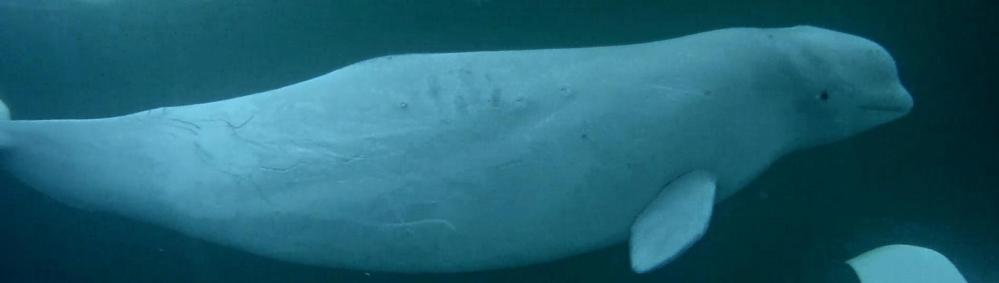
Sub-Adults can be close to the size of an adult, with a more pronounced beak but may still look darker in colour and be slightly mottled. Here is an example of a grey subadult:
Adult beluga will be bright, solid white with a very pronounced beak and large melon.
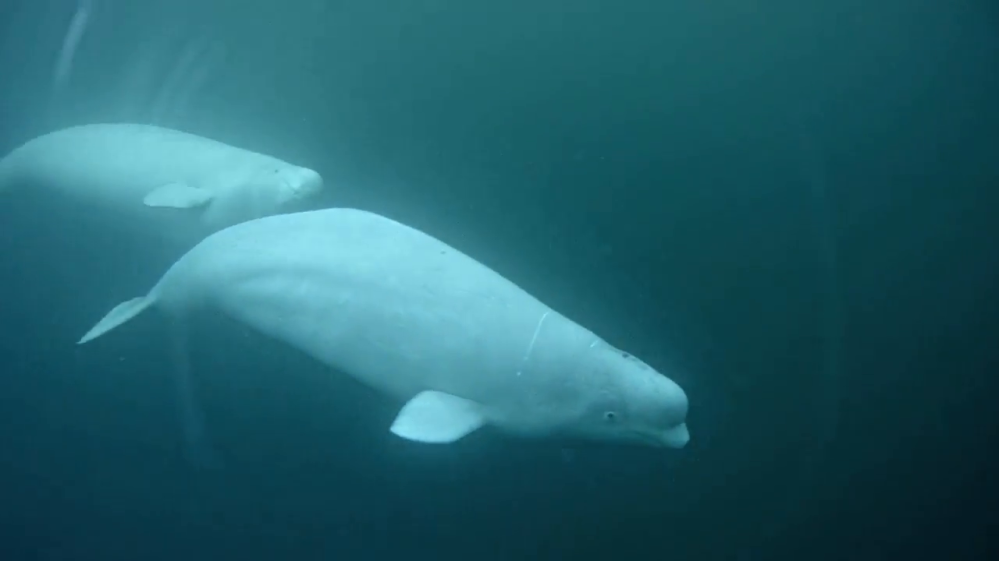
Pectoral fin shape can be used as a secondary means to determine age, especially if lighting conditions make judging colour difficult. Adult male beluga in this population develop upward-curving tips on their pectoral fins. In some pictures this upward curl can be very pronounced in adults, as in the example shown here.
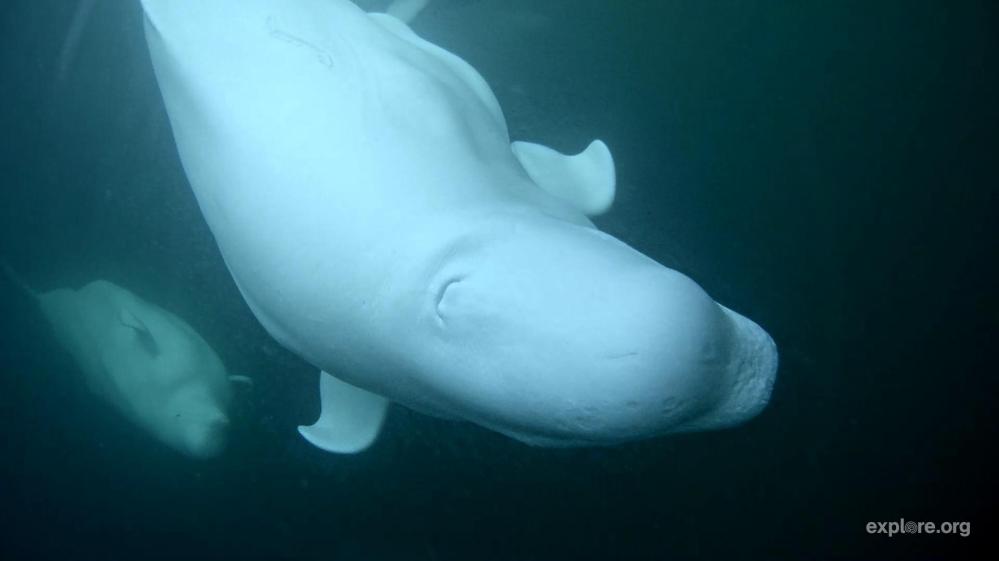
In this image, sunlight shining through the water makes it especially challenging to judge the colour of the beluga. However, the generally lighter overall colour and curled fins give a good indication that this is likely an adult beluga.
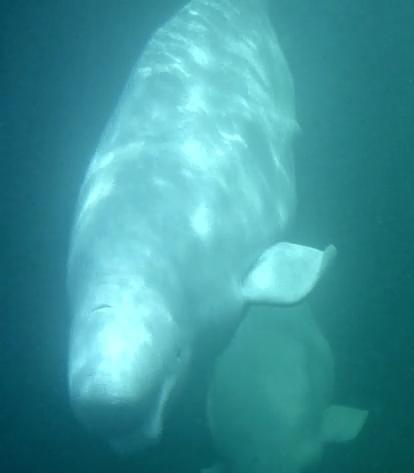
Finally, if you can see the underside of the beluga in the image the presence of thick rolls of blubber or rails may be an indication of an adult. Adults store more blubber than young beluga do!
I am unsure of colour - are there other ways to determine age class?
This is applicable to the Ageing workflow.
The water conditions can make it difficult to determine the colour of each beluga (and thus age class) - We would prefer for this workflow that you use your best judgment to select an age class once you have reviewed all the tutorial and field guide material. However, if you are truly uncertain you can use the "Can't Say" option. In some cases, the water condition might be okay, however you can't see enough of the beluga in question to determine age class. In these instances, you can use the "Not enough of the whale visible to say" option.
While colour is one of the best indicators of beluga age, other traits such as relative size, proximity to other beluga, uniformity of colour, head shape, and fin shape can be helpful as well.
Take a look at the above question "How do I determine age class?" for detailed examples of all of these indicators!
Why do I need to point out the underside/genital region of the belugas?
This is applicable to the Bits workflow.
Identifying photos of the underside/genital region of belugas allows us to determine whether both males and females use the estuary. Please see the next section on how to tell the sexes apart for more information.
How can I tell males and females apart?
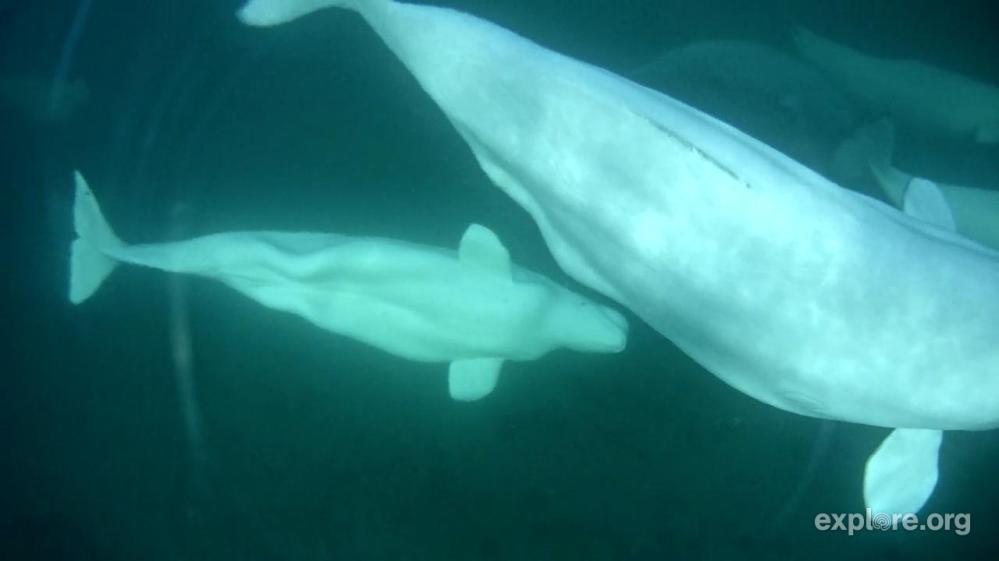
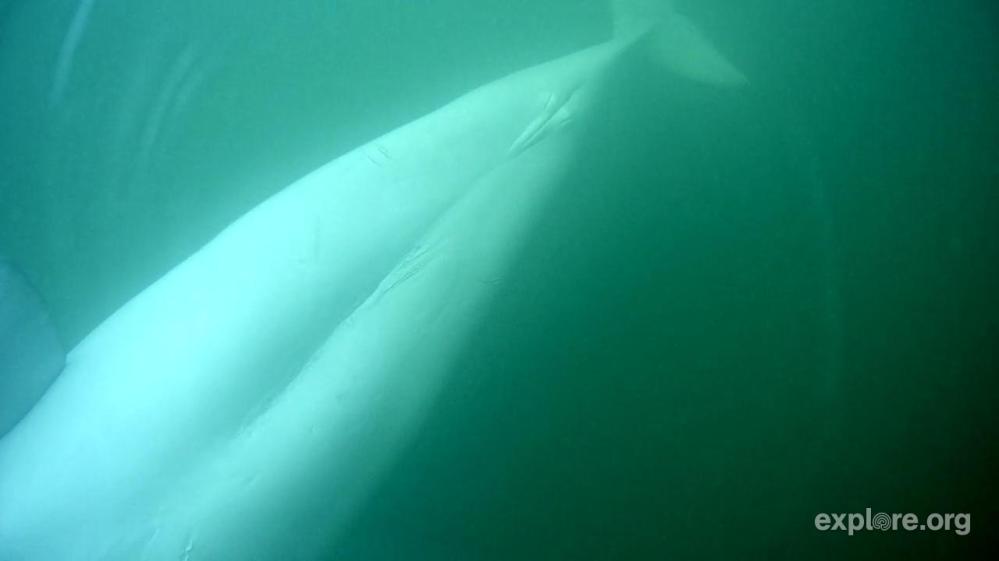
The easiest way to tell male and female beluga apart are by looking for mammillary grooves. Female beluga have two mammillary groves that run from the center line at a 45-degree angle. You can refer to the Field Guide for more diagrams and pictures if you are unsure.
FEMALE
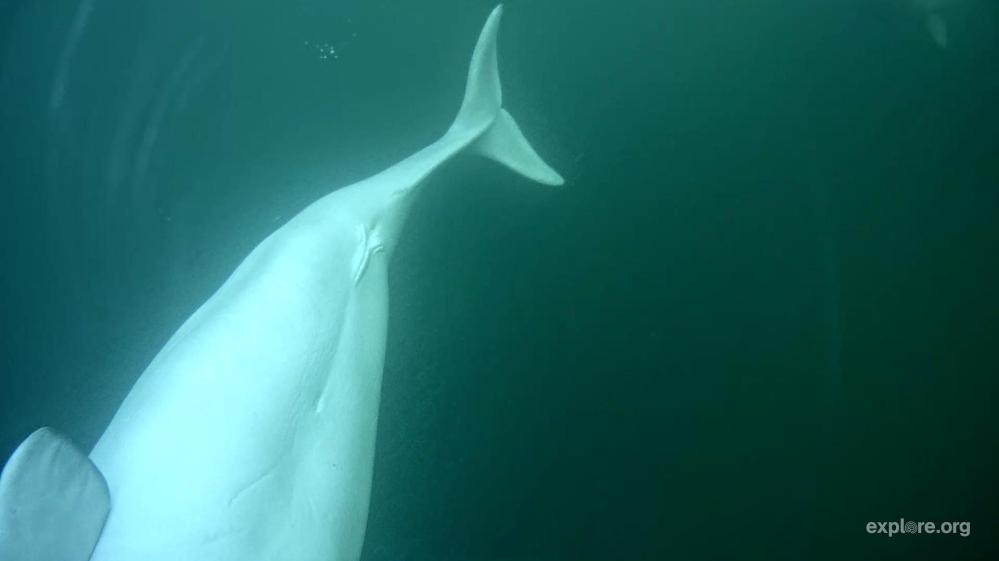
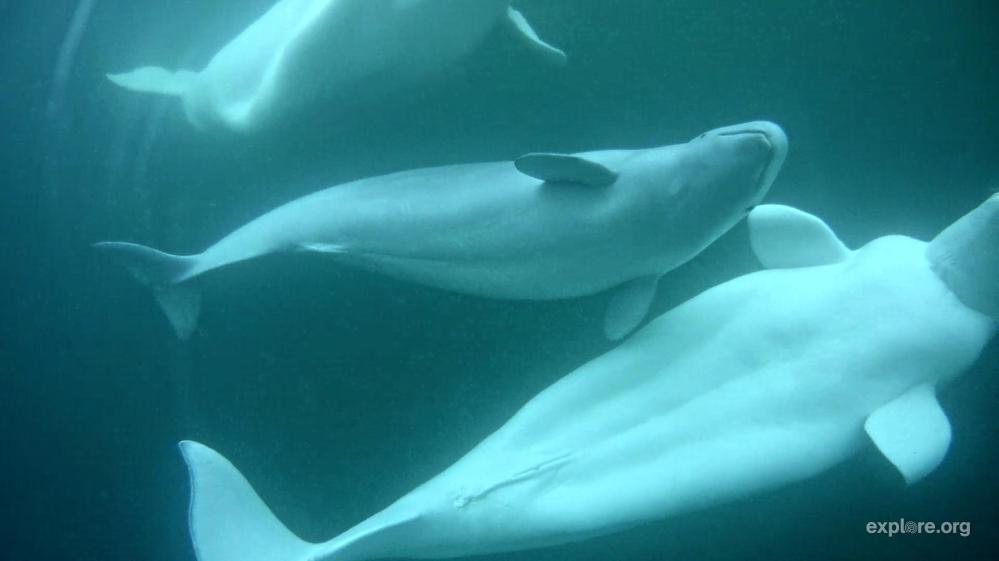
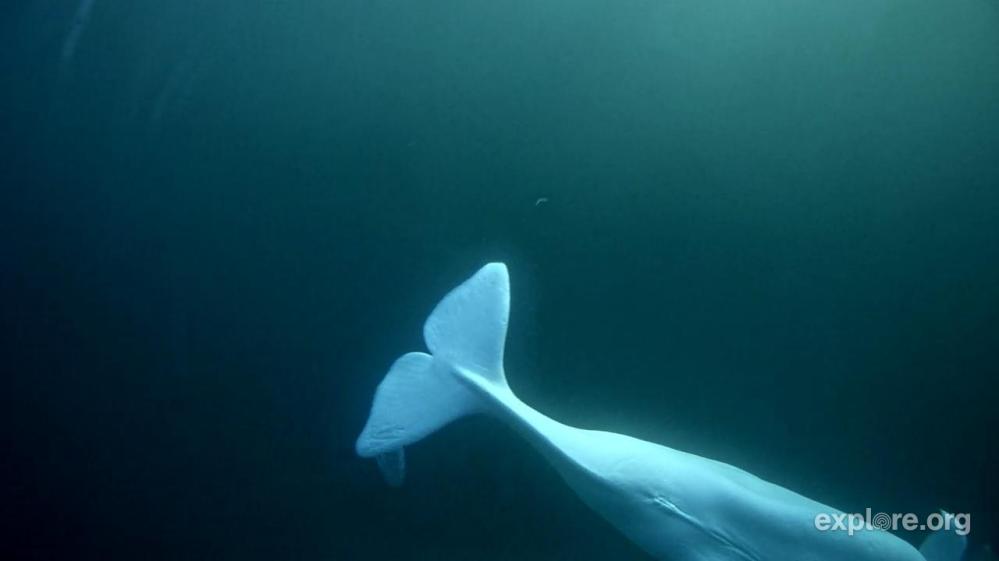
Male beluga have a centre line, but lack distinct mammillary grooves.
MALE
Jellyfish
I have put a mark on several jellyfish but can't go on to the next step
This is applicable to the Is that a jellyfish? workflow.
We ask you to put a mark on jellyfish in the photo, this counts the jellyfish for us. For each mark, you will need to select a species id. However, if you don't choose species id you will still be able to mark the next jellyfish but until you choose an id for each jellyfish the program will not let you proceed.
How can I tell what species of jellyfish this is?
The Field Guide and Tutorial provide some example photos and descriptions of the five species of jellyfish that we know inhabit the estuary: moon, Arctic comb, Lion's mane, melon comb, and common northern comb. They each have relatively distinct body shapes, features, and colours; here are some example photos:
Moon jellyfish
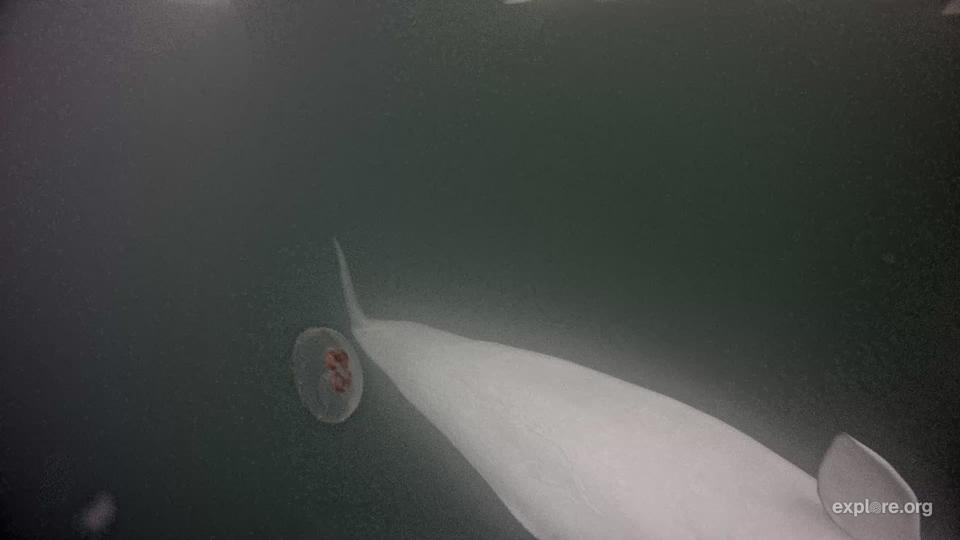
Moon jellyfish are very common and have a translucent, circular bell (body). The rim of the bell is smooth, unlike the Lion's mane jellyfish, and often you can see reddish clumps or "C"s (gonads) grouped in the centre of the bell.
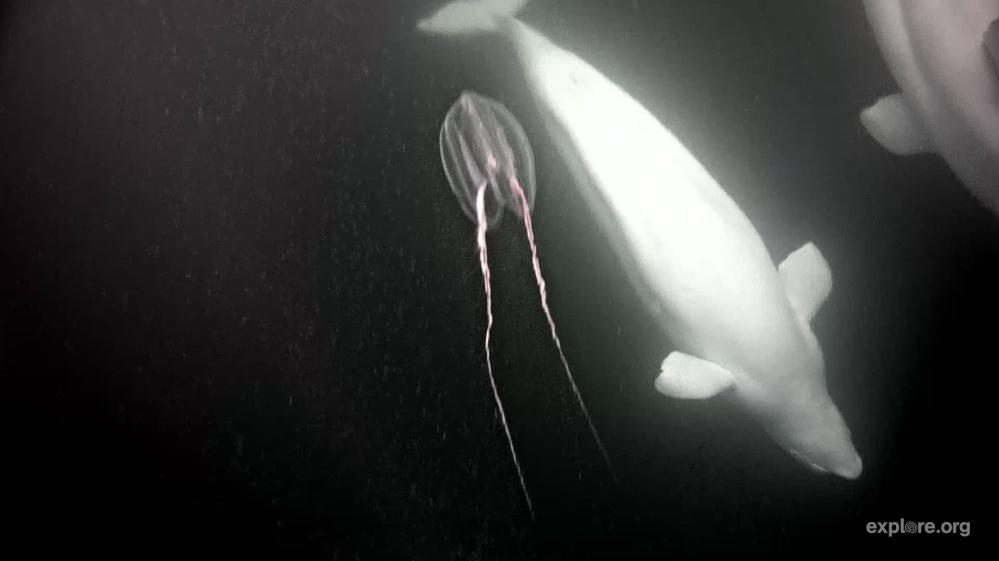
Arctic comb jellyfish
Arctic comb jellyfish are sometimes called "sea-nuts" because of their cylindrical bodies. They often have just a couple long tentacles flowing behind them. You can sometimes make out long "strings" extending from their bodies and down their tentacles. This species produces small amounts of light (bioluminescence) from the structures that help it move through the water.
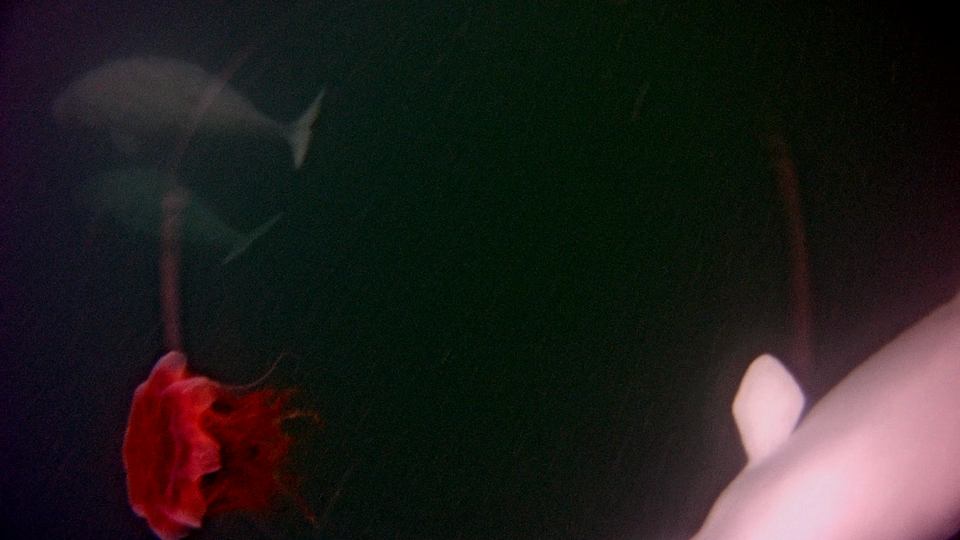
Lion's mane jellyfish
Lion's mane jellyfish are large and reddish in colour, with many showy tentacles flowing from a large bell. The rim of the bell is often wavy in appearance, unlike the moon jelly.
Common northern comb jellyfish
Common northern comb jellyfish have similar-looking comb rows to arctic comb jellyfish, but they also have pronounced pad-shaped lobes surrounding the mouth. Each of these lobes often have a dark patch near the end, but not always.
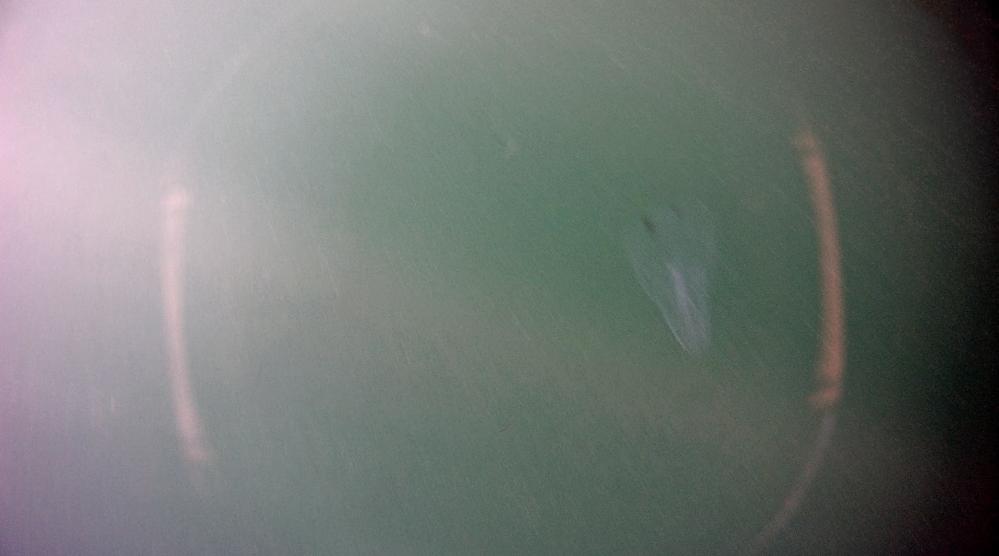
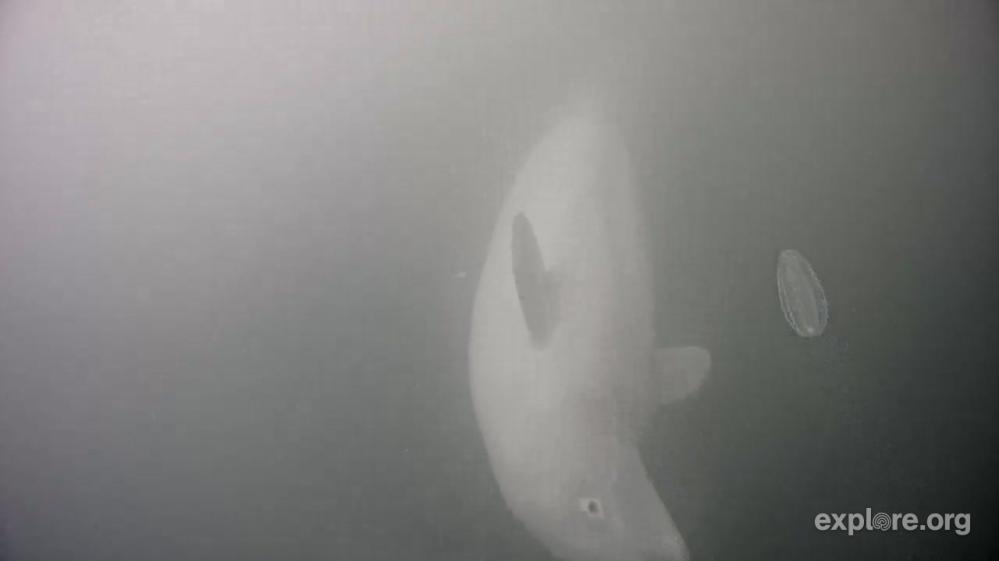
Melon comb jellyfish
Melon comb jellyfish are a species of comb jellyfish, they have eight rows of "combs" which they use propel their bodies through the water. This species can look very similar to arctic comb jellyfish, however melon comb jellyfish do not have tentacles.
This jellyfish doesn't look like any of those species, what is it?
This is applicable to the Is that a jellyfish? workflow.
Maybe this is a species we haven't encountered yet! There's potential that we might discover new or invasive species, but please be sure to carefully check our example photos just to be sure. If you are certain that it isn't one of these five species, please select "Other" as the species ID. If you are uncertain about which species it is or aren't sure that it is a new species, please select "Unsure" as the species ID. You can bring the photo to our attention as you finish classifying by using the "Done & Talk" button and leaving a comment.
Scars and Markings
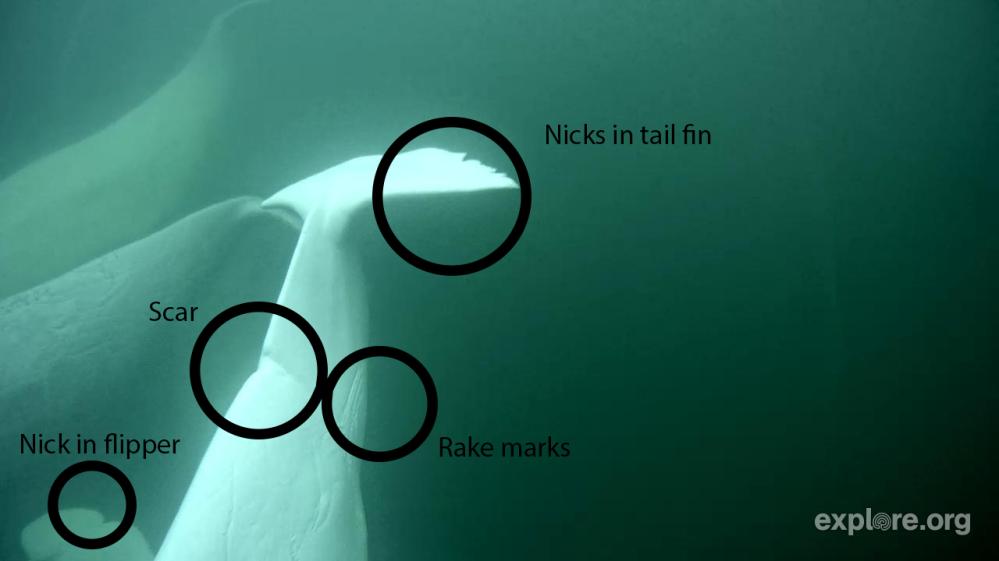
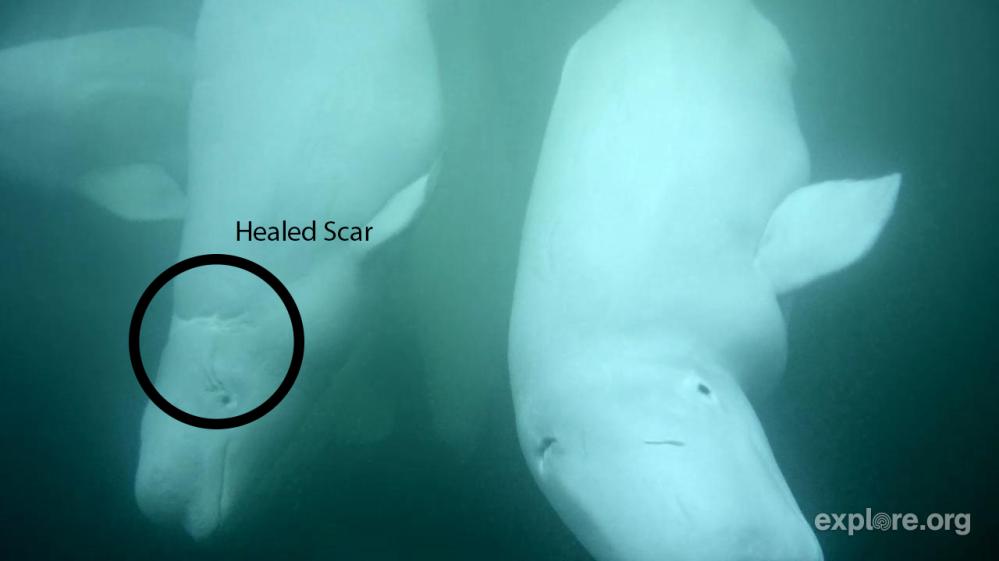
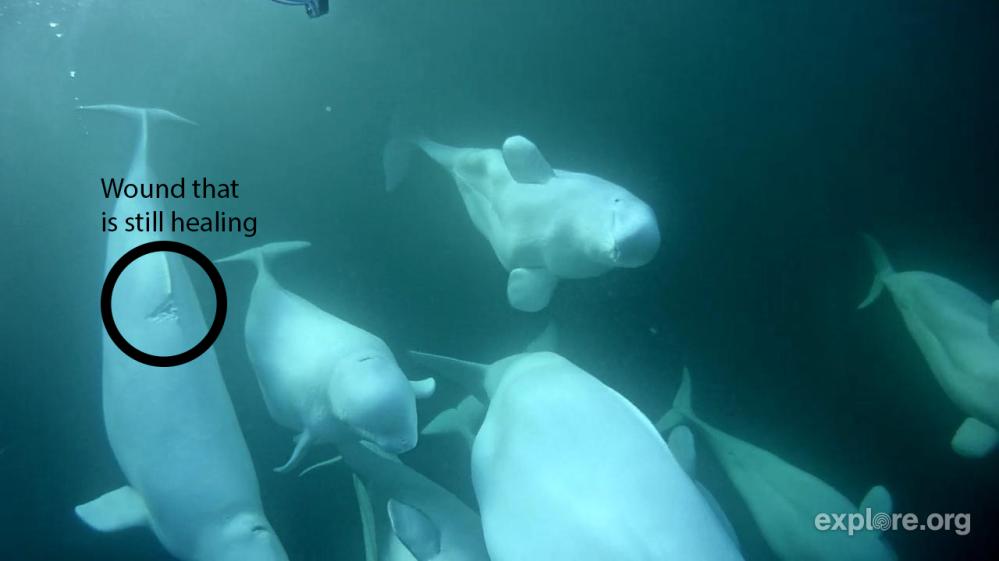
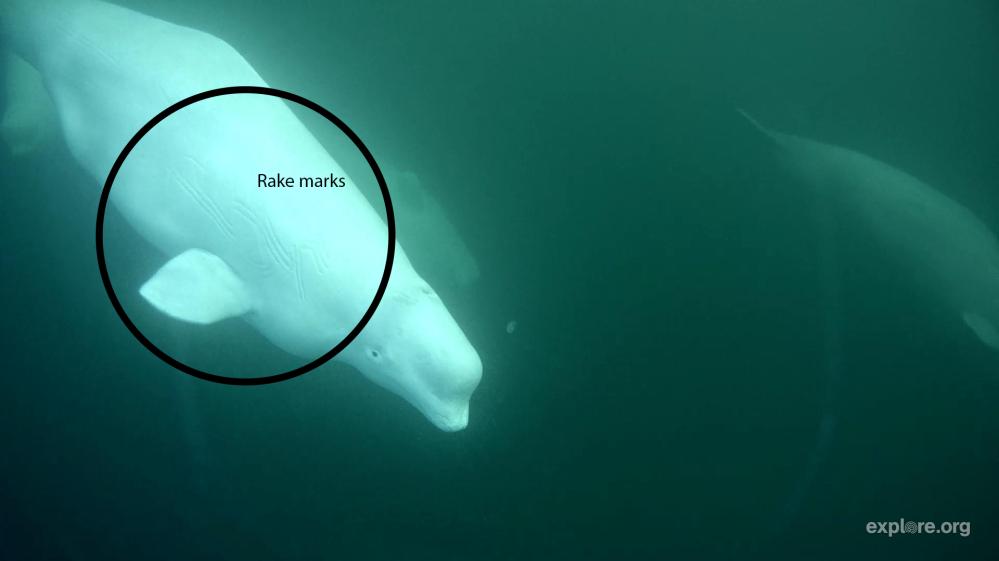
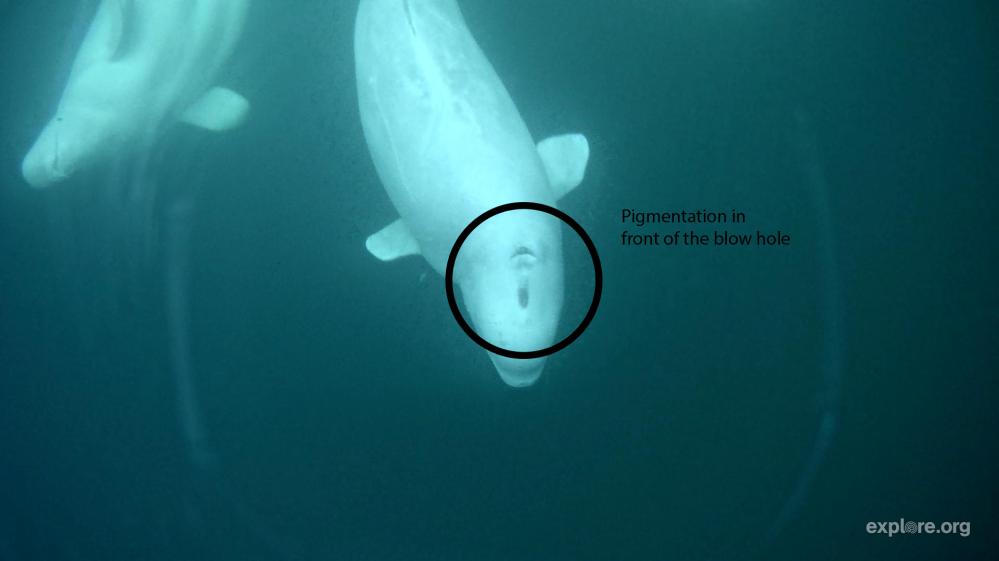
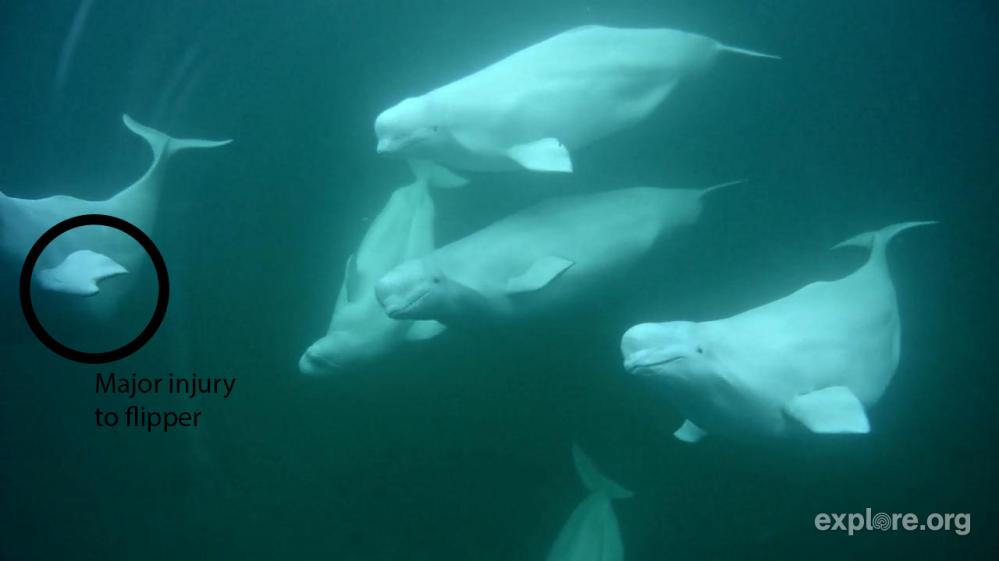
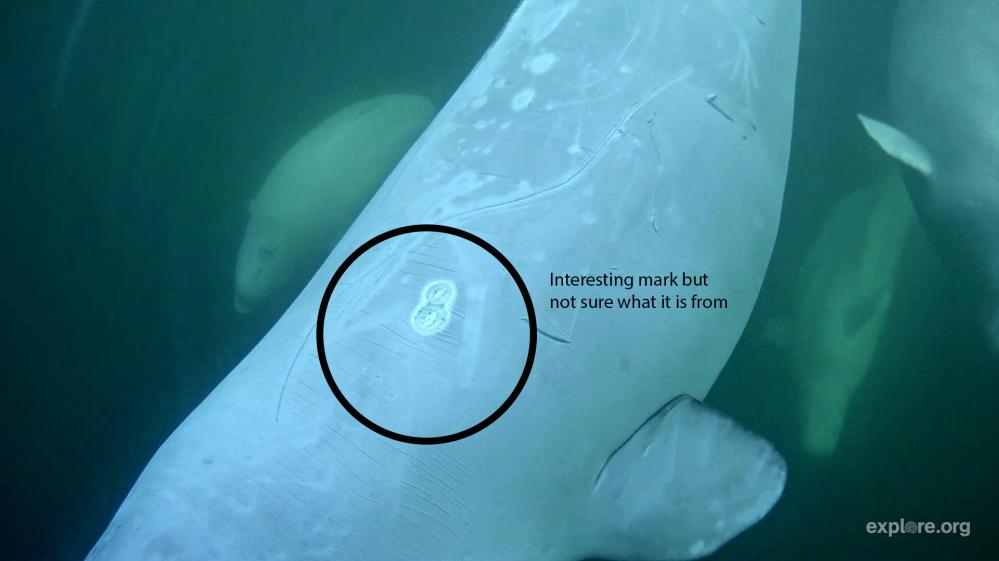
How do scars and markings help researchers monitor belugas in Hudson Bay?
Identifying scars and unique markings allows us to identify individuals; we can create a catalog and keep track of individuals' return to the estuary over consecutive years. Also, the type of injuries can tell us about the risks and threats facing belugas.
Here are some examples:
General Information and Cool Stuff
Why does this beluga have uneven pigmentation, splotchiness, speckling, or strange colouration on its head/body?
There could be a few reasons why the colour of a beluga looks a bit strange.
As beluga mature their colouration transitions naturally from the fairly uniform dark grey of a calf to the white of an adult. If the beluga is smaller than an adult and has mottled or marbled colouration all over its body, it is likely yearling or sub-adult.
Belugas also moult annually, either gradually or all at once. If a beluga is mid-moult their colouration may look a bit uneven or patchy. Other reasons could be skin infections, viruses, scars, or other markings that give the skin an uneven appearance, or differences in lighting and picture quality.
Here is an example of a sub adult transitioning from grey to white with some discolouration on the head that might be due to a skin infection of some kind.
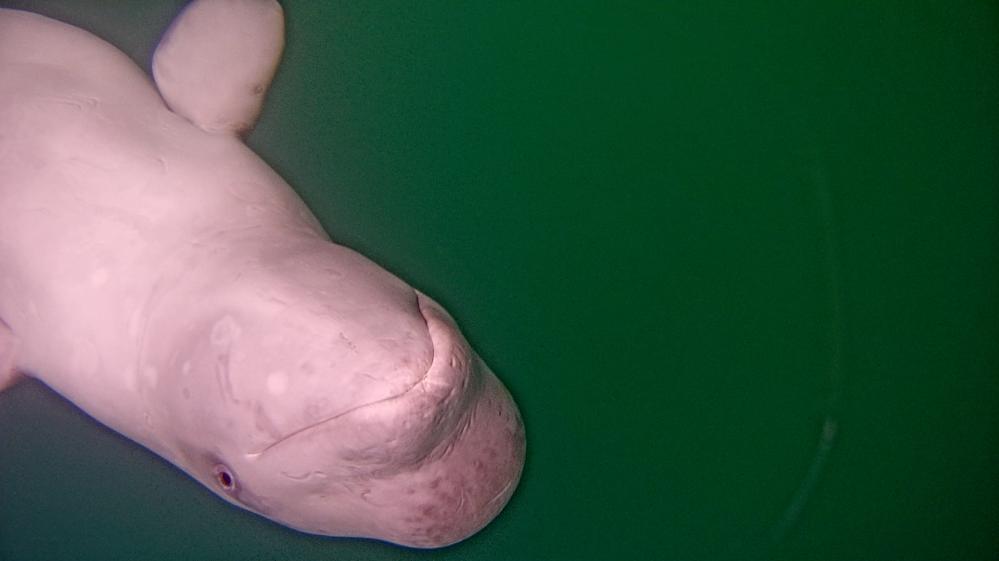
We also sometimes see areas of hypo or hyper pigmentation that is not related to moulting and may be more permanent. We are still unsure as to the cause of these marks but hope they will help us identify individual whales over time.
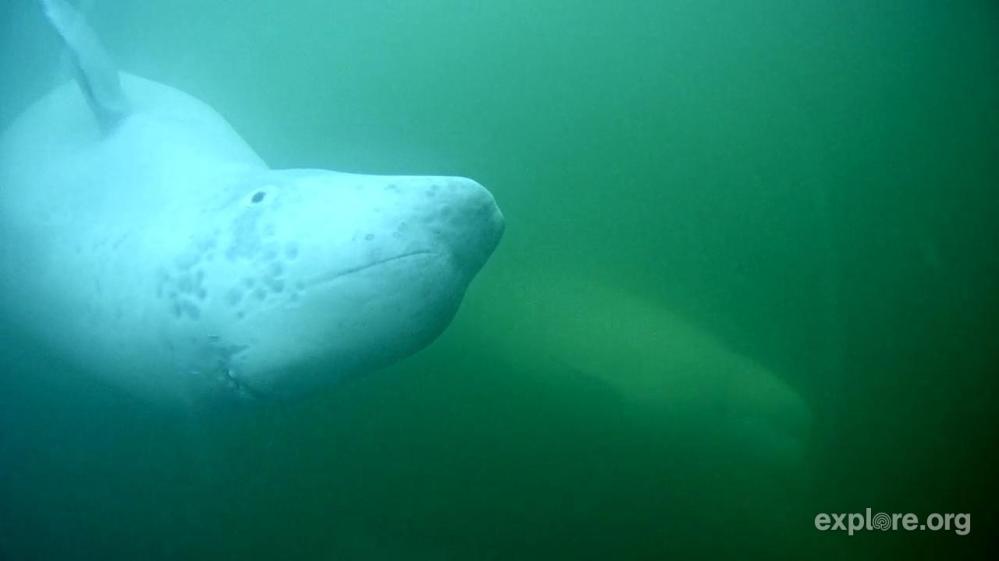
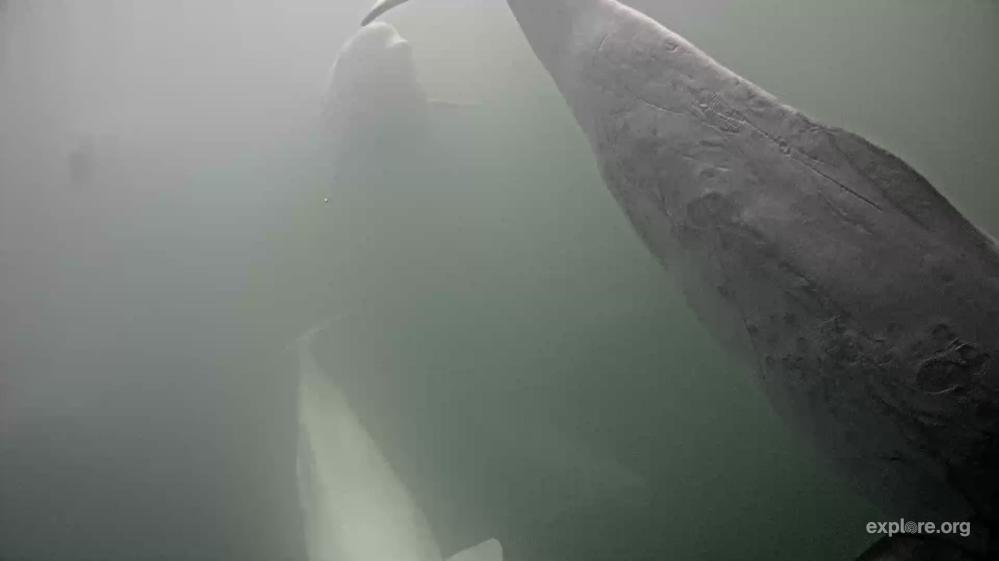
Check out hashtags like #mottled, #sub-adult, #pigmentation, and others in the Talk section to see more examples!
Is something trying to eat the camera?!
Sometimes beluga get a little too curious about the camera! If you come across photos like the ones below while classifying photos, please answer “Yes” to whether there is a beluga in the photo! While we cannot see the underside or identifying marks, we still want to know that there is a beluga in that photo.
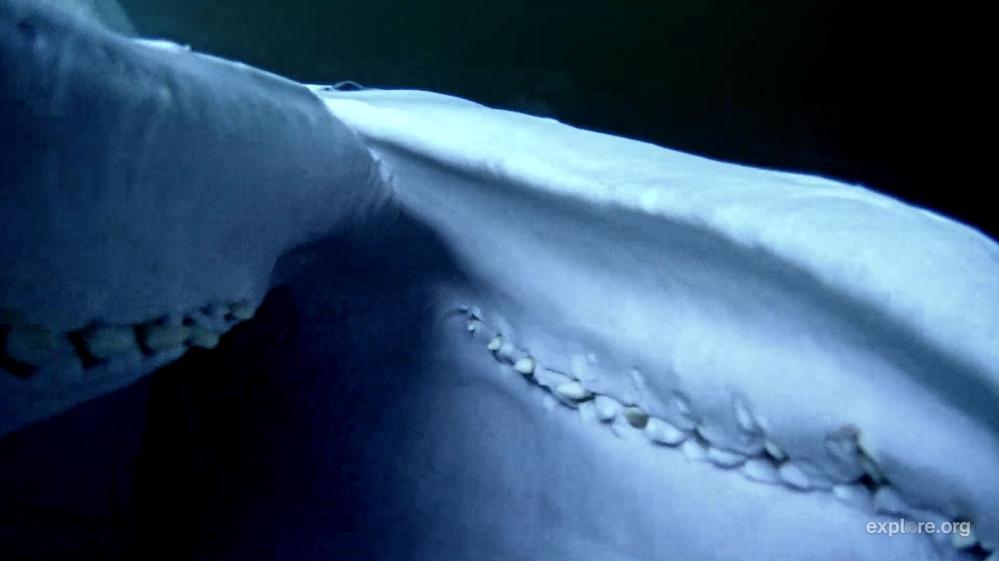
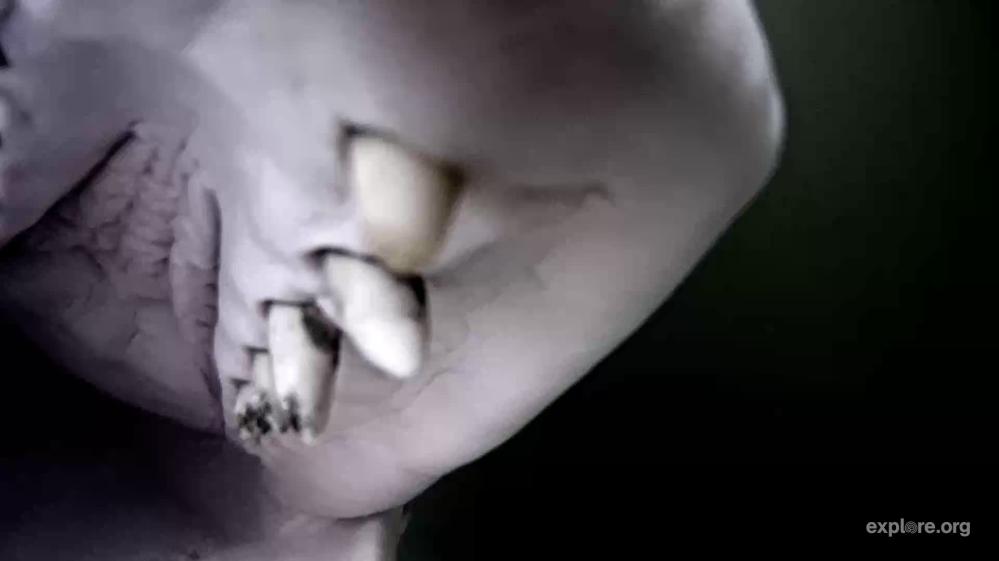
If you’re lucky you might stumble across photos of beluga getting up close and personal, check out those peg-like teeth! Have a look in the Talk section under #teeth, #mouth, and #belugamouth to see more photos of beluga giving the camera a taste!
What is that weird thing in the photo that isn’t a beluga?
Another fun part of this project is spotting other cool things in the photos! What you are seeing could be a variety of things, but here are a couple of common sights:
- Jellyfish are common in photos – lion’ s mane, moon, and arctic comb jellyfish all live within the estuary. Feel free to use the #jellyfish tag if you spot one!
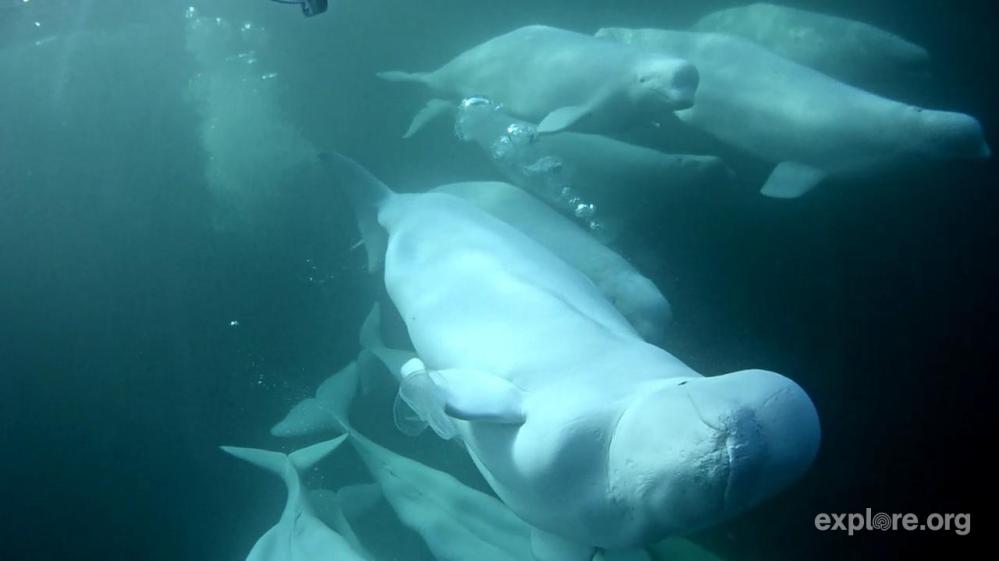
- Lines of bubbles. These might be produced by calves who do not yet have good muscle control for closing their blowholes or by adults that can produce them as a display, when they are vocalizing, or when they are startled.
- The zodiac/boat and propellers - the boat which takes our photos.
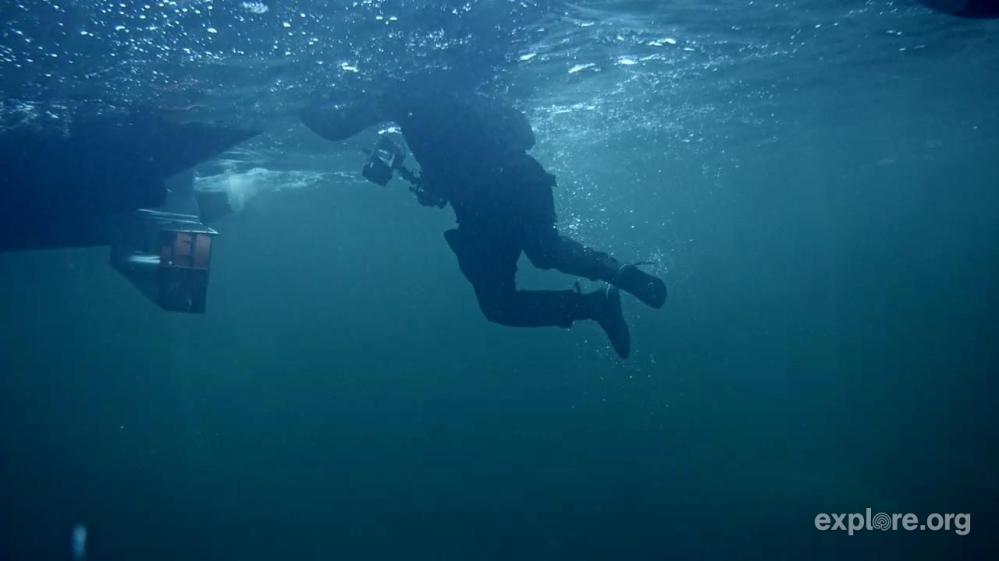
- Humans - sometimes the camera requires maintenance in the water, or you might spot the Beluga Boat captain who drives the boat.
- Seaweed / kelp.
- Rocks along the river bottom.
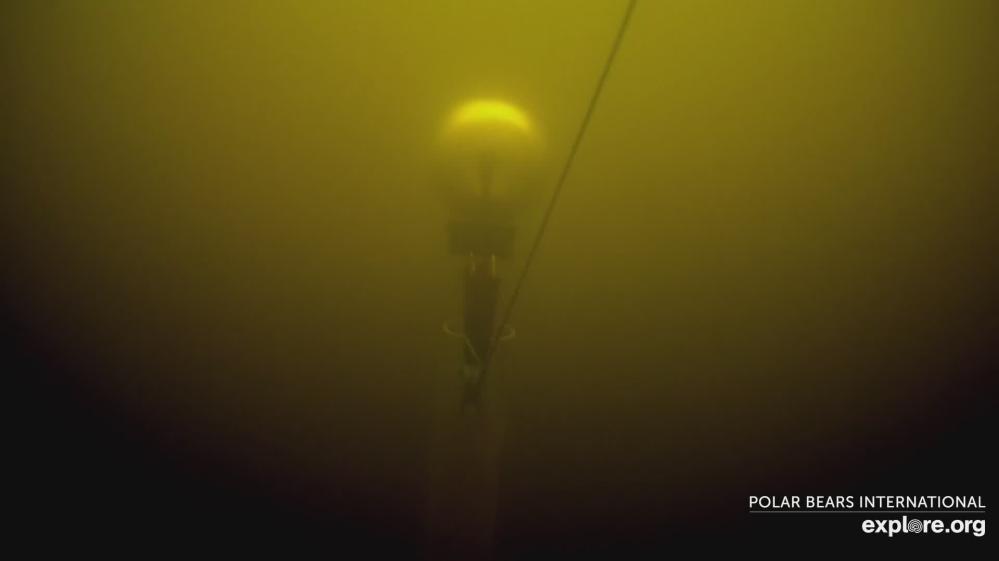
- Our 360 camera and bubble
If there aren’t any beluga in the photo, we still ask that you select “No” when answering whether there are any beluga in the photo. But if you see other cool things we do encourage you to use hashtags and share them with the Beluga Bits community!
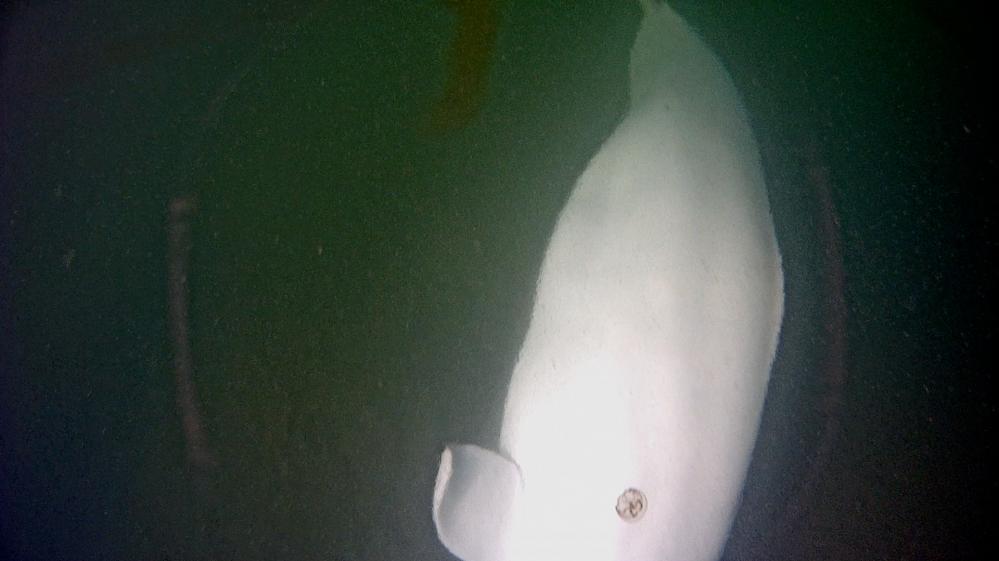
Here is a small jellyfish in front of a beluga:
Here is an example of a jellyfish alongside a beluga group with bubbles:
Our new 360 camera encased in a protective bubble:
And a researcher in their natural habitat 😉
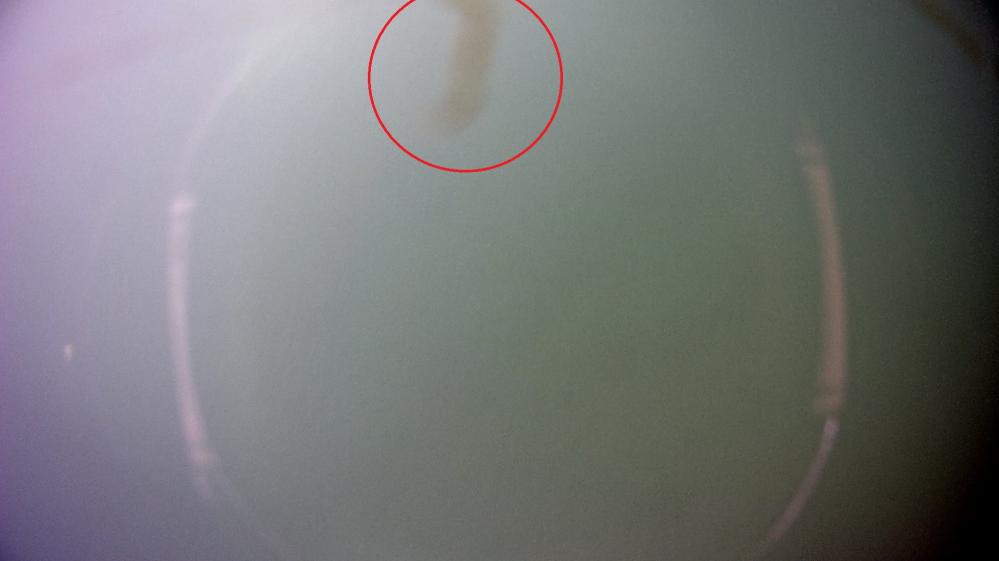
I've seen a few photos with a strange red structure in the middle, what is it?
In the 2019 field season something was caught on the camera lens and unfortunately makes frequent appearances in the top-centre of photos. It could be something hanging from the boat or a piece of debris/algae, but we aren't too sure. For most workflows this structure can be safely ignored when answering questions and making classifications.
Here is a photo with the structure circled in red: