


Finished! Looks like this project is out of data at the moment!

See Results

Protect the forest by finding the spider monkeys for British Science Week 2020

Education

Spider monkeys

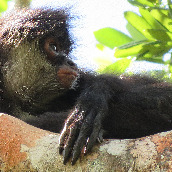
Spider monkeys (genus Ateles) are so named as their five long limbs remind people of spiders. There is quite a lot of variation in the colouration of their fur - some species have entirely black fur whereas others have combinations of black and yellow or brown and white, and even some gold and red. There are 7 species of spider monkeys and they are found from the south of Mexico to the North of Bolivia. Spider monkeys are arboreal, meaning that they spend most of their time in the forest canopy, which in some forests can be around 40-50m above the ground. Like the other primates in their Family (Atelidae), they have highly specialized prehensile tails, full of muscles that can be used as an extra arm and which they use to hang onto branches and prevent themselves from falling (like a safety harness). Females carry their infants on their backs when they travel through the forest for about the first two years of life. Even when the young move independently, the mother is attentive and uses her body as a bridge for the young monkey to cross over when the gaps in the canopy are too large for the young to cross them by herself. Very few primates can do this.

Spider monkeys live in groups that share characteristics with humans and chimpanzees. All group members know one another but are rarely all together at one place and time. Instead, they form subgroups of individuals that change in membership throughout the day. This requires a very large amount of memory, and spider monkeys are one of the most intelligent primates. For example, they are smarter than gorillas, which are several times larger!

This characteristic helps spider monkeys to deal with conflict over decisions where to go and what to do because they can simply form subgroups of individuals that have similar interests. They can also form smaller subgroups to reduce competition within the group when food is less available. If splitting into subgroups is beneficial, there could be trouble when subgroups come together. Spider monkeys deal with the potential of aggression when subgroups come together by greeting one another. A study showed that if spider monkeys embrace one another when they meet after being in different subgroups there is no aggression. Perhaps reducing hostility (and increasing trust) is the reason why people greet when they meet!

Spider monkeys are very long-lived primates and the females only have one infant about every three years. Across their range spider monkey habitat is being lost due to agricultural expansion and tourism expansion. In addition, spider monkeys are often hunted for food or to be kept as pets. Their slow reproduction makes it difficult for spider monkeys to recover from disturbances in their habitat and as a result all species of spider monkeys are threatened with extinction. The decline in spider monkey populations is highly problematic as these monkeys play a vital role in their ecosystem. Spider monkeys have a diet that consists mainly of fruit. In many cases they ingest the seeds that are in the fruits whole and excrete them far away from the parent tree. Studies have shown that passage through the spider monkey gut helps the seeds to germinate. Together, this means that spider monkeys can be considered gardeners of the forest as they play a very important role in forest regeneration. Losing spider monkeys from Latin American forests would equate to large scale changes in the tree species that make up the forest as many trees depend on these monkeys for their dispersal.