



Welcome! This project recently migrated onto Zooniverse’s new architecture. For details, see here.
Research
The Large Hadron Collider (LHC) at CERN is the world's most powerful particle accelerator. In its two 27km-long circular vacuum tubes, beams of protons are accelerated to almost the speed of light, in opposite directions. The tubes intersect at four Interaction Points (IPs) along the LHC circumference, where the beams cross and protons collide. To study the products of proton collisions, four large experiments (particle detectors) are installed around the IPs. The largest, general-purpose detector is called ATLAS (A Toroidal LHC ApparatuS), measuring 44m long and 25m high, and weighing over 7000 tones.
In 2012, ATLAS and CMS (the other general-purpose LHC experiment) co-discovered the Higgs boson, the last elementary constituent missing from our present description of nature and its laws, the Standard Model (SM). The Higgs boson is heavy with a very short lifetime and decays to other particles almost immediately without leaving any trace on the detector; therefore, its discovery had to be based on the observation of its decay products. The figure below illustrates all the known elementary particles along with the carriers of the forces.
The known elementary particles along with the carriers of the forces.

Despite the success of the SM certain open questions remain, and there are several theoretical models Beyond the Standard Model (BSM) that try to answer them. Some of these models predict the existence of new, long-lived particles with lifetimes of the order of picoseconds to nanoseconds, which decay to known SM particles several millimeters or centimeters away from the IP at the center of the detector. Due to their significant distance from the IP, such decay points are called Displaced Vertices (DVs) and their detection is an important subject of research for new physics by both the ATLAS and CMS experiments.
The central region (barrel region) of ATLAS consists of a series of ever-larger concentric layers around one of the LHC IPs. Each end of the barrel (end-cap) is also instrumented with detectors. The detector is divided into four major sub-systems: the Inner Detector, the Calorimeters, the Muon Spectrometer and the Magnet systems, which are complementary:
- the Inner Detector is installed around the center of the ATLAS, right after the LHC beam pipe. It consists of three different sub-detector technologies, all designed to accurately record traces of charged particles produced at the collision point and moving outwards. Neutral particles (e.g. photons) pass through the Inner Detector unnoticed;
- the Calorimeters contain heavier materials (e.g. steel, lead), which cause both charged and neutral incoming particles to interact and deposit all of their energy, allowing us to measure it. In particular, the energy of an incoming particle is distributed among a bunch of lighter particles, which appear as a localized particle-shower in the detector. There are two calorimeter systems in ATLAS:
- the electromagnetic calorimeters absorb and measure the energy of electrons, positrons and photons. Energetic hadrons penetrate this calorimeter leaving only a fraction of their energy;
- the hadronic calorimeters measure the total energy of hadrons, such as protons and neutrons. They stop almost all particles allowing us to measure their energy;
- the Muon Spectrometer detects the energetic muons which leave little energy in the other detectors and have the ability to penetrate the entire detector;
- the Magnet Systems bend charged particles in the Inner Detector and the Muon Spectrometer, allowing for their momenta to be measured accurately from their track curvature.
- Only neutrinos escape undetected from the ATLAS detector but their energy can be measured indirectly from the momentum imbalance in the plane perpendicular to the beam axis.

The ATLAS detector
The proton beams enter ATLAS from the sides and collide at the center. The high-energy proton collisions create a multitude of new particles that move outwards in all directions. Most of those particles are stable and can be detected by ATLAS. There are, however, as previously mentioned, some heavier particles that decay almost instantaneously and which ATLAS cannot detect directly. They decay though into other, stable particles which we can detect. On the other hand, in the case of the hypothesised long-lived particles that we will be searching for, we would see a group of particle tracks originating not from the centre of the detector, the IP, where the collisions take place but from a distant point. This is the point where the invisible particle (which was created at the center and traveled to that location) decayed. It is called a displaced vertex.
Below, you see an example of a visual representation of an event. You will be using this kind of representation to perform most of your data analysis.
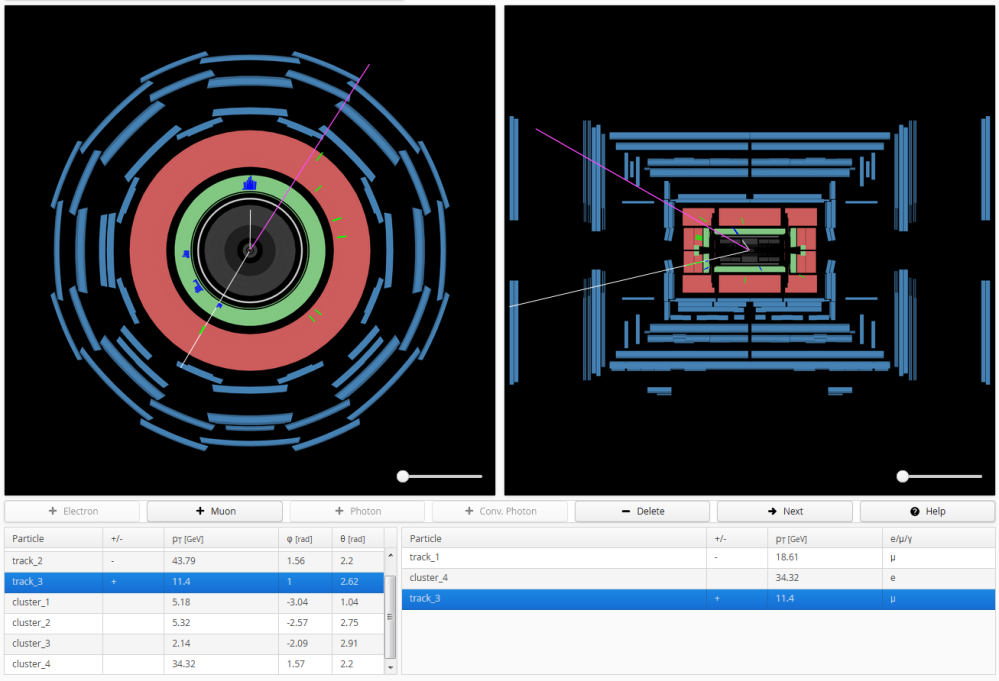
Transverse (left) and longitudinal (right) projection of ATLAS for visual data analysis. The main sub-detector systems are depicted with different colours. The products of the high-energy proton collisions move outwards in all directions and are represented as lines.
Tasks such as the identification of displaced vertices and converted photons are non-trivial, and therefore, complex algorithms (including machine learning and neural networks) are usually employed. However, they may be easy for a human to perform and in this project we would like to determine if this is the case. This could help us fine-tune and possibly improve certain aspects of our algorithms.