



Welcome! This project recently migrated onto Zooniverse’s new architecture. For details, see here.
FAQ
General Questions
How can citizen scientists get involved in the project and eventually help the ATLAS scientists?
Citizen scientists will be guided step-by-step to visually interact with and analyse data from the ATLAS experiment at the LHC. In this way, they will be directly involved in potential discoveries without requiring any high-level computing skills.
What is the LHC?
The Large Hadron Collider (LHC) is the world’s largest and most powerful particle accelerator. It first started running on September 10, 2008, and remains the latest addition to CERN’s accelerator complex. The LHC consists of a 27-kilometer ring of superconducting magnets with a number of accelerating structures to boost the energy of the particles along the way. Inside the accelerator, two high-energy particle beams travel in separate ultra-high vacuum pipes, at speeds close to the speed of light, in opposite directions.. The beams are made to collide at four locations around the accelerator ring, corresponding to the positions of four particle detectors – ATLAS, CMS, ALICE and LHCb.
What is the ATLAS experiment at the LHC?
ATLAS (A Toroidal LHC ApparatuS) is one of the four major experiments installed at the Large Hadron Collider (LHC) at CERN. It is a general-purpose particle physics experiment run by an international collaboration. ATLAS is the largest of the four experiments; it has a cylindrical form and is 46m long, 25m in diameter, and sits in a cavern 100m below ground at the LHC tunnel. The ATLAS detector weighs 7,000 tones, similar to the weight of the Eiffel Tower.
What happens when the LHC beams collide?
When the LHC beams, which travel at speeds of up to 99.999999% that of light, collide at the centre of the ATLAS detector they produce collision debris in the form of new particles which fly out in all directions and which the various layers of ATLAS try to detect.
How is the ATLAS detector made and why did it take so many years to build?
ATLAS is a many-layered instrument designed to detect various types of elementary particles. It consists of six different detecting subsystems that are wrapped concentrically in layers around the LHC beam collision point to record the trajectory, momentum, and energy of particles, allowing them to be individually identified and measured. A huge magnet system bends the paths of the charged particles so that their momenta can be measured as precisely as possible. The sub-detector elements were built as a collaborative effort by many scientists and engineers across the world and finally brought to CERN to be installed in the ATLAS cavern, almost like “a ship in a bottle”.
How many people work in ATLAS?
ATLAS is one of the largest collaborative efforts ever attempted in science. There are about 3,000 scientific authors (including 1,200 PhD students) from about 180 Universities/Institutes around the world.
What am I being asked to do?
You will work with event displays to visually inspect and interact with ATLAS events. The project has three stages and it is very important to sequentially follow all of them. In the first two stages you will be working with SIMULATED events.
What do I do in Stage 1?
You will learn to identify and locate Displaced Vertices, namely points other than the colliding beam center, where the sought-after particles could be decaying. To facilitate your searches, you are ONLY given views of the inner detector of ATLAS and of those events which only contain tracks that may be originating from Displaced Vertices (tracks which originate from the colliding beam center have been removed).
What do I do in Stage 2?
You are given the full visual representation of the ATLAS detector (both views), as provided by the HYPATIA event-display tool, and you will practice in identifying different kinds of elementary particles by the characteristic signatures they leave in the ATLAS sub-detectors.
What do I do in Stage 3?
You will examine REAL data from LHC collisions at a centre of mass energy of 13 TeV, recorded by ATLAS during the year 2016, and corresponding to an integrated luminosity of 10fb-1. This sample was released by ATLAS under the policy of Open Data for educational purposes. The purpose of your searches is two-fold a) “discover” Higgs bosons by reconstructing their decay to two photons and b) search (and possibly discover) new long-lived particles (LLP) predicted by certain theories, which are postulated in order to explain the remaining “puzzles”, after the discovery of the Higgs boson.
What do the colours mean in the HYPATIA display
They simply mark different parts of the ATLAS sub-detectors making it easier for users to identify them.
Why can't a computer do this?
The results which you will generate by processing the simulated sample of events in Stages 1 and 2 will be compared against various (including machine learning) computer algorithms. This comparison may determine areas where the human eye is better, and therefore, may help us improve our computer-based algorithms. For this, we need as much human input as possible.
Higgs boson FAQ
What is a boson?
Bosons make up one of two classes of elementary particles, the other being fermions. Bosons have, by definition, integer spin. The Higgs has zero spin, the gluon, photon, W and Z all have spin equal to one, while the graviton is postulated to have its spin equal to two. Quarks, electrons and neutrinos, on the other hand, are fermions, and all have a half unit of spin.
Why is the Higgs boson so important in physics?
Back in the 1970s, physicists realised that two of the four fundamental forces – the weak force and the electromagnetic force - could be described within the same theory, which forms the basis of the Standard Model (SM). The basic equations of the theory correctly described the electroweak force and its associated force-carrying particles, namely the photon, and the W and Z bosons, except for the fact that the carriers were predicted to have zero mass! While we know that this is true for the photon, we also knew that the W and Z bosons have mass, nearly 100 times that of a proton.
Fortunately, the theorists Robert Brout, François Englert and Peter Higgs proposed a theory which breaks the electroweak symmetry and solves this problem. What we now call the Brout-Englert-Higgs mechanism (BEH) gives mass to the W and Z when they interact with an invisible field, now called the “Higgs field”, which pervades the universe. A necessary ingredient of the Higgs field is its associated particle, the Higgs boson. A problem for many years had been that no experiment had observed the Higgs boson to confirm the theory. On the 4th of July, 2012, the ATLAS and CMS experiments at CERN's Large Hadron Collider announced they had each observed a new particle in the mass region around 125 GeV. This particle is consistent with the Higgs boson and is the last missing component of the SM. On the 8th of October, 2013, the Nobel prize in physics was awarded jointly to François Englert and Peter Higgs, “for the theoretical discovery of a mechanism that contributes to our understanding of the origin of mass of subatomic particles”.
Why am I being asked to investigate the diphoton decay of the Higgs boson?
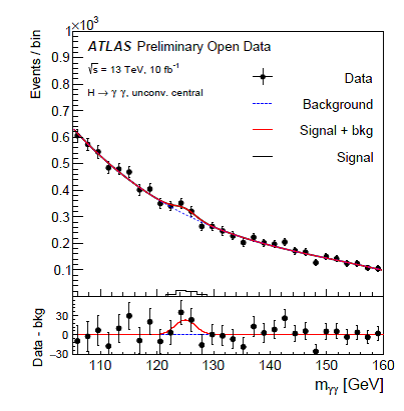
The Higgs boson has various decay modes, but one of the easiest to detect is its decay to two photons (one of which can be converted to an electron-positron pair). The excellent mass resolution of the electromagnetic calorimeters (~1.4% at the Higgs mass) allowed both the ATLAS and CMS experiments to include this decay mode at the first announcement of the Higgs discovery. In the distribution of the invariant mass of the two photons, the Higgs boson appears as a bump sitting on top of a background which can be fitted by a smooth function.
LLP searches FAQ
Why do we need Theories Beyond the Standard Model?
The Standard Model of particle physics agrees very well with experiment, but many important questions still remain unanswered. Among them are the following:
- How does one understand the number of species of matter particles and how do they mix?
- What is the origin of the difference between matter and antimatter, and is it related to the origin of matter in the Universe?
- What is the nature of astrophysical dark matter?
- How does one unify the fundamental interactions?
- How does one quantise gravity?
A lot of theoretical models have been proposed to answer some of the above questions (collectively called Beyond the Standard Model theories), many of which predict the existence of a variety of new particles.
What are the LLPs you will be looking for?
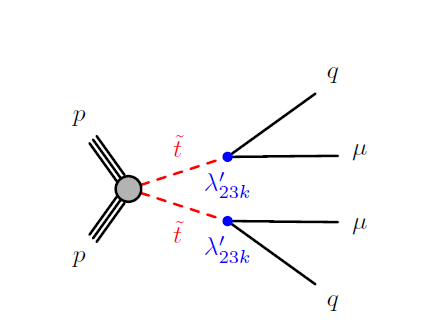
Several extensions of the SM predict the existence of heavy neutral particles with long lifetimes. These Long-Lived Particles (LLP) would decay at a significant distance from the primary collision point of the LHC beams, and therefore, they could be detected from their daughter particles originating from a displaced vertex. In Stage 3 you will be trying to discover LLPs by looking for a muon at the displaced vertex (which is relatively easy to observe since it is a long track traversing the detector) plus some more tracks. The discovery of LLPs would be a major accomplishment -maybe more important than the Higgs boson discovery itself- because it would allow scientists to enter into areas of “new physics”.
Do cosmic rays reach the ATLAS detector?
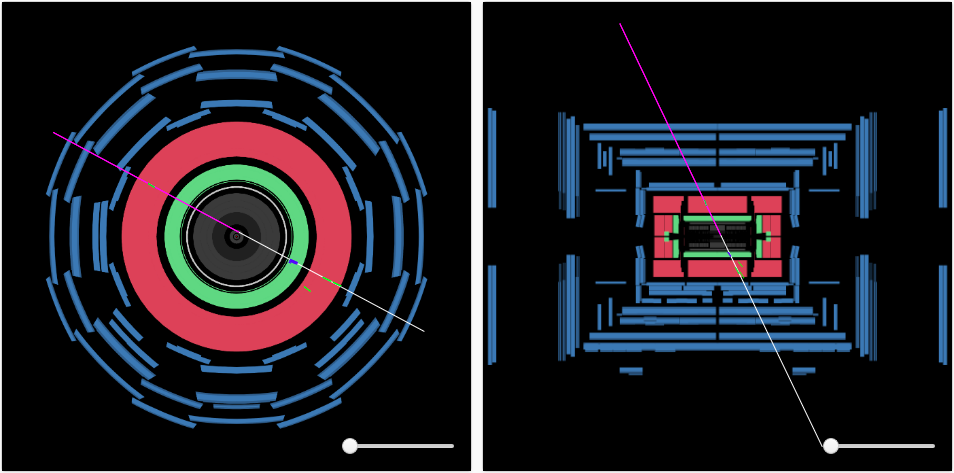
Although ATLAS sits in a cavern 100m below earth’s surface, cosmic rays do reach it and can mimic the signature of displaced vertices. These vertices will consist of only two muons diametrically opposite, in both detector views. For this reason, we have selected events containing displaced vertices with at least three tracks.
Where can I get more information about the LLPs and BSM theories?
There are plenty of resources on the web and a lot of published papers. Selected references are given in the “EDUCATION” tab of the “ABOUT” section.
Didn't find an answer? Ask our community of volunteers and researchers on Talk.