Finished! Looks like this project is out of data at the moment!
Pop the Champagne, we just turned ONE! 🍾.
365 days, 4 360 Volunteers, 25 540 Videos of Flowers and 143 443 Classifications of Insects
Despite all of the chaos this year has brought, one thing remains certain. How grateful I am for all the citizen scientists who have helped make our work across Buzzy Bee – African Canopy Pollinators. Thank you for every like, follow, classification, question and feedback. Without the information gathered by volunteers, much of the work done to identify insect pollinators of large African timber trees simply would not be possible.
The willingness of participants to join together and work collaboratively has also led to the inclusion in this year's 'Into the Zooniverse' book’ highlighting 20 projects chosen from the more than 150 projects active on the Zooniverse platform in the 2020 – 21 academic year.
The link to the PDF version of the book, as well as details on how to order a hard copy, if of interest, are here: https://www.zooniverse.org/about/highlights
The Team
Organizations
Université libre de Bruxelles
Unit of Evolutionary Biology & Ecology
The present work is supervised by Dr. Olivier Hardy. His research team is invested in scientific research of a more fundamental nature (phylogeography, population genetics and quantitative genetics, molecular systematics and taxonomy, development of DNA barcode) of plant biodiversity, especially in African tropical forests. The research team consists of post-doctoral researchers, PhD students, interns, and scientific collaborators from various backgrounds and offers a great working environment promoting exchanges between people working on similar science topics.
Agroecology lab
This study is also co-supervised by Dr. Nicolas Vereecken, a specialist of bees and plant-pollinator coevolution. His work on agroecology aims to promote the social and economic dimensions of the management of natural resources, as well as to collectively develop studies on agroecological innovations, urban agriculture, agroforestry and ecosystem services such as the pollination of crops by wild and managed bees.
AFRITIMB Project
This work is also part of the AFRITIMB project (Reproduction and gene flow of African timber species – towards sustainable forest management) led by Olivier Hardy (Université libre de Bruxelles) et Jean-Louis Doucet (Université de Liège) and funded by FNRS (PDR-WISD) from 2017 until 2020. The research aims at understanding the processes involved in the reproduction of tropical forest trees, including mating system, pollen and seed dispersal, inbreeding depression, and how they are impacted by timber exploitation in the context of Central Africa. This project will ultimately help define new rules for forest managers aiming at maintaining a sufficient potential of regeneration and species adaptation after exploitation to preserve healthy populations of timber species.
Collaborating Organizations:
The International Institute of Tropical Agriculture (IITA-Cameroon), Cameroon
École normale supérieure de Yaoundé (ENS), Cameroon
Station d’Etudes des Gorilles et Chimpanzees (SEGC), Gabon
Agence Nationale des Parcs Nationaux (ANPN), Gabon
Precious Woods Gabon - Compagnie Equatoriale des Bois S.A. (Precious Woods-CEB), Gabon
The National Herbarium of Gabon, Gabon
Centre National de la Recherche Scientifique et Technique (CENAREST), Gabon
Funding organizations:
F.R.I.A Grants - FNRS-F.R.S
Stay Abroad (OUT) Grant - FNRS-F.R.S
French Facility for Global Environment (FFEM)
Collaborators:
Vincent Deblauwe & Vincent Droissart that conceived the cameras and taught how to use them.
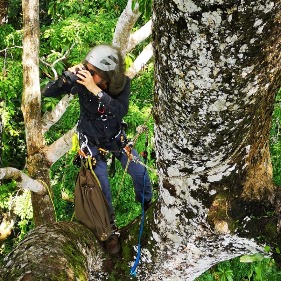
Edouard Coenraets that climbed as well as helped collecting and analysing data in Cameroon and Gabon. But also, that played a important part conceiving this Zooniverse projet.
Eric Guilbert that taught me his climbing technics helped collecting these data in Cameroon.
Gyslène Kamdem Meikeu and Eric Onguene that climbed and helped collect these data in Cameroon.
Romaric Ndondamakemba that shared some of the field work in Gabon. Finally, many thanks to Edmond, Alex, Rémy, Armand et Gaston for sharing their precious field experience.