



Interested in joining the post-analysis efforts? Send an email to Veselin.B.Kostov@nasa.gov.
Research
Exoplanets
Billions of planets orbit the stars of our Galaxy beyond the Sun; these planets are called "exoplanets". When an exoplanet's orbit is lined up so that it passes between its star and the Earth, temporarily blocking the light of its star from our view, we call it a "transiting exoplanet". Surveys to find transiting exoplanets have taught us that worlds a few times the size of Earth are common, but left us with many unanswered questions. Where are the closest Earth-size planets? Do they harbor alien life?
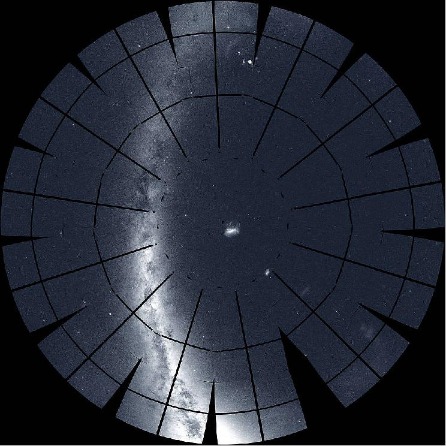
Launched in 2018, NASA's TESS mission has already discovered thousands of potential exoplanets transiting nearby stars--including planets as small as the Earth. Data from this mission should help us find the closest Earth-size planets, ones that are close enough for us to characterize in depth and study their atmospheres. A few dozen TESS planet candidates have already been confirmed as real planets.
Planet Patrol Goals
TESS will monitor the brightness of millions of stars--you can imagine how big a challenge it will be to sort through all these signals. Automated processes help us select the strongest signals. However, planets of smaller sizes, longer periods, in more crowded fields, with weak signals etc., will require human intervention to extract and analyze. Here at Planet Patrol, you will help find transiting exoplanet systems from TESS that confuse automated algorithms--the most informative and exotic planetary systems. Our goals are to visually inspect images corresponding to thousands of TESS planet candidates (as produced by planet-searching methods), and weed out those images that are contaminated by instrument and/or astrophysical artifacts.
The vast majority of planet candidates from TESS are still under scrutiny because several kinds of signals can masquerade as transiting planets: variable stars, eclipsing binary stars, instrumental artifacts, blended stars, etc. These imposters are a major challenge for planet-searching and confirmation efforts; for each real planetary signal detected, there are many non-planetary signals! One way we can identify such false positives is to measure how the TESS image of a target star changes during transits.
While we use computers to obtain these measurements, the produced results are not always correct, especially when the strength of the signal we are trying to evaluate is comparable to all the background noise in the image. This is not unlike trying to listen to music when there is construction nearby! You can help us check through the TESS data, one image at a time, to minimize the effects of that background noise, maximize the efficiency of the automated processes, and ultimately to make sure that objects we suspect are planets REALLY are.
How TESS Finds Planets
TESS takes images of the sky every 2 or 30 minutes, depending on the mode of observations, for at least a month. For each star, these images are combined to produce a brightness time-series called a "light curve". Here is an example of TESS light curve:

The x-axis shows time in days. The y-axis shows how bright the source is as time goes by. The full range of the y-axis is only a 1% change in the star's brightness--so this particular star's brightness is only changing by about 0.25% at most. Look to the right of day 1356 or 1378 and you'll see the star's brightness dip a few times (marked by red arrows); those dips are caused by transiting exoplanets. The gap near the middle of the light curve around day 1368 represents the time when TESS stops observing the sky to transfer the data back to Earth. This star has three transiting planets, one of which produced the transits indicated by the vertical grey lines (some of which are marked by red arrows).
Many of the TESS discoveries are small planets orbiting small stars, including:
-- a planet around a naked-eye star
-- a three-planet system where one of the planets is smaller than Earth
-- a planet orbiting one star of a triple star system
-- a four-planet system around a Sun-like star
and many many more!
What can go wrong? False Positives!
So what could go wrong? Let's take a closer look at how a light curve is made. Each point in the plot above represents 2 minutes of TESS observations, extracted from a sequence of TESS images like these:

Ideally, this sequence of images will show a single, bright spot (a star) near the center of the image with a red dot near the center of the spot -- like for the planet candidate shown above. This bright spot represents the part of the image that is changing during the observed transits, and the red dot shows the source of the measured loss of light. Notice that the brightness of the individual images and the position of the red dot are changing ever so slightly, which is normal.

However, if some of the individual images are bad (like a few of the frames in the gif above), it can throw off the corresponding point in the light curve. For example, sometimes the images may show a bright spot near the side of the image -- like shown above -- multiple bright spots, negative spots, or even no clear spots at all. Sometimes the images are just noise. For more examples of good and bad images, take a look at the pull-out tab of the Field Guide on the right side.
The sequence of images shown above demonstrates the case of a planet candidate that turned out to be a false positive caused by the star near the lower right corner of the image. Here, the target star, which should have been visible in the center of image and which we initially assumed is producing the transits, is nowhere to be seen -- indicating that it is not changing during the observed transits, and is thus not their source!
Here at Planet Patrol, you'll help us inspect these images, and discard the bad ones that our computer software didn't catch. You'll be protecting the world from imposter planets! Good luck!
Thanks to NASA, which has funded this work through the Sellers Exoplanet Environments Collaboration. This project complies with the Paper Reduction Act via Office of Management and Budget Control Number 2700-0168. For more information on Citizen Science in NASA's Science Mission Directorate, go to science.nasa.gov/citizenscience and nasa.gov/solve.
