


Finished! Looks like this project is out of data at the moment!
Research
Planet Earth needs you!
The sun frequently sends huge eruptions of charged particles and magnetic fields hurtling into space at speeds of around a million miles an hour! If an extreme example of one of these solar storms hit the Earth, it could knock out electricity grids, satellite navigation and communication for days, weeks or even months. We are becoming increasingly reliant on these technologies and their loss could have devastating consequences for our way of life.
But you can help! Through this Zooniverse project, you will help us assess the danger posed by these eruptions, known as coronal mass ejections, as they move out from the sun.
Dr Harry Cliff, particle physicist and Curator of The Sun: Living With Our Star exhibition at the Science Museum in London, explains why you should help:
We know that the direction of the magnetic field within these solar storms strongly influences how big an effect they will have on Earth, but currently this magnetic field cannot be measured more than an hour before the storm hits our planet. Is there another way to determine how a storm will affect Earth well ahead of its arrival?
Using images from the twin NASA STEREO spacecraft, it is possible to observe each solar storm as it erupts from the Sun. Some images look very simple, like bubbles, while others are far more complex - like shattered light bulbs. Could the complexity of a storm hold clues as to how badly it will affect our modern technologies here on Earth?
We would like you to help us find out by deciding which storms are simple and which are complex. By doing so you can help us investigate their potential impact and this may ultimately give the people who run our power and communication systems more time to prepare for a major solar storm.
This research is being carried out by Shannon Jones and Chris Scott at the University of Reading and Julia Wilkinson, an experienced solar observer and citizen scientist. This project is being supported by the Science Museum in London which, in October 2018, will open a blockbuster solar exhibition, The Sun: Living With Our Star.
Project detail
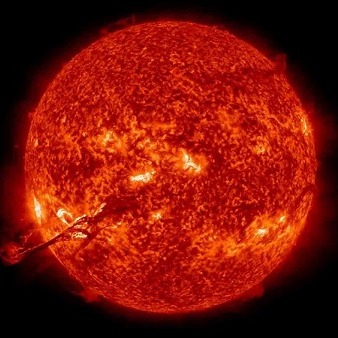
The latest spacecraft imaging the Sun have been able to image material erupting from the solar atmosphere in great detail, such as this image taken by the Solar Dynamic Observatory.

Solar storm image courtesy of NASA/SDO and the AIA, EVE, and HMI science teams.
The launch of the NASA STEREO spacecraft in 2006, provided us with a unique view of the region between the Sun and the Earth. Extremely sensitive wide-field cameras (developed in the UK) on board the spacecraft were able to image these vast gusts of solar wind, some of which were seen headed towards Earth.
The Sun behaves like a slowly rotating leaky football, emitting a constant stream of material in fast and slow jets known as the solar wind. These cameras reveal that clouds of solar matter have complex shapes that change as they move through space. This makes forecasting the arrival of a solar storm on Earth challenging. We need to understand more about how these clouds are distorted by magnetic fields and the solar wind to improve our predictions.

Artist's impression of the STEREO Spacecraft just after launch, courtesy of NASA
Computers are not very good at working out the complexity of these wispy clouds and analysing many hundreds of thousands of images by hand is extremely time consuming.
We need your help to choose which solar storms photographed by the NASA spacecraft are most complex or, to put it another way, the messiest. By doing so you will be participating in research that could help protect our planet!

Example image of a solar storm cloud that we need help analysing.
Please click on the classify tab above to start analysing pairs of images. There is a brief tutorial available on that page to help you record the data we need.
The more pairs of images you can help us categorise, the better we can rank them by their complexity, and analyse their ability to cause havoc on Earth.
A big thank you from everyone on the Solar Stormwatch team!