Finished! Looks like this project is out of data at the moment!
May 2025: Thank you for helping us test new data and a new workflow in preparation for our search of PHAST data for the Andromeda Galaxy.
Research
Welcome to the Local Group Cluster Search!
The goal of this project is to identify star clusters in our galactic neighbors: the Andromeda Galaxy (Messier 31 or M31), the Triangulum galaxy (Messier 33 or M33), the Large Magellanic Cloud (LMC), and the Small Magellanic Cloud (SMC) -- four galaxies in the Local Group, our cosmic neighborhood. We are currently searching images of Andromeda obtained by the Advanced Camera for Surveys (ACS) on the Hubble Space Telescope, and previously used images from the Dark Energy Camera (DECam) on the Blanco 4-m at Cerro Tololo Inter-American Observatory (CTIO).
Star Cluster Science
Star clusters are collections of hundreds to millions of stars that were born at the same time from the same cloud of gas. This shared origin makes star clusters unique tools for understanding how stars form and evolve. Additionally, they are useful for studying the major chapters in the formation history of a galaxy. But before we can unlock these secrets, we need the help of citizen scientists to find the clusters.
Star clusters vary greatly in terms of mass, size, age, and local environment. As a result, star clusters can appear quite different from one another depending on the properties of the clusters and where they are located in the galaxy. This makes the process of identifying clusters tricky and difficult to automate. We hope that you will help us find the thousands of star clusters hiding in the survey data!
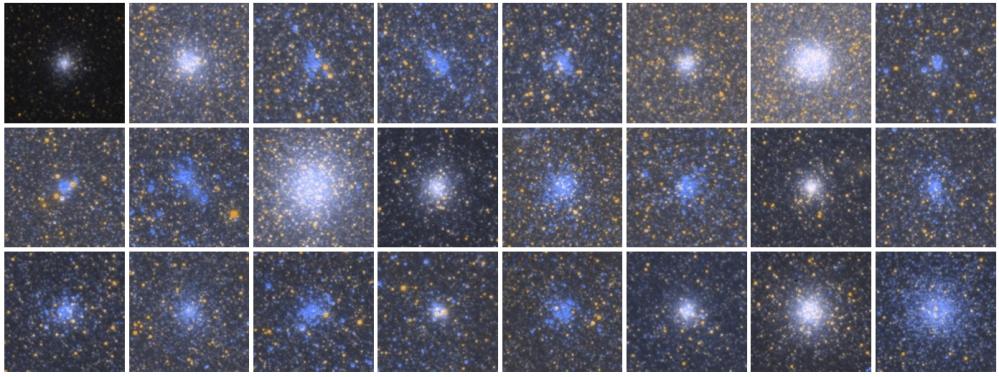
After you help us to find these star clusters, we will determine the properties of these systems, including their ages and masses. We will use the age-dated cluster sample to study a host of interesting topics: rapid and rare stages of stellar evolution, the structure and scale of star formation, the evolution of cluster populations, and how the cluster's host galaxies have changed over billions of years.
Local Group Galaxy Targets
This project focuses on four nearby galaxies: the Andromeda Galaxy (M31), the Triangulum Galaxy (M33), the Large Magellanic Cloud (LMC), and the Small Magellanic Cloud (SMC). Along with our own Milky Way, these five galaxies are the most massive galaxies in the Local Group -- a collection of galaxies that reside inside a sphere with a ~4 million light year diameter. M31 is similar to our own Milky Way galaxy in terms of mass, M33 and the LMC both have stellar masses that are approximately 10% of the stellar mass of the Milky Way, while the SMC is significantly smaller (0.4% of Milky Way stellar mass).
The relatively small distances (in astronomical terms!) to the four target galaxies allows us to obtain detailed images where individual stars can be detected within the galaxy and its star clusters. The ability to spatially resolve individual cluster members is helpful in identifying clusters as well as determining cluster ages.
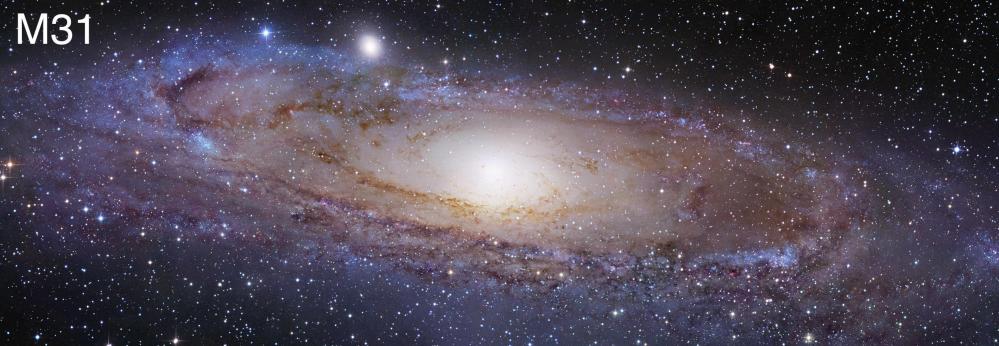
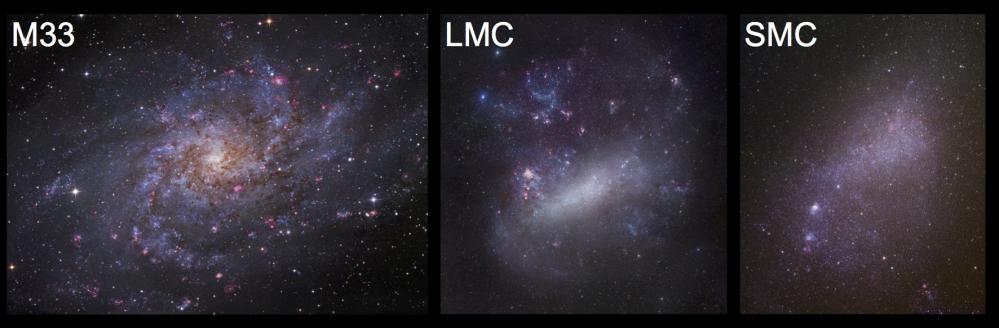
Image Credits: Robert Gender; Robert Gendler, Subaru Telescope (NAOJ); Robert Gendler; Josch Hambsch, Robert Gendler
Synthetic Clusters
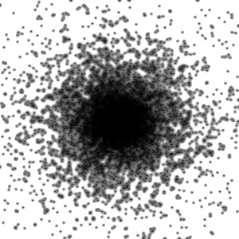
The appearance of star clusters vary greatly, so it is important for us to measure which kinds of clusters we can successfully identify. For this reason, we have inserted realistic synthetic clusters with known ages, masses, and sizes into some of the images. By identifying both real and synthetic clusters, we will learn what types of clusters are detectable in each of the target galaxies. This information is critical for understanding the age and mass distributions of the clusters by allowing us to determine whether certain populations of clusters do not exist or if they are simply avoiding detection. Having you find these clusters is just as important for many of our science goals as the real clusters!
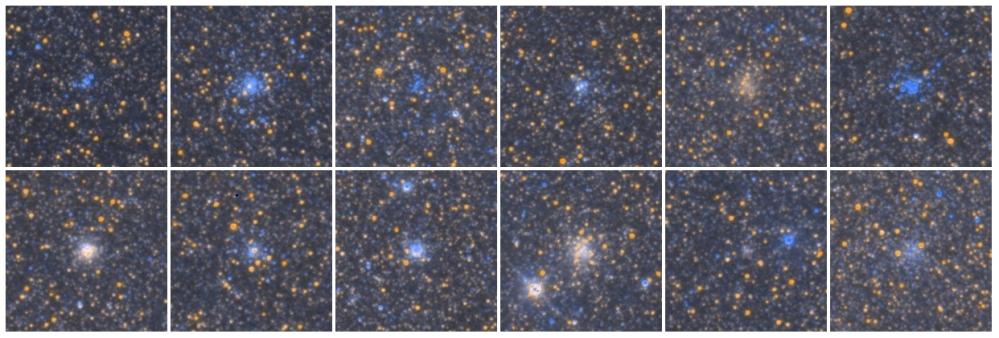
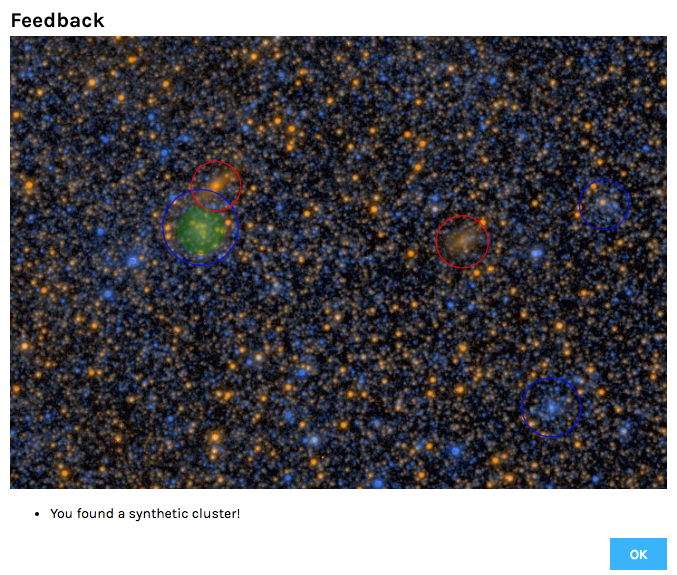
These synthetic clusters are also a way to provide some feedback on how you’re doing with cluster identification. Unlike the real clusters, we know where these objects are located in the image ahead of time. That allows us to tell you when you’ve correctly identified a synthetic cluster. If you’re finding the synthetic clusters, you are likely identifying new, real clusters as well!