


Results are posted! Go to the "About" tab and select the "Results" section!
Research
Project Background
The endangered interior least tern (Sternula antillarum athalassos) and threatened piping plover (Charadrius melodus) migrate to the Central Platte River Basin in Nebraska, during late April to mid-August to nest on exposed river islands and off-channel habitat (sand and gravel mines) along the Platte River. The Platte River Recovery Implementation Program (PRRIP) and its partners have constructed and manage approximately 60 hectares (150 acres) of off-channel nesting habitat that is protected and monitored for interior least tern and piping plover productivity annually.

Prevention of predation by terrestrial and avian predators are important objectives for increasing productivity of interior least terns and piping plovers. As such, potential predator perches near the nesting areas are removed and permanent electrified fences are placed across the entrance to each nesting area that otherwise is moated by water. Non-electrified fence panels are positioned on the ends of the permanent fence and extend 2–3 meters into the water. However, predation is still a factor for reducing productivity within these managed off-channel nesting sites. Identifying predation events and the species responsible are truly difficult to determine if the event is not seen firsthand and no sign of predation (i.e., tracks in the sand, etc.) is left behind.
Purpose
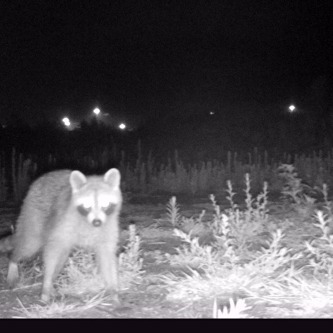
The purpose of our study is to investigate predator presence, composition and abundance and to document possible predation events at interior least tern and piping plover off-channel nesting sites with the use of remote cameras. Remote cameras have been deployed at nesting sites and are programmed to collect an image every 5 minutes and when triggered by predator activity. For each image, we aim to identify species presence, abundance, and activity. Results from our study will help to identify possible management strategies that could be implemented to further reduce predation at off-channel nesting sites and increase productivity of these threatened and endangered species.
Predation on Piping Plover Adult

Fox Tracks at Nesting Site

We Need Your Help
A total of 36 cameras are deployed during the nesting season of interior least tern and piping plover and are programmed to collect an image every 5 minutes and when triggered by predator activity. We will have over 2.5 million photos to review this year and only a few researchers to complete this daunting task. We would love for you to join our team and help evaluate these photographs to identify any predator activity you find in them. Your assistance will make a huge difference in the success of this project! We will use the results of our study to better understand predator communities at off-channel nesting sites and will use this information to further reduce predation events in the future.
The Birds
Piping Plover Adult

Piping Plover Chicks

Interior Least Tern Adult

Interior Least Tern Chicks
