


Finished! Looks like this project is out of data at the moment!
Our project was recently featured on WBZ New England Weekend! You can listen to the podcast here.
Research
Our Research
Thanks for coming along in our journey — and theirs!

What are we doing?
We are trying to better understand when, why, and how baby river herring make their annual journey from freshwater to the ocean. This journey is called "emigration". River herring are anadromous fishes, which means they were born in fresh waters (like lakes and ponds), spend a few months growing up in these lakes and ponds, and will then head to sea. They will spend 3-5 years growing up in the ocean and then return to their home ponds to find their mates. You can trace the river herring life cycle in the cartoon above. There has been very little research on when juvenile river herring start their seaward journey, but this information is important to river herring conservation efforts. To learn more we installed a camera to film this migration and we need your help to count all the baby fish as they travel.
Why should you care about river herring??
River herring refers two species, blueback herring and alewife. Known as the “fish that feeds all,” river herring have been a valued food source for Native Americans for centuries and were historically commercially harvested as food sources, bait, fish meal, and pet food. Also, river herring are a food source for many marine and freshwater predators (e.g. striped bass, cod, porpoises, seabirds) and transport nutrients between marine and freshwater systems. Unfortunately, river herring have experienced centuries-long population declines related, in part, to human stressors like dams, habitat degradation, overfishing, and being caught accidentally as bycatch in other fisheries. Population declines prompted listing of alewife and blueback herring as Species of Concern by the National Marine Fisheries Service (NMFS) and harvest restrictions in several states. In 2011, a petition for the inclusion of river herring in the Endangered Species Act (ESA) was not accepted, partly due to inadequate data on the freshwater portion of the river herring life cycle. We hope our work and your contributions to it will help bridge that gap to support conservation efforts.
So, what are you doing?
You will he helping us count fish in frames of our videos of juvenile emigration. We need to figure out how many juvenile river herring leave a given freshwater system, and what determines when they head to sea. This is the first study to continuously film the juveniles as they emigrate, which happens over a 7 month period! That's a lot of videos to watch, and your help is critical for our research! We will then compare juvenile numbers to different environmental conditions like water quality, weather, moon cycles, food availability, and flow rates to figure out what might trigger baby river herring to leave freshwater ponds.
Where is the research being conducted?
Our camera is in the Monument River near the Cape Cod Canal in Massachusetts. The baby herring grew up in Great Herring Pond before they decided to head to sea. The camera is at a very narrow point in the river where we can see across the entire width of the river and right before the fish spill over one of the many 'steps' (little waterfalls) along the river.
Our video location: the Herring Run Motel. The camera is under the board that provides shade, thereby reducing the day/night difference in light levels.

A closeup of our video setup. The camera is on the far side on the right, the infrared light is on the far side on the left, and the black backdrop is on the near side of the river. The video is recorded by a laptop inside the box in the background, and a phone inside the box allows the computer to connect to the internet (via a hotspot) to allow the system to be monitored remotely. The hotel's owner has graciously provided electricity to run the system.

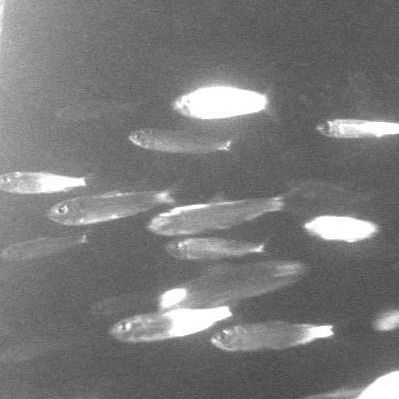
An example frame from our videos. Since we're only interested in whether a fish passes by, we made the dimensions of the frames tall and narrow to minimize file sizes.

How can you help?
All you have to do is put a point on every river herring you see in an image. Since most everything is a herring, if you see a blurry fish, it's likely a herring, so mark it. Some video was taken at night, when we had an infrared light shining. In most of the images you'll see a lot of black and usually just light spots (rarely the entire fish). Mark all the light spots––these are herring too.