


Research
The larger research project in which this data analysis is housed seeks to explore and define representations of the childhood experience as presented in German visual media during the first World War. Early 20th century Germany sees itself at the beginning of what pedagogue and educational reform movement champion Ellen Key described as the ‘Century of the Child,’ an era of history in which the promise of modern societies was met by one of the demographically youngest periods in European history. The paradigm that grew out of this moment strengthened the cultural movements of the industrial age that redefined childhood as a phenomenon legally and socially separate from adulthood. Simultaneously, children’s existing role as agents of adult imagination—and promise of the future—resulted in the reframing of childhood as a protected (even sacred) space in which children are perceived as apolitical symbols of virtue (that is, theoretically removed from the space of the ‘adult’ i.e. political world). This very duality—children as both separated from politics and symbols of purity—creates a scenario in which children come to represent and become responsible for a nation or culture’s understanding of itself and its morals—the best version of a nation to be carried into the future. Henry Jenkins contends in his Children’s Culture Reader that the ‘innocent child’ wants nothing other than its own innocence—which is to say that the symbolic child is a being stripped of its own agency in the face of its own instrumentalization as a vessel of national innocence.
While the strength of the ‘child as symbolic virtue bearer’ model cannot be denied, it is equally important to consider how these symbolic children function as bridges from the present to the future. In his study on childhood, Chris Jenks contends that “the symbolic pure child has come to be the very index of civilization” (Jenks 67). This index suggests that one agent (the child) or category (children) can carry everything important about a history or culture (and, by extension, a nation) from the past and into the future. These expectations, combined with the obvious questions of age and generations, vest children with the power of the future: they are seen as the vessels with which a society secures its continuous timeline.
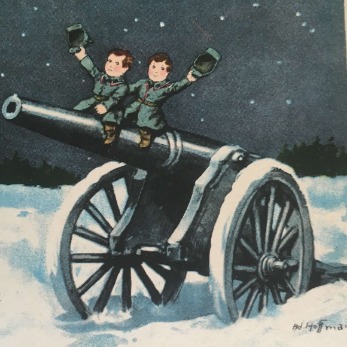
One of the remarkable aspects of WWI is the extent to which children (both aesthetically and in reality) were mobilized for war. Although we may expect the idealized ‘garden of childhood’ to be a walled space far removed from the dangers of the adult realm, WWI’s nationalist culture instead directly positions this childhood space on the front, where both children and their parents could be reminded of the symbolic capital at stake in the conflict. I have chosen two German postcards as examples to demonstrate how propagandistic images illustrate this phenomenon: “Wenn die Soldaten durch die Stadt marschieren” (1918, accessed through the Universität Osnabrück’s digitized collection) and “Im Schützengraben ist es fein” (year unknown, found in the Bibliothek für Zeitgeschichte in Stuttgart) (seen below, and as the background on the front page). Both of these images see an idealized and infantilized version of war, in which armed and uniformed children joyously go perform the motions of war. Rather than contradicting the allegedly innocent and ideologically free space of childhood, these images rely on transporting that innocence into a wartime sphere—a move which both makes the war palatable for a mass audience and sanitizes war violence by placing it in the hands of child subjects. In her book on WWI propaganda, For Home and Country: World War I Propaganda and the Home Front, Celia Kingsbury writes that:
"In the face of global conflict, it might seem psychologically sound to protect the young from violence, to grant them whenever possible the liberties childhood normally offers. Instead, children were expected to go along with the group and play war games in which hating the enemy became great fun. Posters, picture books, and pamphlets made war part of childhood experiences, using details sometimes linked to fairy tales that would have been familiar to most children […] Children were thus recruited, with the hope that they would not only become warlike themselves but would pressure their parents to do the same, thereby becoming an important part of the propaganda machine."
Kingsbury asserts that incorporating the war into daily childhood experience was a calculated effort to mobilize children both as future soldiers and as pint-sized surveillants of their parents. This notion is supported by the veritable avalanche of visual media that seeks to make nationalism, violence toward the enemy, and wartime fervor legible to a very young audience.
The trends that Kingsbury identifies (and can be seen in the above images) speak to the increasingly permeable (or disappearing) frontier between child subjects and adult politics, or between real children and the ideologies they are expected to support with their bodies. Here, children’s bodies become mediums both in visual culture and in reality, casually utilized by adults to manifest German Total War.
Additionally, both of these postcards demonstrate an investment in a future in which young people will still be fighting. The first example—“Wenn die Soldaten durch die Stadt marschieren”—makes no distinction between its cherubic subjects and the weight and responsibility that ‘Soldaten’ carries with it. Similar, the second gleefully assures the reader that “Im Schützengraben ist es fein,” evoking a fantasy of war violence in which the experiences of the front are a playful distraction. Each positions the wartime events of conscription, deployment, and trench warfare as organic and enjoyable extensions of a child’s world and narrative. In short—the children have already been claimed by the state as future tools of violence, and require a culture in which the necessary violence can be inculcated from an early age. Positioning children as combatants is of course not unique to the beginning of the 20th century, not is it entirely dependent on the advent of WWI. German military culture, particularly the intense militarization of society following the first unification, targeted children as much as it did adults (and the violence of which was exacerbated, and even encouraged, by pedagogical strategies of the time). Nevertheless, WWI provided a real-world outlet for a newly modernized, militarized, and nationalized society, creating a proving ground of never before seen scale and violence. The required shift from (relative) peace to war and the resultant demands on children (children are the future, and the future demands soldiers) merges the halcyon space of childhood with the front, demanding a world in which both the domestic and wartime sphere are organized under the same principles. That this casual demand for sacrifice was (in part) embodied by symbolic children is both effective and unsettling. Deploying children as symbols of a national innocence works to legitimize and sanitize the war effort. That same effort however, perpetuates a reality in which children must be sent to the trenches.