


Finished! Looks like this project is out of data at the moment!
New data are almost ready! Check back in mid-September 2026 for new images.
Thank you for your contributions—updates will be posted here
Education
Here you can find the details of the tutorials for this project!
Species ID Tutorial:
Step 1:
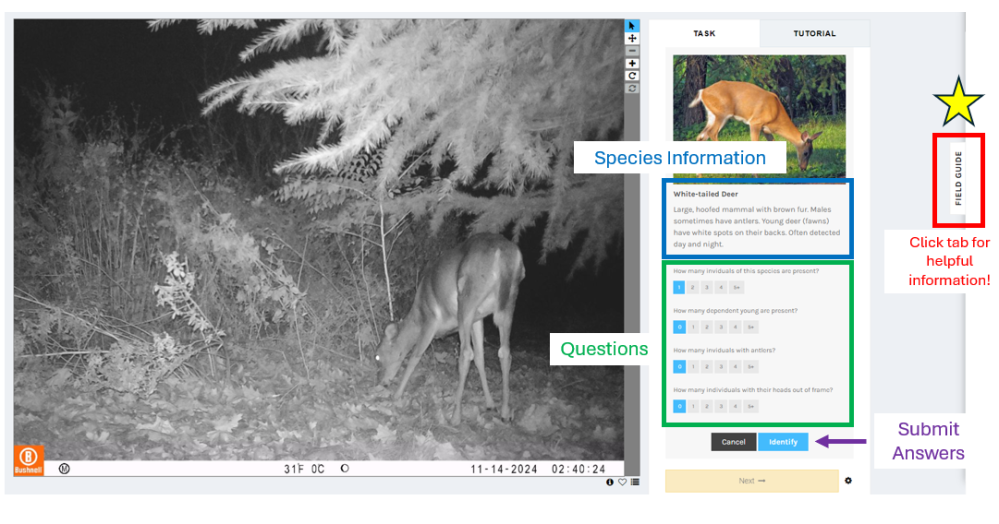
First, review the image in on the left side of the screen. There is likely an animal present in the image, but there might not be. Choose the classification on the right that matches what is in the image.

Occasionally, you may come across a picture where it is hard to tell what kind of animal is in the photo. However, please make your best possible guess by using any clues and referencing the field guide. For example, in this photo below, you can see reddish-brown fur and a black ear, indicating that this is a fox. There's no need to feel pressured to get every identification correct — other people will also review the same photos and contribute!

Step 2:
Answer any follow-up questions.
For help, check the field guide tab on the right side of the screen. The field guide contains lots of helpful information. Once you have answered the follow-up questions, click "Identify".
Step 3:
If there is another species present in the image (for example, the image contains a deer and a fox), you can make a second species selection now.
After all species have been identified, click the green "Done" button to submit.

You are now ready to begin! Thank you for your help on this project!
Behavior ID Tutorial:
Step 1:
First, review the image on the left side of the screen. The mammals present in this photo have already been identified. Look carefully, as animals can sometimes be hard to spot! Pay attention to the behaviors the animal is exhibiting.
Step 2:
Answer behavior-related questions.
On the right side of the screen, you will be asked questions about what the animal is up to. This can be somewhat tricky with some photos - you may need to make an educated guess rather than give a definitive answer. Use the field guide for help with these questions.
Step 3:
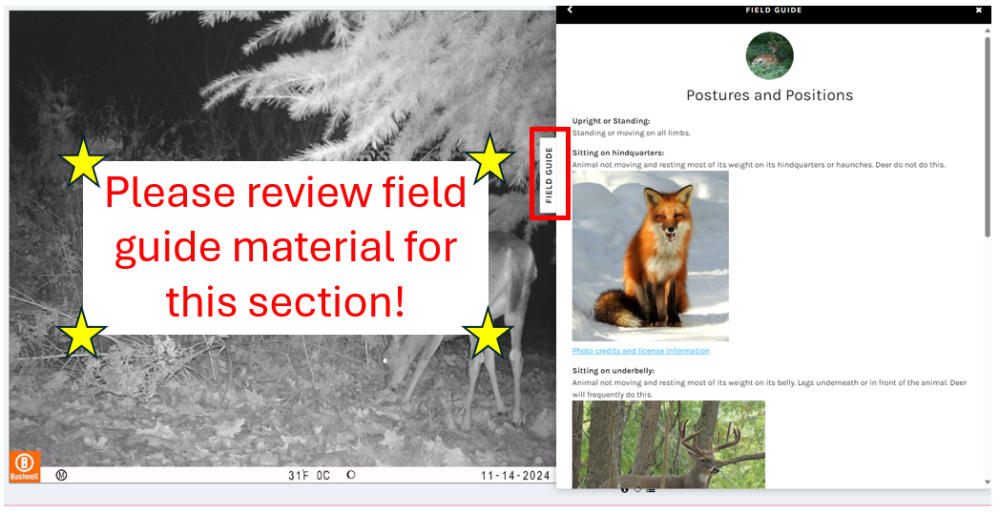
Sometimes, questions can be impossible to answer based on the image provided.

For example, in this image, we can tell the deer is standing upright, but it is impossible to determine other behaviors because the head of the animal is not pictured. IN THESE INSTANCES ONLY, choose the "impossible to tell" option. This option should only be used as a last resort. Always make your best guess whenever possible.
You are now ready to begin! Thank you for your help on this project!