



Finished! Looks like this project is out of data at the moment!
If you would like to receive discovery credit for your classifications, please fill out the form here.
New data on Tuesdays and Fridays!
No Data for the week of 2026/08/31
Research
The International Astronomical Search Collaboration (IASC) is an international collaboration of research institutions and astronomy programs that provides scientific opportunities in astronomy to people throughout the world. Asteroid discovery is a particular interest to the team at IASC.
Why Discover Asteroids?
Asteroids are large pieces of rock and ice that orbit the sun. They are important for scientific research as they can provide insight into how the solar system was formed. They can also pose a threat to life and infrastructure on Earth. Because of this detecting and identifying asteroids is a very important field in astronomy.
Once an asteroid has been detected Astronomers can calculate the orbit and determine if it is a threat to earth. The vast majority of asteroids are not a threat as their orbits reside between the orbits of Mars and Jupiter. These objects are known as Main Belt Asteroids (MBAs). This means they will never cross Earth's orbit and therefore cannot impact the planet. Some asteroids do cross Earth's orbit, however. These are known as Near Earth Objects (NEOs).
How are Asteroids Discovered?
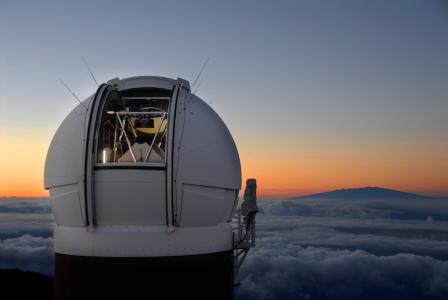
The asteroid discovery that IASC participates in begins with a telescope taking pictures of the night sky. In the case of the data hosted here on Zooniverse, these images are taken by the Pan-STARRS observatory operated by the Institute for Astronomy at the University of Hawaii (pictured below).
Once multiple images of the same part of the sky have been taken, they can be lined up so that the stars appear stationary. Once this is done anything that is not stationary from our viewpoint here on Earth will be moving against that background of stars. In the image below you can see an asteroid (circled in red) moving against the background stars.
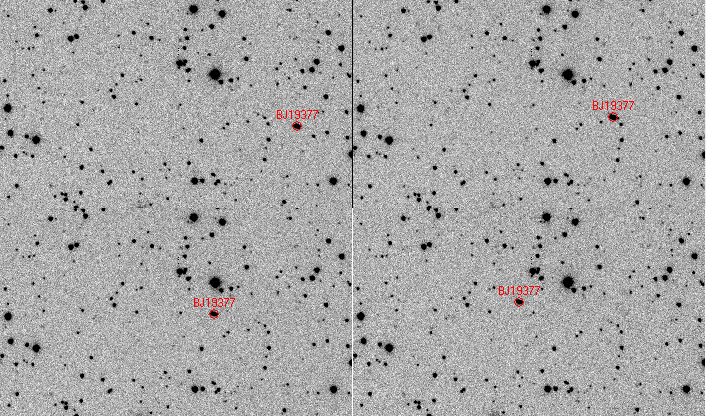
Once a moving object has been identified, a preliminary orbit can be calculated by making very precise measurements of that object. After the object has been seen and measured multiple times its orbit can be finalized and a new asteroid will have been discovered.
How do we select the images for Zooniverse?
We receive four images from Pan-STARRS taken over a one-hour time period of the same sky field. These images are aligned and merged into a single image showing the asteroid as four moving dots in a line. A machine-learning (a type of artificial intelligence) tool has been developed that can identify these four dots and flag them for review. The flagged objects are filtered for known asteroids and then sent to Zooniverse.
The machine-learning tool color-codes the four dots using a different color for each image (the first image is colored cyan, the second is colored green, the third is colored red, and the fourth magenta). A machine-learning, pattern-recognition utility is used to find lines of these dots in the correct order of color.

Why is Citizen Science Important?
There are hundreds of thousands, if not millions, of asteroids yet to be discovered. There are so many that scientists can have a hard time keeping up with the flow of data. Because of this it is important to get your help. By analyzing potential asteroid candidates, you can help scientists know which candidates are important to study.
Collaborators of IASC
IASC ("Isaac") is a collaboration of Cisco College (Abilene, TX), Lawrence Hall of Science (University of California at Berkeley), Global Hands-On Universe Association (Portugal), Panoramic Survey Telescope & Rapid Response System (University of Hawaii), Tarleton State University (Stephenville, TX), The Faulkes Telescope Project (Wales), Yerkes Observatory (Williams Bay, WI), Western Kentucky University (Bowling Green, KY), Las Cumbres Observatory (Santa Barbara, CA), G.V. Schiaparelli Astronomical Observatory (Italy), Catalina Sky Survey (University of Arizona), and Astrometrica (Austria). Additional collaborators for special projects can be found on our website here: IASC Collaborators