


Finished! Looks like this project is out of data at the moment!
Research
Project Goals
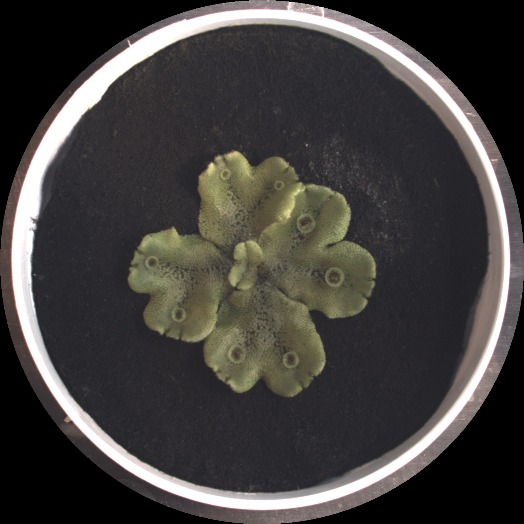
This project asks you to count gemma cups on Marchantia plants to help us learn about plant growth. A gemma cup is an organ formed by Marchantia to reproduce itself. Counting the number of gemma cups tells us information about plant maturity, and helps us learn how to speed plant growth. While we are focusing on Marchantia plants for this project, what we learn in this experiment can be applied to understand how plants, in general, grow.
We will use the gemma cup identifications you make to train a model to detect these cups automatically. This training is very important the model's accuracy, and will allow us to automate this analysis in the future.
What are Marchantia?
Marchantia polymorpha belong to the bryophytes, a group of plants without roots, leaves or vasculature. Marchantia can be found all around the world in wet habitats.

Bryophytes and vascular plants (such as ferns and flowering plants) diverged from each other more than 400 million years ago. By comparing bryophytes with vascular plants, we - the scientists working on plant evolution - aim at understanding how the most recent common ancestor of land plants colonized lands.
Besides this evolutionary aspect, Marchantia is a very interesting model to address question related to development, growth and shape. Marchantia develop as a "thallus", a green, leaf-like structure that grows on the soil surface. From this thallus, rhizoids, short filaments looking like a fungal mycelium, growth into the soil to collect water and nutrients. One particular developmental feature of Marchantia is the presence of "gemmae cups" on the surface of the thallus. Inside these cups are gemmae, which are tiny thalli. A single drop of water is enough to splash out the gemmae from the cup, leading the the development of a new matuer thallus. This vegetative propagation is very efficient.