


Finished! Looks like this project is out of data at the moment!
FAQ
What is Marchantia?
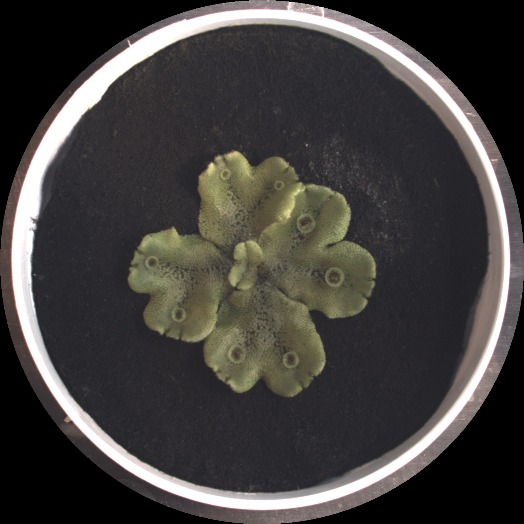
Marchantia polymorpha is a species from a group of plants called bryophytes. These plants do not have roots, stems or vasculature.
Where may you find Marchantia?
Marchantia grows in wet habitats rich in nitrogen. You may easily find them on sidewalks in the UK for instance. In dryer/warmer climates they will be found at the base of north-facing walls.
Why do we care about Marchantia?
In an evolutionary point of view bryophytes such as Marchantia are particularly interesting. Indeed, they share a common ancestor with the vascular plants (the ones with roots and stems such as ferns, conifers or flowering plants) but formed an independent "lineage" 450 million years ago. It does not mean they are "older" than vascular plants, just that they had an independent evolutionary history for a very long time! Evolutionary biologists compare bryophytes with vascular plants to understand how looked their common ancestor.
An example: vascular plants are green (they do photosynthesis) as are bryophytes (they also do photosynthesis. We can thus infer that their last common ancestor, who lived 450 million years ago, was also green and making photosynthesis!