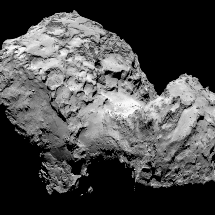
Finished! Looks like this project is out of data at the moment!
Thank you for your efforts! This project's classification effort is complete! To browse other active projects that still need your classifications, check out zooniverse.org/projects
The Team

Mark Bentley is a planetary scientist working at ESA as an archive scientist for BepiColombo and science lead for the Planetary Science Archive. He formerly worked on the Rosetta mission as principal investigator of the MIDAS atomic force microscope on the Rosetta orbiter.
Sebastien Besse is a planetary scientist specialized in remote sensing observations of planetary surfaces and in understanding the spectroscopic and geomorphological properties of objects. He makes use of spectrometers and cameras onboard space missions (Rosetta, SMART-1, Deep Impact, Chandrayaan-1) to investigate surfaces.
Sam Birch is a planetary scientist who studies the evolution of landscapes across the solar system to understand how they evolve and what they can reveal to us about planetary climates. At 67P he was most excited about watching the landscapes evolve before our very eyes, to understand what physical processes are at play, how rapidly they modify the surface, and what we can learn about the long-term evolution of comets more generally.

Dave Heather is a planetary scientist specialising in remote sensing of planetary surfaces and planetary volcanism. He is working at ESA as Project Scientist for the PROSPECT and EMS lunar payloads and was involved in Rosetta as the Planetary Archives Scientist, helping the teams to prepare their science data for delivery to ESA’s Planetary Science Archive.

Detlef Koschny is a planetary scientist who has worked for almost 20 years on the Rosetta mission - first as technical manager for the scientific camera OSIRIS, later at ESA as Science Ground Segment manager and as scientist in the camera team. His scientific interests are small bodies in the solar system and impact craters. His technical expertise is on space-based cameras.

Sandor Kruk is a research scientist at the Max Planck Institute for Extraterrestrial Physics (MPE) in Munich, Germany, working on the ESA Euclid mission. Sandor is the Project Scientist of the Galaxy Zoo project and has been leading the Hubble Asteroid Hunter project. He is interested in how humans and machines can work together to analyse the large and complex datasets that we have in astronomy and planetary science.
Michael Küppers is a planetary scientist working at ESA as Project Scientist for the Comet Interceptor and Hera missions. He was involved in Rosetta in the ESA Science Operations Centre and as a member of the OSIRIS camera team.
Chris Lintott is an astronomer at the University of Oxford. Though he normally thinks about galaxies, he was at mission control for Rosetta's wake up, arrival at its comet and its end of mission. He's happy to be thinking about 67P again.

Bruno Merín is the head of ESAC Science Data Centre of the European Space Agency at ESAC, near Madrid, Spain. His interests are in space data science: exploiting data from ESA’s Space Science missions, scientific software and usability of user interfaces. He is part of the team who developed the science discovery portal ESASky.

Claudia Mignone is an astronomer and science communicator working in public outreach and education at INAF, the National Institute for Astrophysics in Italy. Prior to that, she was a science writer and communicator for ESA for ten years and was part of the award-winning team that communicated the Rosetta mission.

Ellen Schallig loved following Rosetta's (and Philae's!) mission from a distance as she was working towards her PhD in astronomical instrumentation. When the opportunity to work with Rosetta data combined with the Zooniverse came up, she jumped at the chance. She is excited to share the awesome photos of comet 67P with everyone.
Jean-Baptiste Vincent is a planetary scientist working on activity and evolution of small bodies in the Solar System, using imaging data from ground based telescopes and space missions (Rosetta, Dawn, Hera, Comet Interceptor). He investigates surface changes on comets and asteroids to determine whether morphological features are primordial or evolved. By understanding the transformations currently taking place, we learn about the physics shaping the surface and will eventually reconstruct the evolutionary history of small bodies, up to the original conditions of planetesimal formation.
René Laureijs (ESA ESTEC)
Pedro Garcia Lario (ESA ESAC)
Mohamed Ramy El-Maarry (Khalifa University)
Holger Sierks (MPS)
Translators
Translations help us share Rosetta Zoo with the world. The science team is grateful to our translators for volunteering their time and expertise:
Claudia Mignone - Italian
Jean-Baptiste Vincent - French
Markus Schichtel - German