


Finished! Looks like this project is out of data at the moment!
Thank you for your efforts! This project's classification effort is complete! To browse other active projects that still need your classifications, check out zooniverse.org/projects
FAQ
Where do these images come from?
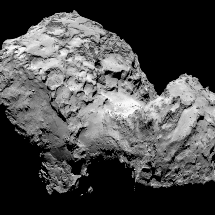
The images used by this project were captured by the European Space Agency's Rosetta space craft which visited and flew alongside Comet 67P/Churyumov-Gerasimenko between 2014 and 2016. Starting its journey with the comet out beyond the orbit of Jupiter, Rosetta watched as the comet was warmed by its approach to the Sun, sending back a rich archive of images. The images used by the project have been selected to show the same parts of the comet but weeks, months or even more than a year apart, allowing us to identify changes on the surface. Most of the images were obtained by the OSIRIS imaging system.
Why this comet?
First of all, Rosetta needed a target it could reach during its long cruise phase! 67P, a periodic comet with an orbital period of nearly seven years, is a frequent visitor to the inner solar system allowing a rendezvous plan to be developed. As a so-called Jupiter-family comet, it belongs to the most numerous class of periodic comets making it - hopefully - representative of a large part of the Solar System's cometary population.
Why can't machines do this?
Many of the changes on the surface, as you'll discover, are quite subtle, and it's proven difficult to train a machine to do the task satisfactorily. In particular, the task is made much more complicated by the fact that images of the same part of the comet are often taken with the spacecraft at different distances, and from different angles. The need to adjust to the changing activity of the comet itself, plus the nucleus' irregular shape, meant that Rosetta wasn't able to fly a regular mapping orbit which would make all of these things consistent. Luckily, people such as yourselves are pretty good at looking past such inconsistencies to identify real changes.
What do the team hope to accomplish?
We want to understand how the comet changes as it is heated by the Sun; to do this, we'll use your classifications to map changes like collapsing cliffs and moving boulders. We can then combine these maps with what we know already about the physics of comet heating, allowing us to understand in detail for the first time how the comet changes in these circumstances.
What will happen to the data?
Many of the scientists who worked on the Rosetta team, and with the cameras on board, are keen to make use of a catalogue of changes, something that hasn't yet been made available. We will make the results from the project available via the ESA archive.
Can I make use of the images myself?
Yes! Rosetta images are available under a Creative Commons license so help yourself.
Who are Churyumov and Gerasimenko?
Comets are named after their discoverers, in this case Klim Churyumov and Svetlana Gerasimenko, two Ukrainian-born astronomers who found the comet in their photographic plates in 1969 while working at the Kyiv University Observatory.
How can I ask a question that’s not in this FAQ?
If you check out "Talk" at the top of this page, you can see questions and discussions from other volunteers who have interacted with the project. Take a look there first to see if someone has already answered your question. If not, start a new thread to see if other volunteers can give you a hand. We also check the boards frequently and try to answer as many questions as possible.