


Finished! Looks like this project is out of data at the moment!
Thank you for your efforts! This project's classification effort is complete! To browse other active projects that still need your classifications, check out zooniverse.org/projects
Research
To catch a comet, land a probe on its surface and follow it as it swings around the Sun for over two years. That, in a nutshell, is Rosetta, one of the most ambitious endeavours ever accomplished in the history of space exploration.
Rosetta was a European Space Agency (ESA) mission that set off in 2004 with a ten-year journey ahead and a daring objective: reaching a comet and studying it up close like no other spacecraft had done before. The destination was Comet 67P/Churyumov-Gerasimenko (67P for short), a short-period comet with a nucleus roughly 4.3 km by 4.1 km in size and an orbit that takes it around the Sun in 6.5 years: its aphelion (the farthest point from the Sun) lies beyond Jupiter’s orbit and its perihelion (the nearest point to the Sun) between those of Mars and Earth.
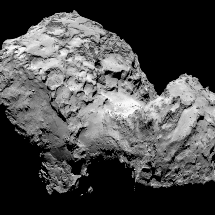
The rest is literally history: Rosetta reached the comet in August 2014, revealing a geologically complex, curiously double-lobed body (that to many resembles a rubber duck) and proceeding to the historic comet landing of the Philae probe on 12 November of the same year. As the comet proceeded towards its perihelion, in August 2015, Rosetta kept orbiting the small celestial body, collecting an unprecedented set of images, spectra and in-situ data that made 67P the best studied comet ever, until completing its mission by descending on the comet’s surface on 30 September 2016.

Collection of Rosetta navigation camera (NAVCAM) images from August 2014 to June 2016. Credit: From M. Taylor et al. (2019); ESA/Rosetta/NavCam CC BY-SA IGO 3.0
Rosetta has completely changed our view of comets, from the detection of molecular nitrogen, noble gases like neon and xenon, and water unlike that of Earth’s oceans – all pointing to an origin of 67P in a very cold region of the protoplanetary nebula from which the Solar System took form, far from the Sun – to the discovery of the amino acid glycine, which is commonly found in proteins, the building blocks of life as we know it on Earth. The mission also demonstrated the important role the comet’s shape and surface features play in its activity, controlling the release of gas and dust that form the coma and tail that can be observed from afar, and shed new light on how comets interact with their plasma environment.
But much still remains to be explored in this rich and unique data set.
What is being researched and why is this important?
Rosetta provided, for the first time, exceptionally high-resolution images (<1m per pixel) of a comet’s surface. These detailed observations, taken with the OSIRIS camera on board the spacecraft, revealed the complex shape of the nucleus in its full glory as well as the morphological diversity of its surface, witnessing a significant degree of surface changes as the comet moved towards the Sun and then away from it over the course of the mission.
In the two years of observations, Rosetta witnessed a handful of large-scale changes such as cliff retreat, the deflation of smooth terrains and the transport of large size blocks. A whole lot more took place on smaller scales: a careful examination of selected high-resolution images has shown thousands of changes on a 1-10 metre scale, including the formation of small pits, impacts, rolling and bouncing boulders.

Movement of a 30-metre wide boulder over a distance of around 140 metres in the Khonsu region of 67P. Credit: From El-Maarry et al. (2017)
Comets are very primitive objects in the history of our Solar System and as such provide us with a window on the primordial environment from which the Sun and planets took shape 4,6 billion years ago. However, 67P and most comets that have been visited by spacecraft are small-period comets that circle the Sun in 10 years or less, meaning that their surface is no longer as pristine as we would need to investigate our cosmic origins, having been modified by several processes such as impacts, sublimation, dust deposition and explosive outbursts over many orbits around the Sun. To learn about the early Solar System, we need to understand these evolution processes and recover the original conditions, and this requires building an exhaustive catalogue of all types of changes observed by Rosetta on 67P, tracking their locations and when they occurred.
Such a catalogue would also enable a deeper understanding of the sublimation process of the comet’s upper surface layers, by which ice turns into gas and also lifts dust grains off the surface – a process that has not been fully modelled yet. Over the course of the Rosetta mission, scientists have produced many maps of active areas on the surface of the comet, ranging from gentle emission of jet-like features to explosive events which sporadically ejected tons of material. Astrophotographers and space enthusiasts, too, have spontaneously identified changes and signs of activity in Rosetta’s images. However, except for a few cases, it has not been possible to link any of these events to surface changes, mostly due to the lack of human eyes sifting through the whole dataset.
How citizen scientists can help
Given the large number of high-resolution OSIRIS images, it is practically impossible for comet experts to visually inspect and catalogue all the changes. In this citizen science project, we invite volunteers to delve into the gorgeous views captured by Rosetta and to get up close and personal with the evolving surface of Comet 67P.
Volunteers will be viewing pairs of OSIRIS images of the same region of the comet, taken before the perihelion passage (when the comet was least active) and around or after the perihelion passage (when the comet was most active), and we ask them to identify whether they see significant modifications between the two images, marking the areas that display changes in the two images with purposely-designed tools. Volunteers are also asked to label the type of change in the images.
This will produce maps of changes and active areas on the comet’s surface, with labels for each type of change, from the visual inspection of many volunteers, enabling us to associate activity with surface modifications and thus develop new models linking the physics of comet activity to observed changes like lifted boulders and collapsed cliffs.
Why not use computers?
Rosetta’s observation strategy was rather complex. Operating a spacecraft at a comet is extremely challenging, especially during peaks of activity: Rosetta did not have a systematic mapping orbit, so it rarely observed the same region of the comet with the same viewing geometry, resulting in images taken from different viewpoints and different illumination. This makes it difficult to track surface changes in an automated way.
A new algorithm was designed recently to automate the detection of changes on the comet’s surface down to small scales, which detects many changes, but not yet every surface modification, so scientists need to refine the underlying criteria. The algorithm also requires images to be co-aligned, a much time consuming step: humans are much better at this, because we can do the image alignment in our brain. The human eye is still currently better at detecting changes in images and is less susceptible to differences in resolution and illumination between images. The database created from this citizen science project will also provide an excellent training set for potentially new machine learning efforts.

Example of automated change detection on the nucleus of comet 67P. Credit: J.-B. Vincent