


Finished! Looks like this project is out of data at the moment!
This project is currently paused; please check Talk for updates on when we might be restarting with fresh data. We will post as soon as we have news. In the meantime, thank you for all your classifications!
Note: our results pages are available at https://supernovahunters.github.io/
Research
Supernova Hunters
The Crab Nebula (M1). This is thought to be the remnant of a supernova reported in 1054AD by Chinese astronomers. The supernova was so bright that it could be seen from Earth by the naked eye. The nebula is the gas thrown out be the supernova. At the centre of the nebula is a pulsar left behind by the supernova and which causes the gas to glow.

Supernovae are stars that explode with the energy of a few 10^27 atom bombs. We want to understand which stars explode and why. But it's probably not a good idea to try and setup an experiment to recreate the explosion on Earth (not that we could anyway)! Instead we must rely on our observations of supernovae to come up with theories that explain what we see. It turns out that there are many different types of supernovae and theories that try to explain each. These theories make predictions about the type of star that exploded or whether there is a nearby companion star and even the relative frequency of one type of supernova to another. These have implications for our understanding of how stars evolve and even explain how exotic objects like pulsars and blackholes form.
If a supernova doesn't match thoretical predictions, that makes it interesting. It suggests that we don't fully understand the underlying physics or maybe the explosion is caused by some other scenario that we haven't considered yet. These tend to be rare events and we have very little data that can help inform theory. The more common types of supernova are still important, we can use them to check that predictions of how often they should occur are correct and certain types can even be used to measure the expansion of the Universe.
With Supernova Hunters we aim to discover lots of new explosions and pass them on to the wider astronomical community. But finding supernovae isn't easy. We expect to observe about one supernova per galaxy every few centuries. So to find lots of supernovae we need to look at many galaxies at once. Pan-STARRS1 is great for this. Due to the large camera, the telescope has a field-of-view that covers about the same area as the full moon. This allows the telescope to scan large areas of the sky each night imaging many galaxies. Supernovae are also extremely bright and can out-shine all the other billions of stars that make up their galaxy. This means that we can discover distant supernovae even if we don't see the galaxy hosting the supernova.
In this example a star in the galaxy visible in the centre image explodes as a supernova. Despite the fact that this galaxy contains many billions of stars the supernova in the left image is many times brighter.

Searching for supernovae in this way produces vast amounts of data each night that we must sift through to find supernovae. We have software that tries to do this for us, but it produces many bogus detections of supernovae that must be filtered out by humans. Which is slow. With a small team of researchers data may not get filtered for a few days by which time the supernova could have reached peak.
This plot shows how the brightness of a supernova changes over time. Each point shows a Pan-STARRS1 observation. The x-axis is in units of days (MJD is just how astronomers count days) and the y-axis shows how bright the supernova was on each day. In this case we can't be sure when the supernova exploded or how bright it managed to get before it was discovered.

By helping us filter each nights data we can discover supernovae earlier. This allows us to alert other astronomers who can gather observations that cover the entire evolution of a supernova from explosion until it fades and disappears. We also hope to use your classifications to improve our algorithms and reduce the number of bogus detections that rely on human filtering.
Pan-STARRS1
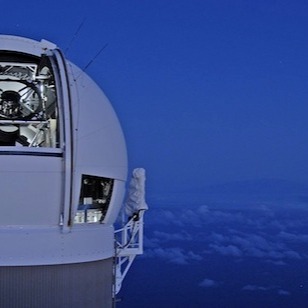
Left: The Pan-STARRS1 telescope. Right: The Gigapixel Camera (GPC1) the largest CCD camera ever built. Image Credit: PS1SC


Pan-STARRS stands for the Panoramic Survey Telescope and Rapid Response System. The 1 refers to the fact that the current telescope is the first of 4 planned. The Pan-STARRS1 telescope is a prototype developed at the University of Hawai'i's Institute for Astronomy. The design combines a relatively small mirror at 1.8m (the largest telescopes are currently about 10m) with a large digital camera with 1.4 gigapixels (GPC1). This produces a cost effective way to observe the entire sky visible from Hawai'i several times a month. Pan-STARRS1 was built with the primary goal of finding Near Earth Objects (NEOs), both asteroids and comets, which may pose a danger to earth. However, the survey also lends itself to looking for supernovae, rather than looking for objects that move we instead look for objects that suddenly appear.
During 2008 - 2014, the Pan-STARRS1 Surveys (PS1) were made possible through contributions of the
PS1 Science Consortium (PS1SC) composed of the Institute for Astronomy, the University of Hawaii, the Pan-STARRS Project Office, the Max-Planck Society and its participating institutes, the Max Planck Institute for Astronomy, Heidelberg and the Max Planck Institute for Extraterrestrial Physics, Garching, The Johns Hopkins University, Durham University, the University of Edinburgh, Queen's University Belfast, the Harvard-Smithsonian Center for Astrophysics, the Las Cumbres Observatory Global Telescope Network Incorporated, the National Central University of Taiwan, the Space Telescope Science Institute, the National Aeronautics and Space Administration under Grant No. NNX08AR22G issued through the Planetary Science Division of the NASA Science Mission Directorate, the National Science Foundation under Grant No. AST-1238877, the University of Maryland, and Eotvos Lorand University (ELTE). The PS1SC
have produced an all sky reference image, making it possible to find new supernovae.
PESSTO
Different transients discovered by Pan-STARRS1. Top: a supernova. Middle: a variable star Bottom: an Quasi Stellar Object (QSO).

From the Pan-STARRS1 discovery images in the figure above, it difficult to tell whether the source in the difference image (3rd column) is due to a supernova. There are many different types of stars that vary in brightness and as a result show up in our difference images. There are also Quasi Stellar Objects caused by matter falling onto supermassive blackholes at the centres of distant galaxies. In the difference images, detections of these real astrophysical sources all look like point sources of light. It is only by obtaining spectra that we begin to see differences (right most column above). Spectra measure how much light is emitted at each wavelength from a source. The examples above show that the different types are brighter at some wavelengths than others which makes them easy to distinguish. This is also the case for distinguishing between different supernova types.
The Public ESO Spectroscopic Survey of Transient Objects (PESSTO) aims to confirm discoveries as supernovae and then continue to follow the supernova throughout its evolution. With PESSTO data we can study how the light emitted at each wavelength changes overtime. We will be feeding potential supernovae from Supernova Hunters directly to the PESSTO team. If PESSTO observes these supernovae the classification will be publicly announced in Astronomer's Telegrams (ATels). So far PESSTO has obtained spectra for 757 potential supernovae and has gathered data sets that span the evolution of 190 supernovae.